Critical-Set Views, Biographical Identity, and the Long Term
Abstract
Critical-set views avoid the Repugnant Conclusion by subtracting some constant from the welfare score of each life in a population. These views are thus sensitive to facts about biographical identity: identity between lives. In this paper, I argue that questions of biographical identity give us reason to reject critical-set views and embrace the total view. I end with a practical implication. If we shift our credences towards the total view, we should also shift our efforts towards ensuring that humanity survives for the long term.
1. Introduction
Although Tutankhamun has been dead for over three millennia, we have some ideas about his life. He was slight-of-build and may have walked with a cane, the unfortunate result of a curved spine. He came to the Egyptian throne at the age of nine and died about a decade later. Once thought to have been murdered, scholars now believe that his death was accidental. It was perhaps the consequence of a chariot crash (Booth 2007).
Suppose that someday we come to know much more about the life of King Tut. Suppose that Mina — some future scientist — has access to Tut’s DNA, along with information about his memories, desires, and other psychological features. And suppose that Mina creates a duplicate of Tut — Tut* — to these specifications. As this duplicate hobbles around the lab, Mina might wonder: has Tut’s life resumed? Or has a new life begun?
Some will find this question interesting. Others will not, thinking it instead empty or merely verbal. But even these others may find their interest roused by a question of a more practical flavour. Rewind, and suppose that Mina has two options. She can create Tut* who (she knows for sure) will live a good life, or she can create Bukayo — an entirely new person — who will live a slightly better life. Whoever she creates, other people will be unaffected. Which outcome would be better?
On one view in population axiology (and granting an assumption I discuss below), the answer is simple. The total view implies that it is better to create Bukayo, because that will result in greater total welfare. On critical-set views, the answer is not so simple. Their verdicts depend on whether Tut’s life will resume. If Tut’s life will not resume, then it is better to create Bukayo. If Tut’s life will resume, then it is better to create Tut* (on critical-level views) or else the two outcomes are incommensurable (on critical-range views).If you think that the question ‘Will Tut’s life resume?’ is empty — that there is no answer to discover — then I can save you some time. Read the following argument, and then skip straight to Section 6: On critical-set views, the relative value of outcomes depends on whether Tut’s life will resume. ‘Will Tut’s life resume?’ is an empty question. The relative value of outcomes cannot depend on the answer to an empty question. (C) Therefore, critical-set views are false.Here’s a brief elaboration on premise (3). If a question is empty, then there is no answer to discover (not even ‘it is indeterminate’). We can at most stipulate answers to empty questions. But we cannot determine the relative value of outcomes by an act of stipulation.I have some sympathy for this argument, but my case against critical-set views does not rely on it. From now on, I assume that questions of identity between lives are substantive: that they have answers to discover. This assumption is not intended to rule out that their answers are sometimes ‘it is indeterminate.’
In this paper, I argue that these questions of identity between lives — questions of biographical identity — spell trouble for critical-set views. I end with a practical implication for those aiming to promote the impartial good. If we shift our credences towards the total view, we should also shift our efforts towards reducing the risk of premature human extinction.In a companion paper, I argue that questions of personal identity pose similar problems for person-affecting views. Those arguments have a similar practical upshot.
2. Framework
Let a life-episode be an episode of a life: a stretch of a person’s life without any gaps. Your third birthday (for example) is a life-episode, as is your twentieth year, as is the next second, as is your life in its entirety. Let biographical identity be a binary relation that obtains between two life-episodes iff they are episodes of the same life.
A life-episode’s welfare is how good that
life-episode is for the person living it. I assume that a
life-episode’s welfare can be represented by a real-valued
function
A population is a set of lives. On the total
view, we sum the welfare scores of the lives in a population
to get the value of that population. A population
Here is an example to illustrate the difference between
the total view, critical-level views, and critical-range
views. Suppose that we can bring about either population
(1)
(2)
On the total view, the value of
That is all the set-up required for this paper. Onto the objections.
3. The Drop
Suppose that there exists a machine called the
LifeTransformer. Stored on this machine is a
digital file, containing all the information needed to
create an entirely new person: Leah. At setting
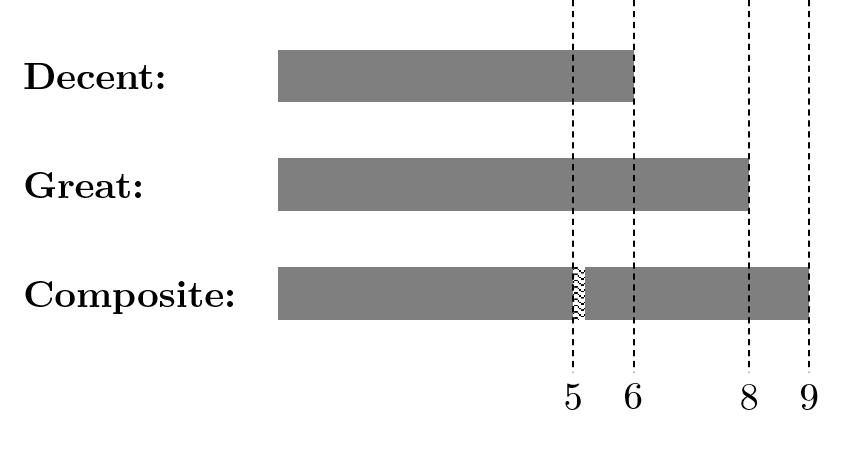
Now consider the following three outcomes:
Decent: Emile does not enter the LifeTransformer. He lives a life with a welfare score of
. Great: Emile does not enter the LifeTransformer. He lives a life with a welfare score of
. Composite: Emile lives a life-episode with a welfare score of
. He then enters the LifeTransformer at some setting. Emile* then lives a life-episode with a welfare score of .
Here is a diagram to illustrate:
Suppose — for now — that individual welfare is
additively separable over life-episodes: that is to
say, for all non-overlapping life-episodes
Is Composite better than Great?
Is Composite better than Decent?
On the total view, the answers are simple. Composite is
better than Great and better than Decent. That is because
(ignoring all unaffected lives), the value of Decent is
Consider first our critical-level view, with a critical
level of 4. If Emile and Emile* live the same life, the
value of Decent is
If Emile and Emile* live different lives, however, the
value of Decent is
Clearly, when Emile enters the LifeTransformer at setting
We get a similar drop on critical-range views. Recall
that on our example critical-range view we calculate the
value of each population on a range of critical levels
running from
If Emile and Emile* live different lives, however, the
values of Decent, Great, and Composite on a critical level
of
If biographical identity is
determinately-all-or-determinately-nothing, our
critical-range view implies that there is some setting
Now to consider a few objections. First, advocates of
critical-set views might argue that the drop is not so bad.
They might say that it should come as no surprise that
Composite’s value drops markedly as we move from
Onto the next point. I assumed above that individual
welfare is additively separable over life-episodes. That
assumption allowed me to infer that, since Emile and
Emile*’s welfare scores are
Suppose first that Emile’s and Emile*’s welfare score
when they live the same life is greater than
So, suppose instead that Emile’s and Emile*’s welfare
score when they live the same life is less than
More generally, to avoid all discontinuities in
LifeTransformer cases on our critical-level view, the
longevity penalty (as I will call it) must always
equal
Critical-range views, meanwhile, cannot avoid all
discontinuities by denying additive separability. Even if
Emile and Emile*’s combined welfare score is exactly equal
to 5, there will still be a discontinuity. It will just be
in the opposite direction: a jump rather than a drop. On a
critical level of
A more promising way to soften these discontinuities is
to move the critical level towards 0 in the case of
critical-level views, and to move one or both of the
endpoints of the critical range towards
A more radical way for advocates of critical-set views to
avoid discontinuities is to deny another assumption that I
made above. Besides assuming that individual welfare is
additively separable over life-episodes, I also assumed that
biographical identity is
determinately-all-or-determinately-nothing: that there is
some setting
This discount-by-degrees — as I will call it — could be justified by claiming that biographical identity is sometimes indeterminate and that the truth of claims about biographical identity admits of degrees.Lewis (1976) makes these claims about personal identity. A discount-by-degrees could also be justified by claiming that the size of the discount constant depends not on biographical identity but on some relation more commonly thought to come in degrees, such as psychological or physical connectedness.Parfit (1984, 313) makes this claim of prudential decisions: the degree to which we can rationally discount future welfare depends on psychological connectedness. Whichever way the move is justified, however, critical-set views will face an objection from Egyptology.
4. Egyptology
The total view and critical-set views satisfy
Separability over Lives: whether an outcome
It is commonly thought that critical-set views — being separable over lives — do not require research in Egyptology. But that is not true. At least, it is not true so long as critical-set views are paired with what I call a non-fire account of biographical identity. I explain the distinction between fire and non-fire accounts below. For now, it suffices to say that, on non-fire accounts, life-episodes need not be spatiotemporally continuous to be part of the same life. Critical-set views paired with non-fire accounts require Egyptology whether they feature an all-or-nothing discount constant or a discount-by-degrees.
To see how, recall the case of Mina and Tutankhamun.
Assume for now that individual welfare is additively
separable over life-episodes, and suppose for concreteness
that Tut’s ancient Egyptian life-episode has a welfare score
of 10, Tut*’s life-episode would have a welfare score of 9,
and Bukayo’s life-episode would have a welfare score of 10.
On our critical-level view, creating Tut* is better than
creating Bukayo iff the discount
As above, I have thus far assumed that individual welfare
is additively separable over life-episodes. But, again as
above, denying additive separability is an unappealing
escape-route. We can avoid the need for Egyptology on
critical-level views only if the longevity penalty is
Critical-range views, meanwhile, cannot avoid Egyptology by denying additive separability. If a longevity penalty cancels out the effect of a discount from some level in the critical range, it will fail to cancel out a discount from some other level. Thus, the value of Mina’s creating Tut* on at least one level in the critical range — and hence whether it is better to create Tut* than some other life — will depend on how closely Tut* resembles Tut.
Rather than avoid Egyptology, advocates of critical-set views might instead accept it. Or else they might claim that their kind of Egyptology (learning about ancient Egyptians’ physical and psychological features) is acceptable, whereas the kind of Egyptology required by views like the average view (learning about how numerous or well-off the ancient Egyptians were) is unacceptable.I thank an anonymous reviewer for suggesting this response. In defending this claim, advocates of critical-set views might contend that the value-relations pertinent to Mina’s choice depend on the extent to which Tut* resembles Tut. If Tut* bears little resemblance to Tut, creating Tut* is more like creating a new life and Tut*’s welfare should be heavily discounted. If Tut* bears a strong resemblance to Tut, then creating Tut* is more like bringing Tut back from the dead and Tut*’s welfare should be discounted little if at all. Bringing people back from the dead is better than creating new lives.
Even with this rationale, however, the need for any kind of Egyptology still seems to me like a blow. It seems implausible to claim that which of Mina’s available outcomes is best could depend on — say — whether an ancient Egyptian Pharaoh liked the taste of honey. More implausible still is the following implication: which outcome is best could depend on the resemblance between Tut and Tut* even if Tut’s life was (and Tut*’s life would be) not particularly rich or varied: even if, for example, Tut’s life was (and Tut*’s life would be) no more than an unbroken period of mild and uniform pleasure.This proviso rules out cases in which Tut* would complete some project of Tut’s or satisfy some of Tut’s desires: cases in which it might seem more plausible that the value of the available outcomes depends on the resemblance between Tut and Tut*. What is more, I expect these implications to seem especially worrying to advocates of critical-set views. After all, one of the major attractions of these views was that they seemed to avoid the need for Egyptology.Wilkinson (2022, 467), for example, writes that avoiding the need for Egyptology is ‘one of the main appeals’ of views like critical-set views. See also remarks from Blackorby, Bossert, and Donaldson (2005, 132–33), Broome (2004, 194), and Bossert (2022, 74, 83). Of course, advocates might hold on to critical-set views even so, but these views will have lost a significant draw.
What seems to me a better response is to pair critical-set views with a fire account of biographical identity. On fire accounts, lives are like fires.Analogies along these lines are old. See Seneca (2004, Letter LIV, 104-5): Wouldn't you say that anyone who took the view that a lamp was worse off when it was put out than it was before it was lit was an utter idiot? We, too, are lit and put out. We suffer somewhat in the intervening period, but at either end of it there is deep tranquillity. See also the Aggi-Vacchagotta Sutta (Majjhima Nikāya 72), in which the Buddha compares asking where an enlightened person goes after death to asking where a fire goes after it is blown out. Their identity requires both spatial and temporal continuity. Putting out a fire and then lighting another in the same place does not bring back the same fire, no matter how close the resemblance. The gap in temporal continuity means that the old fire is gone forever. Similarly for spatial continuity. A fire lit in a different place at the same instant some fire is put out is not the same fire, no matter how similar they are in other respects. On fire accounts, lives are the same. To die for an instant is to die forever.
For an example of a fire account, consider a version of McMahan’s Embodied Mind account of personal identity (2002, chap. 1.5), amended so that it refers to lives rather than persons. On this account, biographical identity consists in the continued existence and functioning of enough of the same brain to support the capacity for consciousness.
Advocates of critical-set views can use fire accounts to
address my Drop and Egyptology objections. They can
avoid the drop by claiming that the discount
applied to Emile*’s welfare score increases in small
increments as we ramp up the settings on the
LifeTransformer, or else they can justify the drop
by appealing to their criterion of biographical identity. If
they adopt an Embodied Mind account, for example, they can
claim that the drop should come as no surprise: despite the
small physical and psychological differences between Emile*
at
However, trouble remains. Advocates of critical-set views may be surprised to find themselves driven towards such a narrow class of views about biographical identity. They may also be reluctant to accept some of fire accounts’ implications. Consider, for example, Parfit’s Teletransporter (1984, 199), which vaporises your brain and body and then creates a perfect replica out of new matter. Since the Teletransporter does not preserve spatiotemporal continuity between you and your replica, fire accounts imply that your life ends when you enter. And a variation on Parfit’s Teletransporter throws up some unsavoury ethical implications. First imagine a long, wonderful life. Then suppose that some event like this life occurs, except that the brain and body at its centre are momentarily and frequently blinked out of and then back into existence. Call this event a wonderful-but-blinking life-series. Since fire accounts imply that each blink causes the end of one life and the beginning of another, critical-set views paired with a fire account imply that the welfare scores of each of these short lives is discounted. If the blinks occur frequently enough, the value of each wonderful-but-blinking life-series on a positive critical level will be arbitrarily low. That means that critical-level views paired with a fire account imply the Blinking Sadistic Conclusion:
For any population of awful lives, there is some population of wonderful-but-blinking life-series such that the blinking population is worse than the awful population.
Critical-range views, meanwhile, imply the Weak Blinking Sadistic Conclusion:
For any population of awful lives, there is some population of wonderful-but-blinking life-series such that the blinking population is not better than the awful population.For the original Sadistic Conclusion, see Arrhenius (2000, 256). For the Weak Sadistic Conclusion, see Gustafsson (2020, 86).
Both conclusions seem tough to accept, since the blinking population is exactly like a population of wonderful lives except for the blinks.
Advocates of critical-set views might react by holding on to fire accounts and accepting a Blinking Sadistic Conclusion, or else by rejecting fire accounts and accepting the need for Egyptology. Neither option strikes me as appealing, and both options lead to trouble in cases of fission.
5. Fission
Suppose that Asiya’s brain is divided in two, and each half is implanted into an exact replica of her body. Each of the resulting people — call them Lefty and Righty — share all of Asiya’s psychological features. Both Lefty and Righty are also phenomenally, physically, and functionally continuous with pre-fission Asiya. That is to say, Asiya’s stream of (and capacity for) consciousness divides and flows uninterrupted into the streams of (and capacities for) consciousness of Lefty and Righty.This is a cosmetic variation on Parfit’s My Division (1984, 254–55). Contra my claims in footnote 8, one might contend that this case — involving as it does the dividing of consciousness into two separate streams — will not happen in the actual world or is not imaginable. However, it may be interesting to note that this dividing seems to have actually occurred in patients whose corpus callosum has been severed. The evidence for this ‘dual consciousness’ phenomenon comes in the form of experiments like the following. Two objects are presented to a patient, one in each half of their visual field. If the patient is asked to pick out a matching object by feel alone, they pick out only the object presented in the left half of their visual field. If the patient is then asked to name the object they have picked, they name only the object presented in the right half of their visual field. As the experimenters write, ‘it is as if two separate brains were viewing the left and right halves of the visual field.’ (Sperry, Gazzaniga, and Bogen 1969, 278). See also Sperry’s (1982) and Parfit’s (1984, 245–46) discussions of this phenomenon.
In this case, which — if any — of Lefty’s and Righty’s welfare scores is discounted? Here are six possible answers.
Both Lefty’s and Righty’s welfare scores are discounted.
Lefty’s welfare score is discounted.
Righty’s welfare score is discounted.
One of Lefty’s and Righty’s welfare scores is discounted, but it is indeterminate which.
Each of Lefty’s and Righty’s welfare scores is ‘half-discounted.’
Neither Lefty’s nor Righty’s welfare scores is discounted.
I believe that only (6) is viable. Each of (1)-(5) implies some especially implausible Sadistic Conclusion. To see how, suppose that Asiya splits into Lefty and Righty. Each of Lefty and Righty then live a life-episode with a welfare score of 1, before themselves splitting in two. Each of their descendants also lives a life-episode with a welfare score of 1 before splitting in two, and so on. Call this a good-but-splitting life-tree. On answers (1)-(5) and a critical level of 4, each split reduces the population’s value: each of the two splittees lives a life-episode with a welfare score of 1, but the welfare discount is at least 4.On (1), each of Lefty’s and Righty’s welfare scores is discounted by 4, for a total discount of 8. On (2), (3), and (4), one of Lefty’s and Righty’s welfare scores is discounted by 4, for a total discount of 4. On (5), each of Lefty’s and Righty’s welfare scores is discounted by 2, for a total discount of 4. That means that our critical-level view paired with (1)-(5) implies the Splitting Sadistic Conclusion:
For any population of awful lives, there is a population of good-but-splitting life-trees that is worse.
Our critical-range view paired with (1)-(5), meanwhile, implies the Weak Splitting Sadistic Conclusion:
For any population of awful lives, there is a population of good-but-splitting life-trees that is not better.
These Splitting Sadistic Conclusions are more troubling than the originals, since each splittee can be psychologically, phenomenally, physically, and functionally continuous with all of their ancestors and descendants. Their lives need not be lives of ‘muzak and potatoes’ either (Parfit 1986, 148). In fact, each splittee’s life-episode can be almost exactly like an episode within a long, wonderful life. The only difference is that this life frequently branches, with each descendant also living a life-episode almost exactly like an episode within a long, wonderful life.
Thus, I take it that advocates of critical-set views will opt for (6): when Asiya splits, neither Lefty’s nor Righty’s welfare score is discounted. That answer allows critical-set views to avoid both forms of Splitting Sadistic Conclusion. The catch is that (6) exposes critical-set views to analogues of all of the problems that afflict the total view, in addition to the classic problems for critical-set views like the original Sadistic and Weak Sadistic Conclusions.For other objections to critical-set views, see Thornley (2022).
Consider first the Repugnant Conclusion (Parfit 1984, 388):
For any population of wonderful lives, there is a population of lives barely worth living that is better.
The total view implies the Repugnant Conclusion, while our example critical-set views do not. However, critical-set views paired with (6) do imply the Splitting Repugnant Conclusion:
For any population of wonderful lives, there is a population of life-branches barely worth living that is better.
By ‘life-branch’ I mean the kind of life-episode lived by
Lefty and Righty: life-episodes that begin post-fission. To
see how critical-set views plus (6) imply the Splitting
Repugnant Conclusion, consider a finite but arbitrarily
large population of wonderful lives. Call this population
More generally, wherever creating new lives presents a problem for the total view, creating new life-branches presents an analogous problem for critical-set views paired with (6). Consider an example. Given a plausible principle about the link between value and reasons, the total view implies that we have reason to create lives barely worth living. Then given a plausible principle about the link between reasons and obligations (and in the absence of any countervailing considerations), the total view implies that we are obliged to create lives barely worth living. That might seem implausible. However, critical-set views paired with (6) have a similarly implausible implication. Given plausible principles about the links between value, reasons, and obligations, critical-set views imply that we are obliged to create life-branches barely worth living.
The upshot is that fission presents a real challenge to critical-set views. If advocates claim that some discount constant applies in fission cases, critical-set views imply some Splitting Sadistic Conclusion. If, on the other hand, advocates claim that no discount constant applies in fission cases, critical-set views face analogues of all of the problems that blight the total view, in addition to the classic problems faced by critical-set views alone.
Thus, I claim, considerations of biographical identity give us reason to shift our credences away from critical-set views and towards the total view. Once we begin asking questions about identity between lives, critical-set views run into all kinds of difficulties. Paired with some claims about biographical identity, they entail implausible discontinuities in the value of populations. Paired with other claims, they require research in Egyptology to determine which outcome available to us is best. And no matter what our views about biographical identity, they have troubling consequences in fission cases.
6. Practical Implications
Suppose, then, that we shift some portion of our credence from critical-set views to the total view. This move has practical implications for those aiming to promote the impartial good.
To see how, consider an example. You have £
Donate to the Nuclear Threat Initiative, and thereby reduce the risk of human extinction this century from
Donate to Emergent Ventures, and thereby increase expected average future welfare scores conditional on survival from
On the total view, the expected value of donating to the
Nuclear Threat Initiative is
On our critical-level view, meanwhile, the expected value
of donating to the Nuclear Threat Initiative is
In this case, then, shifting some portion of our credence from critical-set views to the total view enhances the appeal of donating to the Nuclear Threat Initiative. More generally, placing more stock in the total view increases the relative importance of ensuring humanity’s long-term survival and decreases the relative importance of improving humanity’s prospects conditional on survival.
7. Conclusion
Critical-set views avoid the Repugnant Conclusion by subtracting some constant from the welfare score of each life in a population. These views are thus sensitive to facts about biographical identity, and this sensitivity raises a whole host of problems. If the application of the discount constant is all-or-nothing, critical-set views lead to implausible discontinuities in the value of populations. Severing one synapse and erasing one faint memory can make a population significantly worse. If biographical identity does not require spatiotemporal continuity, then critical-set views require us to become Egyptologists to determine which of some set of outcomes is best. And if biographical identity does require spatiotemporal continuity, then critical-set views imply some Blinking Sadistic Conclusion. We can add some Splitting Sadistic Conclusion to the list of charges if the welfare scores of splittees are discounted. And if the welfare scores of splittees are not discounted, critical-set views imply the Splitting Repugnant Conclusion instead, along with analogues of all the other problems faced by the total view.
So, I argue, we should reject critical-set views in favour of the total view. This move has practical implications for those aiming to promote the impartial good. It decreases the relative importance of improving humanity’s future conditional on survival, and increases the relative importance of ensuring that humanity has a future.For helpful comments and discussion, I thank Adam Bales, Hilary Greaves, William MacAskill, Teruji Thomas, two anonymous reviewers for the Australasian Journal of Philosophy, and the audience at the Slippery Slope Normativity Summit 2022.
References
Arrhenius, Gustaf. 2000. ‘An Impossibility Theorem for Welfarist Axiologies’. Economics & Philosophy 16 (2): 247–66.
Blackorby, Charles, Walter Bossert, and David Donaldson. 2005. Population Issues in Social Choice Theory, Welfare Economics, and Ethics. Cambridge: Cambridge University Press.
Booth, Charlotte. 2007. The Boy Behind the Mask: Meeting the Real Tutankhamun. Oxford: Oneworld.
Bossert, Walter. 2022. ‘Anonymous Welfarism, Critical-Level Principles, and the Repugnant and Sadistic Conclusions’. In The Oxford Handbook of Population Ethics, edited by Gustaf Arrhenius, Krister Bykvist, Tim Campbell, and Elizabeth Finneron-Burns. Oxford: Oxford University Press.
Bostrom, Nick. 2013. ‘Existential Risk Prevention as Global Priority’. Global Policy 4 (1): 15–31.
Broome, John. 2004. Weighing Lives Oxford: Oxford University Press.
Buchak, Lara. 2013. Risk and Rationality. Oxford: Oxford University Press.
Buddha, Gautama. n.d. ‘Aggi-Vacchagotta Sutta’. In Majjhima Nikāya, 72.
Dainton, Barry F. 1992. ‘Time and Division’. Ratio 5 (2): 102–28.
Dennett, Daniel C. 1995. ‘The Unimagined Preposterousness of Zombies’. Journal of Consciousness Studies 2 (4): 322–26.
Dorsey, Dale. 2015. ‘The Significance of a Life’s Shape’. Ethics 125 (2): 303–30.
Gustafsson, Johan E. 2020. ‘Population Axiology and the Possibility of a Fourth Category of Absolute Value’. Economics & Philosophy 36 (1): 81–110.
Gustafsson, Johan E., and Petra Kosonen. forthcoming. ‘Prudential Longtermism’. In Essays on Longtermism, edited by Jacob Barrett, Hilary Greaves, and David Thorstad. Oxford: Oxford University Press.
Hudson, James L. 1987. ‘The Diminishing Marginal Value of Happy People’. Philosophical Studies 51 (1): 123–37.
Huemer, Michael. 2008. ‘In Defence of Repugnance’. Mind 117 (468): 899–933.
Lewis, David. 1976. ‘Survival and Identity’. In The Identities of Persons, edited by Amelie Oksenberg Rorty, 17–40. University of California Press.
McMahan, Jeff. 1981. ‘Problems of Population Theory’. Ethics 92 (1): 96–127.
McMahan, Jefferson. 2002. The Ethics of Killing: Problems at the Margins of Life. New York: Oxford University Press.
Parfit, Derek. 1984. Reasons and Persons. Oxford: Clarendon Press.
———. 1986. ‘Overpopulation and the Quality of Life’. In Applied Ethics, edited by Peter Singer, 145–64. Oxford: Oxford University Press.
Pummer, Theron. 2021. ‘Sorites on What Matters’. In Ethics and Existence: The Legacy of Derek Parfit, edited by Jeff McMahan, Tim Campbell, James Goodrich, and Ketan Ramakrishnan, 498–523. Oxford: Oxford University Press.
Qizilbash, Mozaffar. 2007. ‘The Mere Addition Paradox, Parity and Vagueness’. Philosophy and Phenomenological Research 75 (1): 129–51.
———. 2018. ‘On Parity and the Intuition of Neutrality’. Economics & Philosophy 34 (1): 87–108.
Rabinowicz, Wlodek. 2009. ‘Broome and the Intuition of Neutrality’. Philosophical Issues 19 (1): 389–411.
———. 2022. ‘Getting Personal: The Intuition of Neutrality Reinterpreted’. In The Oxford Handbook of Population Ethics, edited by Gustaf Arrhenius, Krister Bykvist, Tim Campbell, and Elizabeth Finneron-Burns. Oxford: Oxford University Press.
Seneca, Lucius Annaeus. 2004. Letters from a Stoic. Translated by Robin Campbell. London: Penguin Books.
Sperry, Roger W. 1982. ‘Some Effects of Disconnecting the Cerebral Hemispheres’. Science 217 (4566): 1223–26.
Sperry, Roger W., Michael S. Gazzaniga, and Joseph E. Bogen. 1969. ‘Interhemispheric Relationships: The Neocortical Commissures; Syndromes of Hemisphere Disconnection’. In Handbook of Clinical Neurology, edited by P. J. Vinken and G. W. Bruyn, 4:273–90. Amsterdam: North-Holland Publishing Co.
Tännsjö, Torbjörn. 2002. ‘Why We Ought to Accept the Repugnant Conclusion’. Utilitas 14 (3): 339–59.
Tarsney, Christian J. and Teruji Thomas. 2020. ‘Non-Additive Axiologies in Large Worlds’.
Thomas, Teruji. 2022. ‘Separability and Population Ethics’. In The Oxford Handbook of Population Ethics, edited by Gustaf Arrhenius, Krister Bykvist, Tim Campbell, and Elizabeth Finneron-Burns, 271–95. Oxford: Oxford University Press.
Thornley, Elliott. 2022. ‘Critical Levels, Critical Ranges, and Imprecise Exchange Rates in Population Axiology’. Journal of Ethics and Social Philosophy 22 (3): 382–414.
Wilkinson, Hayden. 2022. ‘In Defence of Fanaticism’. Ethics 132 (2): 445–77.