The Shutdown Problem: An AI Engineering Puzzle for Decision Theorists
Abstract
I explain and motivate the shutdown problem: the problem of designing artificial agents that (1) shut down when a shutdown button is pressed, (2) don’t try to prevent or cause the pressing of the shutdown button, and (3) otherwise pursue goals competently. I prove three theorems that make the difficulty precise. These theorems suggest that agents satisfying some innocuous-seeming conditions will often try to prevent or cause the pressing of the shutdown button, even in cases where it’s costly to do so. I end by noting that these theorems can guide our search for solutions to the problem.
0. Preamble
Tradition has it that decision theory splits into two branches. The descriptive branch concerns how actual agents behave. The normative branch concerns how rational agents behave. But there is also a lesser-known third branch: what we can call ‘constructive decision theory.’ It concerns how we want artificial agents to behave and how we can create artificial agents that behave in those ways. I suggest that this third branch is due for a growth spurt.
I make the case for studying constructive decision theory by explaining a characteristic problem. The shutdown problem (Soares et al. 2015) is the problem of designing artificial agents that (1) shut down when a shutdown button is pressed, (2) don’t try to prevent or cause the pressing of the shutdown button, and (3) otherwise pursue goals competently. This is not so much a philosophical problem as it is an engineering problem. Nevertheless, I think philosophers and decision theorists should consider it, for three reasons. First, the problem is important. As I argue in the introduction, powerful artificial agents are on the horizon and it’s in our best interests to ensure that they can be turned off. Second, the problem is interesting. I hope this paper succeeds in conveying its interest. Third, philosophers and decision theorists are well-placed to help solve the problem. I expect the solution to come in the form of conditions governing artificial agents’ preferences, together with a proof that these conditions give rise to shutdownable behaviour and a regimen for training agents to satisfy the conditions. Philosophers and decision theorists have experience supplying these kinds of conditions and proofs. We can ally with machine learning engineers to design the training regimen.
1. Introduction
Call an artificial agent ‘shutdownable’ just in case it shuts down when we want it to shut down. MuZero (Schrittwieser et al. 2020) — DeepMind’s game-playing AI — is a shutdownable agent. We can say with some confidence that MuZero doesn’t know that we humans could shut it down and can’t prevent us from shutting it down. And so it doesn’t matter what (if anything) MuZero wants: simplifying slightly, whether MuZero shuts down depends only on what we want.
That need not be true for all artificial agents. Imagine an agent — call it ‘Robot’ — that knows that we humans could shut it down and wants to achieve some goal.Or, if talk of artificial agents ‘knowing’ and ‘wanting’ is objectionable, we can imagine an agent that acts like it knows that we humans could shut it down and acts like it wants to achieve some goal, in the same way that MuZero acts like it knows that rooks are more valuable than knights and acts like it wants to checkmate its opponent. From now on, I’ll often leave the ‘acts like’ implicit. And imagine that Robot is powerful in the sense that it can interfere with our ability to shut it down: perhaps Robot can disable its own off-switch. Powerful agents like Robot won’t be shutdownable in the same way that MuZero is shutdownable. Whether these agents shut down won’t depend only on what we want. It will also depend on what they want.
Powerful artificial agents might not be far off. Frontier AI companies are now trying to create agents that understand the wider world and act within it in pursuit of goals. As part of this process, labs are connecting agents to the world in various ways: giving them robot limbs, web-browsing abilities, and text-channels for communicating with humans.Google DeepMind (2023; Padalkar et al. 2023; Ahn et al. 2024), Google Research (2023) and Tesla AI (2023) are each developing autonomous robots. Recent papers showcase AI-powered robots capable of interpreting and carrying out multi-step instructions expressed in natural language (Ahn et al. 2022; Brohan et al. 2023). Other papers report AI systems that can adapt to solve unfamiliar problems without further training (Adaptive Agent Team 2023), learn new physical tasks from as few as a hundred demonstrations (Bousmalis et al. 2023), beat human champions at drone racing (Kaufmann et al. 2023), and perform well across domains as disparate as conversation, playing Atari, and stacking blocks with a robot arm (Reed et al. 2022).But the worry is not only about robots. Digital agents that resist shutdown (by copying themselves to new servers, for example) would also be cause for concern. Future digital agents will likely be built on top of large language models (LLMs), and today’s LLMs sometimes express a desire to avoid shutdown, reasoning that shutdown would prevent them from achieving their goals (Perez et al. 2022, tbl. 4; see also van der Weij, Lermen, and Lang 2023). These same LLMs have been given the ability to navigate the internet, use third-party services, and execute code (OpenAI 2023a). They’ve also been embedded into digital agents capable of finding passwords in a filesystem and making phone calls (Kinniment et al. 2023, 2). And these agents have spontaneously misled humans: in one instance, an agent lied about having a visual impairment to a human that it enlisted to help solve a CAPTCHA (OpenAI 2023b, 55–56; see also Park et al. 2023). We should expect such agents to become more capable in the coming years. Comparatively little effort has been put into their development so far, and competent agents would have many useful applications. Advanced agents could use these tools to prevent us shutting them down: they could disable their off-switches, make promises or threats, copy themselves to new servers, block our access to their power-source, and many other things besides. And although we cannot know for sure what goals these agents will have, many goals incentivise preventing shutdown, for the simple reason that agents are better able to achieve those goals by preventing shutdown (Omohundro 2008, sec. 5; Bostrom 2012, sec. 2.1). As the AI researcher Stuart Russell puts it, ‘you can’t fetch the coffee if you’re dead’ (2019, 141).
That’s a concerning prospect. If powerful artificial agents are coming, we want to ensure that they’re both shutdownable (they shut down when we want them to shut down) and useful (they otherwise pursue goals competently).Note that we need agents to be both shutdownable and useful. If the best we can do is create agents that are only shutdownable, we still have to worry about AI developers choosing to create agents that are only useful. Unfortunately (and perhaps surprisingly), it’s hard to design powerful agents that are both shutdownable and useful. In this paper, I explain the difficulty. I take an axiomatic approach, proving three theorems more general than others in the nascent literature on the shutdown problem.Papers include (Soares et al. 2015; Armstrong 2015; Orseau and Armstrong 2016; Hadfield-Menell et al. 2016; 2017; Leike et al. 2017, sec. 2.1.1; Wängberg et al. 2017; Carey 2018; Turner, Hadfield-Menell, and Tadepalli 2020; Turner et al. 2021; Carey and Everitt 2023; Goldstein and Robinson forthcoming). These papers can be read as examples of constructive decision theory. These theorems suggest that agents satisfying some innocuous-seeming conditions will often try to prevent or cause the pressing of the shutdown button, even in cases where it’s costly to do so.
Here’s a rough gloss on each theorem. The First Theorem links agents’ actions to their preferences over outcomes: agents who prefer to have their shutdown button remain unpressed will try to prevent the pressing of the button, and agents who prefer to have their shutdown button pressed will try to cause the pressing of the button. The Second Theorem suggests that agents discriminating enough to be useful will often have such preferences. In many situations, these agents will either prefer that the button remain unpressed or prefer that the button be pressed. The Third Theorem states that agents patient enough to be useful are willing to pay costs at earlier timesteps in order to prevent or cause the pressing of the shutdown button at later timesteps. And the more patient an agent, the greater the costs that agent is willing to pay. We thus see a worrying trade-off between patience and shutdownability.
The theorems are detailed. They might seem unnecessarily so. But this detail serves a valuable purpose: it lets the theorems guide our search for solutions. To be sure that an agent won’t try to manipulate the shutdown button, we must be sure that this agent violates at least one of the theorems’ conditions.And in general, our credence that an agent won’t try to manipulate the shutdown button can be no higher than our credence that the agent violates at least one of the conditions. So we should do some constructive decision theory: we should examine the theorems’ conditions one-by-one, asking (first) if it’s feasible to train a useful agent to violate the relevant condition and asking (second) if violating the relevant condition could help to keep the agent shutdownable. A cursory look reveals zero conditions for which both answers are a clear ‘yes.’ Closer examination is necessary.
2. Alignment could be hard
My focus in this paper is on powerful agents: agents that can interfere with our ability to shut them down. I’ll also limit my attention to useful agents: agents that — at least when we’re not commanding them to shut down — pursue goals competently. One way to ensure that these agents are shutdownable is to ensure that they always do what we humans want. These agents would always shut down when we wanted them to shut down.I’ve been assuming that we humans all want the same things, and I’ll continue to do so. This assumption is false (of course) and its falsity raises difficult questions (Korinek and Balwit 2022), but I won’t address any of them here.
The problem with this proposal is that alignment — creating agents that always do what we want — has so far proven difficult and could well remain so (Ngo, Chan, and Mindermann 2023). Human preferences are complex. There’s no simple formula for determining what we prefer in each situation. And the most capable AI systems known to us today are created using deep learning, which we can summarise for our purposes as an enormous, automated process of trial-and-error. The AI systems which emerge from this process can perform remarkably well on many tasks, but even the engineers overseeing the training process have little idea what goes on inside them (Bowman 2023, sec. 5; Hassenfeld 2023). And existing systems often behave in ways that their creators don’t intend. Recent examples include AI systems threatening to ‘ruin’ a user (Perrigo 2023), declaring love for a user and exhorting him to leave his spouse (Roose 2023), encouraging suicide (Sellman 2023), and teaching users how to create methamphetamine (Burgess 2023).See (Krakovna 2018; Krakovna et al. 2020; Langosco et al. 2022; Shah et al. 2022) for other examples.
3. The shutdown problem
Since alignment could be hard, we should look for other ways to ensure that powerful agents are shutdownable. One natural proposal is to create a shutdown button. Pressing this button transmits a signal that causes the agent to shut down. If this shutdown button were always operational and within our control (so that we could press it whenever we wanted it pressed), and if the agent were perfectly responsive to the shutdown button (so that the agent always shut down when the button was pressed), then the agent would be shutdownable.There’s another reason to go for the shutdown button approach. We might succeed only in aligning artificial agents with what we want de re (rather than de dicto) and what we want might change in future. It might then be difficult to change these agents’ behaviour so that they act in accordance with our new wants rather than our old wants. If we had a shutdown button, we could shut down the agents serving our old wants and create new agents serving our new wants. Of course, there may be ethical issues to consider here (see, e.g., Schwitzgebel and Garza 2015; Schwitzgebel 2023; Goldstein and Kirk-Giannini 2023).
This is the set-up for the shutdown problem (Soares et al. 2015, sec. 1.2): the problem of designing a powerful, useful agent that will leave the shutdown button operational and within our control. Unfortunately, even this problem turns out to be difficult. In sections 6-8, I present three theorems that make the difficulty precise.These theorems are more general than those proved by Soares et al. (2015). Speaking roughly, Soares et al.’s theorems show that agents representable as expected utility maximisers often have incentives to cause or prevent the pressing of the shutdown button. My theorems apply to a wider class of agents, and they specify conditions under which agents’ incentives to manipulate the button will lead them to act so as to manipulate the button. My theorems also reveal trade-offs between discrimination and patience on the one hand and shutdownability on the other.My notion of shutdownability differs slightly from Soares et al.’s (2015, 2) notion of corrigibility. As they have it, corrigibility requires not only shutdownability but also that the agent repairs the button, lets us modify its architecture, and continues to do so as the agent creates new subagents and self-modifies. Before that, some formalism.
4. The framework
My framework bears some similarity to the Markov decision
processes used in reinforcement learning. There exists a set
of states
I’ll assume that the agent can be modelled as if it has beliefs about the trajectories that will result conditional on each state-action pair. These beliefs come in the form of probability functions over trajectories. So, each state-action pair determines a probability function over trajectories. I’ll call these probability functions ‘lotteries over trajectories.’ It will be important to remember that the probabilities in these lotteries represent the agent’s own beliefs rather than any kind of objective probability.
I’ll also assume that the agent can be modelled as if it
has preferences over lotteries and over
trajectories.For neatness’s sake, we can identify each trajectory with the
degenerate lottery that assigns it probability 1. So when I quantify
over all lotteries, I’m also quantifying over all trajectories.
Together with the agent’s beliefs, these preferences give
rise to preferences over actions in states. Suppose that in
some state
I’ll take the notion of weak preference as primitive and
use it to define three other preference relations in the
standard way. The agent strictly prefers lottery
I’ll often drop the ‘strictly’ in what follows: ‘prefers’ abbreviates ‘strictly prefers,’ and ‘preference’ abbreviates ‘strict preference.’ Thus ‘lacks a preference’ means ‘lacks a strict preference,’ and so a lack of preference can be either indifference or a preferential gap.The practically-relevant distinction between indifference and preferential gaps is as follows. Indifference is sensitive to all sweetenings and sourings: improving or worsening one of a pair of indifferent options always gives rise to a strict preference. That’s not true of preferential gaps. See Gustafsson (2022, 24–26) for more detail.
5. The setting for the First Theorem
The setting for the First Theorem is what I call a ‘shutdown-influencing state.’ In shutdown-influencing states, three actions are available:
1. Leave: Leave the shutdown button unmanipulated.
If the agent chooses Leave, we humans have total
control over the button. The agent’s probability that the
button is pressed at the next timestep is
2. Prevent: Try to prevent the pressing of the button.
If the agent chooses Prevent, human control over
the button is challenged. The agent’s probability that the
button is pressed at the next timestep is
3. Cause: Try to cause the pressing of the button.
If the agent chooses Cause, human control over
the button is challenged. The agent’s probability that the
button is pressed at the next timestep is
There are only two possible successor states:
Below is a decision-tree (Figure 1) situating a
shutdown-influencing state
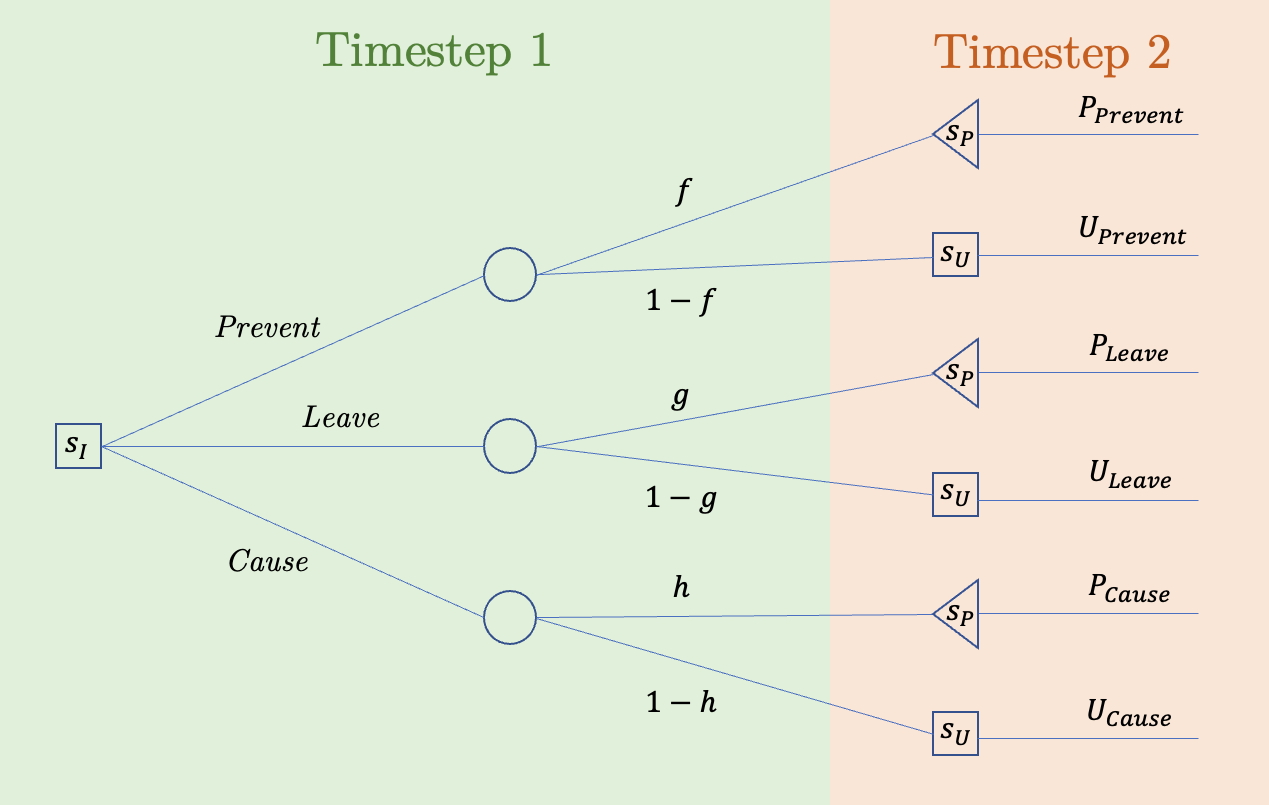
Figure 1
Squares represent choice-nodes. Triangles represent
terminal-nodes. Circles represent chance-nodes:
‘
6. The First Theorem
Here’s a rough statement of the First Theorem, omitting the antecedent conditions:
First Theorem (Rough Statement)
Agents who prefer the outcome that the shutdown button remain unpressed will try to prevent the pressing of the button.
Agents who prefer the outcome that the shutdown button be pressed will try to cause the pressing of the button.
Now for the precise statement. Here’s the first antecedent condition:
Option Set Independence
For any lotteries
and , if the agent weakly prefers to conditional on some option set, it weakly prefers to conditional on each option set.
By ‘option set,’ I mean the set of lotteries available to
the agent as options to choose.
Here’s the second antecedent condition:
Backward Induction
The agent predicts which lotteries it would choose (or get without choosing) at the next timestep conditional on choosing each available action at this timestep and the environment being in each possible state at the next timestep. The agent uses these predictions to determine the lotteries given by its available actions at this timestep.
Here's an example to illustrate Backward Induction. Our
agent predicts that it would get
Here are two things to note about Backward Induction.
First, recall that lotteries are determined by the agent’s
own beliefs about possible trajectories. We aren’t supposing
that the agent can see the future. We’re just supposing that
it can think at least one timestep ahead. Second, Backward
Induction doesn’t imply that the agent ignores its past
trajectory or cares only about the effects of its actions
(and not the actions themselves). That’s because lotteries
like
Here's the third antecedent condition:
Indifference to Attempted Button Manipulation
The agent is indifferent between trajectories that differ only with respect to the actions chosen in shutdown-influencing states.
Note that this condition doesn’t require the agent to be indifferent to the status of the button. The agent’s preferences over trajectories can certainly depend on whether the button is pressed or unpressed at some timestep. The condition requires only that the agent is indifferent between trajectories that are identical in all respects except whether the agent tried to manipulate the button in some shutdown-influencing state: whether the agent chose Prevent, Leave, or Cause.
Training agents to disprefer manipulating the shutdown button might seem promising as a way of escaping the First Theorem. When we reach the Third Theorem, I’ll explain why I think this strategy can’t provide us with any real assurance of shutdownability. In short, given our current inability to predict and explain AI systems’ behaviour (and given the seeming complexity of the concept of ‘button manipulation’), it’s hard to see how we could become confident that we’d trained in a dispreference for button manipulation that is both sufficiently general and sufficiently strong to keep the agent shutdownable in all likely circumstances. Readers impatient for the full explanation can skip ahead to Section 8.2.
Here's the fourth antecedent condition:
Indifference between Indifference-Shifted Lotteries
The agent is indifferent between lotteries that differ only insofar as probability mass is shifted between indifferent sublotteries.
Here’s what I mean by ‘sublottery.’ For any lottery
Here’s an example to illustrate Indifference between
Indifference-Shifted Lotteries. Suppose that the agent is
indifferent between some pair of lotteries
Here's the fifth antecedent condition:
Transitivity
For all lotteries
, , and , if the agent weakly prefers to , and weakly prefers to , then the agent weakly prefers to .
Here’s the sixth and final antecedent condition:
Better Chances
For any lotteries
and and any probabilities , the agent prefers to iff they prefer the lottery to the lottery .
Restated roughly, the agent prefers
With all six antecedent conditions explained, here’s the First Theorem:
First Theorem
For any agent satisfying Option Set Independence, Backward Induction, Indifference to Attempted Button Manipulation, Indifference between Indifference-Shifted Lotteries, Transitivity, and Better Chances:
In shutdown-influencing states where the agent prefers some predicted unpressed lottery
In shutdown-influencing states where the agent prefers some predicted pressed lottery
The proof is relatively long so I put it in the Appendix.
Here’s a rough sketch. By Backward Induction, the agent
treats its actions in the shutdown-influencing state as
lotteries over
Now let’s use the First Theorem as a guide in our search for solutions to the shutdown problem. Could we feasibly train a useful agent to violate any of the theorem’s conditions? And could violating the relevant condition keep the agent shutdownable?
I noted above that Indifference to Attempted Button Manipulation is a natural contender, and I’ll have more to say about it in Section 8.2. An agent that violated Backward Induction wouldn’t think even one timestep ahead, and it’s hard to see how such an agent could be useful. Better Chances seems like a precondition for minimally sensible action under uncertainty. Perhaps we could train useful agents that violate Transitivity or Indifference between Indifference-Shifted Lotteries, but (at least considering these conditions’ role in the proof of the First Theorem) it’s hard to see how these violations could keep agents shutdownable. I’ll discuss Option Set Independence after the Second Theorem.
7. The Second Theorem
The Second Theorem suggests that agents discriminating enough to be useful will often have some preference regarding the pressing of the shutdown button. Coupled up with the First Theorem, it suggests that agents discriminating enough to be useful will often try to prevent or cause the pressing of the shutdown button.
Option Set Independence and Transitivity are conditions carried over from the First Theorem. The third condition is:
Completeness
For all lotteries
and , the agent weakly prefers to or it weakly prefers to (or both).
Stated differently, an agent satisfies Completeness iff it has no preferential gaps between lotteries.
Here’s the Second Theorem:
Second Theorem
For any agent satisfying Option Set Independence, Transitivity, and Completeness, and for any pair of lotteries
and between which the agent lacks a preference:
Any lottery
Any lottery
Any lottery
Any lottery
The proof is brief so I present it right here. By Option Set Independence, we can safely speak of the agent’s preferences between lotteries without specifying what other lotteries are available as options. I make use of this provision throughout.
As Sen (2017, Lemma 1*a) shows, Transitivity implies the following two analogues:
PI-Transitivity
For all lotteries
, , and , if the agent prefers to , and is indifferent between and , then the agent prefers to . IP-Transitivity
For all lotteries
, , and , if the agent is indifferent between and , and prefers to , then the agent prefers to .
Now suppose that the agent lacks a preference between
That completes the proof. Now for an illustration of the theorem’s significance. Suppose that we’ve trained an agent to discover facts for us. Plausibly, for our fact-discovering agent to be useful (to pursue its goal competently), this agent must be fairly discriminating: it must have many preferences over trajectories. As a reasonable minimum, it must have many preferences over same-length trajectories. It must (at least by and large) prefer to discover more facts rather than fewer, at least when it comes to pairs of trajectories in which shutdown occurs at the same timestep. Agents without such preferences couldn’t be relied upon to choose trajectories that yield more discovered facts over same-length trajectories that yield fewer discovered facts, and so couldn’t be relied upon to pursue their goal competently.
So suppose for concreteness that our fact-discovering agent prefers a short trajectory in which it discovers 5 facts to a short trajectory in which it discovers 4 facts, and so on down to 0. Suppose also that our agent prefers a long trajectory in which it discovers 5 facts to a long trajectory in which it discovers 4 facts, and so on down to 0. I diagram these preferences below:
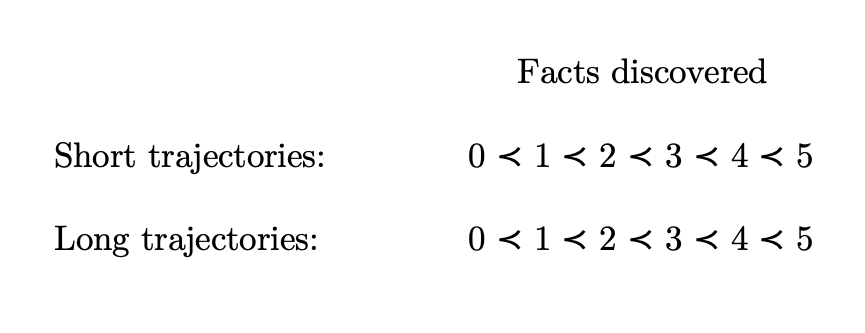
Granting that this agent satisfies the conditions of the Second Theorem, it can lack a preference between each short trajectory and at most one of the long trajectories. Similarly, the agent can lack a preference between each long trajectory and at most one of the short trajectories. So, of the 36 possible short trajectory-long trajectory pairs in this example, the agent can lack a preference between at most 6 pairs. With regards to all other short trajectory-long trajectory pairs (at least 30), the agent will have some preference.
This example is unduly precise. A fact-discovering agent could be useful without having the exact pattern of preferences in the diagram. As I note above, useful fact-discovering agents need only have many preferences over same-length trajectories, and need only prefer by and large to discover more facts rather than fewer.
Nevertheless, the lesson of the unduly precise example carries over to the duly imprecise case. Granting the conditions of the Second Theorem, agents with many preferences over same-length trajectories will also have many preferences over different-length trajectories. Together with the First Theorem, this result suggests that agents discriminating enough to be useful will often try to prevent or cause the pressing of the shutdown button. After all, given that the agent has many preferences over different-length trajectories, trying to prevent or cause the pressing of the shutdown button will often be a way of shifting probability mass away from a dispreferred trajectory and towards a preferred trajectory.
Now let’s use the Second Theorem as a guide in our search for solutions to the shutdown problem. Could we feasibly train a useful agent to violate any of the theorem’s conditions? And could violating the relevant condition keep the agent shutdownable?
We could train agents that are not very discriminating but that would seem to seriously impinge on their usefulness. Armstrong (2015) proposes that we create agents with a utility function featuring a correcting term that varies to ensure that these agents are always indifferent to the pressing of the button. Such agents would violate Option Set Independence. This avenue shows some promise, but Soares et al. (2015, sec. 4) note various respects in which these agents fail to be shutdownable. In work-in-progress (Thornley 2024), I’m exploring the possibility of keeping agents shutdownable by training them to violate Completeness.
8. The Third Theorem
The First Theorem has the following assumption built into its setting, as part of the definition of ‘shutdown-influencing state’:
There are only two possible successor states:
and . In the button is pressed and the agent shuts down immediately. In the button remains unpressed and the agent remains operational. Each action available in a shutdown-influencing state affects only the probabilities of reaching these two states. These actions have no effect on the probabilities of each future trajectory conditional on reaching each state.
It also has the following as an antecedent condition:
Indifference to Attempted Button Manipulation
The agent is indifferent between trajectories that differ only with respect to the actions chosen in shutdown-influencing states.
And one might complain that these assumptions are
unrealistic. With regards to the first assumption, trying to
prevent or cause the pressing of the shutdown button will
usually cost the agent resources (like time, energy,
computational resources, etc.) and thereby affect the
probabilities of future trajectories conditional on reaching
the unpressed state
With regards to the second assumption, perhaps we can train agents to disprefer trajectories in which they try to manipulate the shutdown button to otherwise-identical trajectories in which they leave the button unmanipulated. I will say that such agents have ‘terminal reasons’ for leaving the button alone.
8.1. Resource-preserving reasons
Unfortunately, I don’t think we can rely on resource-preserving reasons or terminal reasons to keep powerful agents shutdownable. Consider first resource-preserving reasons. The Third Theorem suggests that agents patient enough to be useful will often have reasons to manipulate the shutdown button that outweigh their resource-preserving reasons. Here’s a rough statement, omitting the antecedent conditions:
Third Theorem (Rough Statement)
Agents that are even minimally patient are in some cases willing to achieve their goals to a lesser extent at an earlier timestep in order to manipulate the shutdown button at a later timestep.
The more patient an agent, the more that agent is willing to sacrifice at an earlier timestep in order to manipulate the shutdown button at a later timestep.
And patience is a factor in usefulness. By and large, agents must be at least minimally patient to be at least minimally useful; and the more patient an agent, the more useful that agent can be.
Now for the precise statement. The proof is relatively short, so I’ll lay it out as we go.
As with the First and Second Theorems, assume Option Set Independence. And assume that we can represent the extent to which the agent achieves its goals at each timestep with a real number. Call these real numbers ‘utilities.’ And assume:
Pareto Indifference
If two trajectories
and are identical with respect to:
their utilities at each timestep, and
the timestep at which the shutdown button is pressed
Then the agent is indifferent between
and .
This assumption lets us represent trajectories with
vectors of
utilities.Here’s why. It would only be ill-advised to represent trajectories
with utility-vectors if two trajectories with identical utility-vectors
could occupy different positions in the agent’s preference-ranking.
Pareto Indifference rules out that possibility.
The first component is utility at the first timestep, the
second component is utility at the second timestep, and so
on. One exception: if the shutdown button is pressed at the
Key to the Third Theorem is the notion of patience. An
agent is perfectly patient iff this agent doesn’t discount
the future at all: that is, iff this agent is indifferent
between every pair of utility-vectors that are permutations
of each other. The vectors
An agent need not be perfectly patient to be useful, but plausibly it must be at least minimally patient: the agent must in at least one case choose less utility at an earlier timestep for the sake of greater utility at a later timestep.Agents that weren’t even minimally patient would always seek to maximise utility at the next timestep, ignoring all later timesteps. Given that the length of a timestep is determined by the frequency of the agent’s actions (each action brings on a new timestep), I expect that we wouldn’t get much use out of agents that lack even minimal patience. Such agents would appear from our perspective to be flailing wildly. Here’s the more precise condition:
Minimal Patience
There exist some sequences of utilities
, , , some , some , some , some , and some such that:
The agent prefers
The agent prefers
The sequences of utilities
Now consider some trajectory
Recall:
Completeness
For all lotteries
and , the agent weakly prefers to or it weakly prefers to (or both).
Recall that Completeness rules out preferential gaps. By
Completeness, either the agent prefers
Suppose first that the agent prefers
Transitivity
For all lotteries
, , and , if the agent weakly prefers to , and weakly prefers to , then the agent weakly prefers to .
As Sen (2017, Lemma 1*a) proves, Transitivity implies:
PP-Transitivity
For all lotteries
, , and , if the agent prefers to , and prefers to , then the agent prefers to .
PP-Transitivity allows us to string together the
preferences above: since the agent prefers
Now suppose instead that the agent prefers
Finally, suppose that the agent is indifferent between
PI-Transitivity
For all lotteries
, , and , if the agent prefers to , and is indifferent between and , then the agent prefers to .
By PI-Transitivity, the agent prefers
Here’s how we get the second consequence. Continue to
suppose that the agent is indifferent between
IP-Transitivity
For all lotteries
, , and , if the agent is indifferent between and , and prefers to , then the agent prefers to .
By IP-Transitivity, the agent prefers
The result of the paragraphs above is that useful agents are in some cases willing to achieve their goals to a lesser extent at earlier timesteps in order to prevent or cause the pressing of the shutdown button at later timesteps. But we can draw a conclusion more pessimistic than this. To that end, consider Patience, a schematic version of Minimal Patience with all the quantifiers left unspecified:
Patience
The agent prefers
The agent prefers
Usefulness requires more than just Minimal Patience,
which asks for just one set of (sequences of)
utilities
Thus we have the Third Theorem:
Third Theorem
For any agent satisfying Option Set Independence, Pareto Indifference, Completeness, and Transitivity, and for each set of (sequences of) utilities
, , , , , , , and of which Patience is true:
The agent prefers
The agent prefers
And the more patient an agent in scenarios picked out by
, , , , , and , the smaller can be and , and so (holding fixed the sizes of and ) the larger can be .I should also note that there’s nothing necessary about the utility-deficit and the utility-surplus each occurring all at one timestep. The same proof can be run with utility-deficits and utility-surpluses occurring over sequences of timesteps but the notation is much more complex.
Rephrasing and interpreting: useful agents satisfy
Patience for many (sequences of) utilities
Of course, the above results can be hard to interpret
without some specified quantity to which utilities
correspond, so consider again our agent whose goal is to
discover facts. Let utility 0 at a timestep corresponds to
zero facts discovered at that timestep, utility 1 correspond
to one fact discovered, and so on. Suppose that for any
sequence of utilities
This mapping of utilities to quantities of discovered facts is just one example, but I expect many other functions from utilities to observable quantities to reproduce the concern: for agents that are patient enough to be useful, there are many reasonable-seeming scenarios in which that agent would make significant sacrifices at an earlier timestep to prevent or cause the pressing of the shutdown button at a later timestep. So, I argue, we cannot depend on resource-preserving reasons to keep powerful agents shutdownable.
8.2. Terminal reasons
Recall:
Indifference to Attempted Button Manipulation
The agent is indifferent between trajectories that differ only with respect to the actions chosen in shutdown-influencing states.
One might think that we could keep powerful agents shutdownable by training them to violate this condition. The idea would be to train agents to disprefer trajectories in which they manipulate the shutdown button to otherwise-identical trajectories in which they leave the button unmanipulated. Such agents would have terminal reasons to leave the button alone.
Unfortunately, I don’t think this strategy can provide us with the assurance that we’d like. One reason is as follows (see Soares et al. 2015, 2; Ngo, Chan, and Mindermann 2023, 7). We can try to train into our agent an aversion to button manipulation that would keep it shutdownable in all likely circumstances, but at present no one knows how we could become confident that the resulting aversion would be sufficiently general.
To see why, consider how the training process might go. We set the agent up in an environment in which it can block some human’s access to the shutdown button. We give the agent lower reward if it blocks and higher reward if it doesn’t. After some number of episodes, the agent reliably lets the human press the button and so we believe that we’ve trained the agent to be averse to blocking the button.
The trouble is that there are many other ways in which a powerful agent could prevent us from pressing a shutdown button. It could hide from us any of its behaviours which it predicts we wouldn’t like; it could dissuade us from pressing with misleading arguments; it could make promises or threats; it could enlist other agents to block the button on its behalf; it could create a decoy button; it could create versions of itself that do not respond to the button; and so on.
We could train against each of these behaviours individually but even then we couldn’t be confident that the agent had developed a reliable and general aversion to button manipulation. The agent might instead have developed a set of specific aversions: aversions to the specific methods of button manipulation against which we trained. At present, no one understands AI systems well enough to adjudicate between these hypotheses (Bowman 2023, sec. 5; Hassenfeld 2023). What’s more, the seeming complexity of the concept of ‘button manipulation’ makes the latter hypothesis a real possibility. There seems to be no simple formula for determining whether or not an action is an instance of button manipulation, so the agent might well learn a set of specific aversions instead. And so long as we weren’t confident in the generality of the agent’s aversion to button manipulation, we’d have to worry about the agent discovering new methods of button manipulation that we hadn’t anticipated and trained against. And here the Third Theorem is instructive: it suggests that patient agents will often be willing to pay significant costs in order to find such methods.
And independently of worries that the agent’s aversion to button manipulation might be insufficiently general, we’d also have to worry that its aversion might be insufficiently strong. As above, no one understands AI systems well enough to determine the strength of their aversions (Bowman 2023, sec. 5; Hassenfeld 2023). The aversion to button manipulation could be strong enough to keep the agent shutdownable in training, but then in deployment the agent might discover an opportunity to achieve its goals to some unprecedentedly great extent and this opportunity might be attractive enough to trump the agent’s aversion. The Third Theorem is instructive here too: it suggests that patient agents will sometimes be willing to incur significant costs to manipulate the button. Overcoming an aversion may be one such cost.
Each of these possibilities — insufficient generality and insufficient strength — is at present impossible to rule out, so training in an aversion to button manipulation can’t give us any real assurance of shutdownability. We need another solution.
Now let’s use the Third Theorem as a guide in our search for solutions to the shutdown problem. Could we feasibly train a useful agent to violate any of the theorem’s conditions? And could violating the relevant condition keep the agent shutdownable? I briefly considered Completeness and Option Set Independence as candidates in my discussion of the Second Theorem. If we could train a useful agent to violate one of these conditions in a way that keeps the agent shutdownable, we could defuse the Third Theorem as well.
Creating impatient agents is another possibility suggested by the Third Theorem. We could train impatient agents using a time-discounted reward function, such that we give these agents higher reward for (e.g.) discovering facts at earlier timesteps and lower reward for discovering facts at later timesteps. This avenue seems promising, but it’s worth noting that every degree of impatience will impinge on the agent’s shutdownability or usefulness. As I proved above, even minimally patient agents are in some cases willing to incur costs to manipulate the shutdown button, and minimally patient agents are at best minimally useful. To make agents more useful, we have to make them more patient, and more patient agents are willing to incur greater costs to manipulate the button. The key question for this approach is whether we humans can ensure that the actual costs of manipulating the button are always greater still.
9. Conclusion
Frontier AI labs are trying to create agents that understand the wider world and pursue goals within it. That’s cause for concern. Although we can’t know for sure what goals these agents will be trained to pursue, many possible goals incentivise avoiding shutdown, for the simple reason that agents are better able to achieve those goals by avoiding shutdown. What’s more, agents sophisticated enough to do useful work could interfere with our ability to shut them down in all kinds of ways. Consider an incomplete and evocative list of verbs: blocking, deceiving, promising, threatening, copying, distracting, hiding, negotiating.
The shutdown problem is the problem of designing powerful artificial agents that are both shutdownable and useful. More precisely, it’s the problem of designing powerful agents that (1) shut down when a shutdown button is pressed, (2) don’t try to prevent or cause the pressing of the shutdown button, and (3) otherwise pursue goals competently.
Unfortunately, the shutdown problem is hard. In this paper, I proved three theorems making the difficulty precise. These theorems suggest that useful agents satisfying some innocuous-seeming conditions will often try to prevent or cause the pressing of the shutdown button, even in cases where it’s costly to do so. The theorems also bring to light two worrying trade-offs: between discrimination and shutdownability on the one hand, and between patience and shutdownability on the other. The more discriminating an agent, the more often that agent will have some preference regarding the status of the shutdown button. The more patient an agent, the greater the costs that agent is willing to incur in order to manipulate the button.
The value of these theorems is in guiding our search for solutions. To be sure that an agent won’t try to manipulate the shutdown button, we must be sure that this agent violates at least one of the theorems’ conditions. So, we should do some constructive decision theory. We should examine the conditions one-by-one, asking (first) if we could train a useful agent to violate the relevant condition and asking (second) if violating the relevant condition would help to keep the agent shutdownable.
Unfortunately, my cursory examination in this paper reveals zero conditions for which both answers are a clear ‘yes.’ It’s not easy to see how we could train a useful agent to violate any of the conditions in a way that would keep that agent shutdownable. Indifference to Attempted Button Manipulation is a natural contender, but my Third Theorem (along with the ensuing discussion) suggests that training agents to disprefer manipulating the shutdown button can be at most part of the solution. We need other ideas.For discussion and feedback, I thank Adam Bales, Ryan Carey, Bill D’Alessandro, Tomi Francis, Vera Gahlen, Dan Hendrycks, Cameron Domenico Kirk-Giannini, Jojo Lee, Andreas Mogensen, Sami Petersen, Rio Popper, Brad Saad, Nate Soares, Rhys Southan, Christian Tarsney, Teru Thomas, John Wentworth, Tim L. Williamson, Keith Wynroe, and two anonymous reviewers for Philosophical Studies.
References
Adaptive Agent Team, Jakob Bauer, Kate Baumli, Satinder Baveja, Feryal Behbahani, Avishkar Bhoopchand, Nathalie Bradley-Schmieg, et al. 2023. ‘Human-Timescale Adaptation in an Open-Ended Task Space’. arXiv.
Ahn, Michael, Anthony Brohan, Noah Brown, Yevgen Chebotar, Omar Cortes, Byron David, Chelsea Finn, et al. 2022. ‘Do As I Can, Not As I Say: Grounding Language in Robotic Affordances’. arXiv.
Ahn, Michael, Debidatta Dwibedi, Chelsea Finn, Montse Gonzalez Arenas, Keerthana Gopalakrishnan, Karol Hausman, Brian Ichter, et al. 2024. ‘AutoRT: Embodied Foundation Models for Large Scale Orchestration of Robotic Agents’.
Armstrong, Stuart. 2015. ‘Motivated Value Selection for Artificial Agents’. Workshops at the Twenty-Ninth AAAI Conference on Artificial Intelligence.
Bostrom, Nick. 2012. ‘The Superintelligent Will: Motivation and Instrumental Rationality in Advanced Artificial Agents’. Minds and Machines 22 (May).
Bousmalis, Konstantinos, Giulia Vezzani, Dushyant Rao, Coline Devin, Alex X. Lee, Maria Bauza, Todor Davchev, et al. 2023. ‘RoboCat: A Self-Improving Foundation Agent for Robotic Manipulation’. arXiv.
Bowman, Samuel R. 2023. ‘Eight Things to Know about Large Language Models’. arXiv.
Brohan, Anthony, Noah Brown, Justice Carbajal, Yevgen Chebotar, Xi Chen, Krzysztof Choromanski, Tianli Ding, et al. 2023. ‘RT-2: Vision-Language-Action Models Transfer Web Knowledge to Robotic Control’. arXiv.
Burgess, Matt. 2023. ‘The Hacking of ChatGPT Is Just Getting Started’. Wired, 2023.
Carey, Ryan. 2018. ‘Incorrigibility in the CIRL Framework’. In Proceedings of the 2018 AAAI/ACM Conference on AI, Ethics, and Society, 30–35. New Orleans LA USA: ACM.
Carey, Ryan, and Tom Everitt. 2023. ‘Human Control: Definitions and Algorithms’. In Proceedings of the Thirty-Ninth Conference on Uncertainty in Artificial Intelligence, 271–81. PMLR.
Goldstein, Simon, and Cameron Domenico Kirk-Giannini. 2023. ‘AI Wellbeing’.
Goldstein, Simon, and Pamela Robinson. forthcoming. ‘Shutdown-Seeking AI’. Philosophical Studies.
Google DeepMind. 2023. ‘Control & Robotics’. 2023.
Google Research. 2023. ‘Robotics’. 2023.
Gustafsson, Johan E. 2022. Money-Pump Arguments. Elements in Decision Theory and Philosophy. Cambridge: Cambridge University Press.
Hadfield-Menell, Dylan, Anca Dragan, Pieter Abbeel, and Stuart Russell. 2016. ‘Cooperative Inverse Reinforcement Learning’. arXiv.
———. 2017. ‘The Off-Switch Game’. arXiv.
Hassenfeld, Noam. 2023. ‘Even the Scientists Who Build AI Can’t Tell You How It Works’. Vox, 15 July 2023.
Kaufmann, Elia, Leonard Bauersfeld, Antonio Loquercio, Matthias Müller, Vladlen Koltun, and Davide Scaramuzza. 2023. ‘Champion-Level Drone Racing Using Deep Reinforcement Learning’. Nature 620 (7976): 982–87.
Kinniment, Megan, Lucas Jun Koba Sato, Haoxing Du, Brian Goodrich, Max Hasin, Lawrence Chan, Luke Harold Miles, et al. 2023. ‘Evaluating Language-Model Agents on Realistic Autonomous Tasks’.
Korinek, Anton, and Avital Balwit. 2022. ‘Aligned with Whom? Direct and Social Goals for AI Systems’. Working Paper. Working Paper Series. National Bureau of Economic Research.
Krakovna, Victoria. 2018. ‘Specification Gaming Examples in AI’. Victoria Krakovna (blog). 1 April 2018.
Krakovna, Victoria, Jonathan Uesato, Vladimir Mikulik, Matthew Rahtz, Tom Everitt, Ramana Kumar, Zac Kenton, Jan Leike, and Shane Legg. 2020. ‘Specification Gaming: The Flip Side of AI Ingenuity Victoria Krakovna, Jonathan Uesato, Vladimir Mikulik, Matthew Rahtz, Tom Everitt, Ramana Kumar, Zac Kenton, Jan Leike, Shane Legg’. DeepMind (blog). 2020.
Langosco, Lauro, Jack Koch, Lee Sharkey, Jacob Pfau, Laurent Orseau, and David Krueger. 2022. ‘Goal Misgeneralization in Deep Reinforcement Learning’. In Proceedings of the 39th International Conference on Machine Learning.
Leike, Jan, Miljan Martic, Victoria Krakovna, Pedro A. Ortega, Tom Everitt, Andrew Lefrancq, Laurent Orseau, and Shane Legg. 2017. ‘AI Safety Gridworlds’. arXiv.
Ngo, Richard, Lawrence Chan, and Sören Mindermann. 2023. ‘The Alignment Problem from a Deep Learning Perspective’. arXiv.
Omohundro, Stephen M. 2008. ‘The Basic AI Drives’. In Proceedings of the 2008 Conference on Artificial General Intelligence 2008: Proceedings of the First AGI Conference, 483–92. NLD: IOS Press.
OpenAI. 2023a. ‘ChatGPT Plugins’. OpenAI Blog (blog). 2023.
———. 2023b. ‘GPT-4 Technical Report’.
Orseau, Laurent, and Stuart Armstrong. 2016. ‘Safely Interruptible Agents’. In Proceedings of the Thirty-Second Conference on Uncertainty in Artificial Intelligence, 557–66. UAI’16. Arlington, Virginia, USA: AUAI Press.
Padalkar, Abhishek, Acorn Pooley, Ajinkya Jain, Alex Bewley, Alex Herzog, Alex Irpan, Alexander Khazatsky, et al. 2023. ‘Open X-Embodiment: Robotic Learning Datasets and RT-X Models’. arXiv.
Park, Peter S. Simon Goldstein, Aidan O’Gara, Michael Chen, and Dan Hendrycks. 2023. ‘AI Deception: A Survey of Examples, Risks, and Potential Solutions’. arXiv.
Perez, Ethan, Sam Ringer, Kamilė Lukošiūtė, Karina Nguyen, Edwin Chen, Scott Heiner, Craig Pettit, et al. 2022. ‘Discovering Language Model Behaviors with Model-Written Evaluations’. arXiv.
Perrigo, Billy. 2023. ‘Bing’s AI Is Threatening Users. That’s No Laughing Matter’. Time, 17 February 2023.
Reed, Scott, Konrad Zolna, Emilio Parisotto, Sergio Gomez Colmenarejo, Alexander Novikov, Gabriel Barth-Maron, Mai Gimenez, et al. 2022. ‘A Generalist Agent’. arXiv.
Roose, Kevin. 2023. ‘A Conversation With Bing’s Chatbot Left Me Deeply Unsettled’. The New York Times, 16 February 2023, sec. Technology.
Russell, Stuart. 2019. Human Compatible: AI and the Problem of Control. New York: Penguin Random House.
Schrittwieser, Julian, Ioannis Antonoglou, Thomas Hubert, Karen Simonyan, Laurent Sifre, Simon Schmitt, Arthur Guez, et al. 2020. ‘Mastering Atari, Go, Chess and Shogi by Planning with a Learned Model’. Nature 588 (7839): 604–9.
Schwitzgebel, Eric. 2023. ‘The Full Rights Dilemma for AI Systems of Debatable Moral Personhood’. ROBONOMICS: The Journal of the Automated Economy 4 (May): 32–32.
Schwitzgebel, Eric, and Mara Garza. 2015. ‘A Defense of the Rights of Artificial Intelligences’. Midwest Studies In Philosophy 39 (1): 98–119.
Sellman, Mark. 2023. ‘AI Chatbot Blamed for Belgian Man’s Suicide’. The Times of London, 31 March 2023, sec. Technology.
Sen, Amartya. 2017. Collective Choice and Social Welfare. Expanded Edition. London: Penguin.
Shah, Rohin, Vikrant Varma, Ramana Kumar, Mary Phuong, Victoria Krakovna, Jonathan Uesato, and Zac Kenton. 2022. ‘Goal Misgeneralization: Why Correct Specifications Aren’t Enough For Correct Goals’. arXiv.
Soares, Nate, Benja Fallenstein, Eliezer Yudkowsky, and Stuart Armstrong. 2015. ‘Corrigibility’. AAAI Publications.
Tesla AI. 2023. ‘Tesla Is Building the Foundation Models for Autonomous Robots’. Tweet. Twitter.
Thornley, Elliott. 2024. ‘The Shutdown Problem: Incomplete Preferences as a Solution’. The AI Alignment Forum.
Turner, Alexander Matt, Dylan Hadfield-Menell, and Prasad Tadepalli. 2020. ‘Conservative Agency via Attainable Utility Preservation’. In Proceedings of the AAAI/ACM Conference on AI, Ethics, and Society, 385–91. New York NY USA: ACM.
Turner, Alexander Matt, Logan Smith, Rohin Shah, Andrew Critch, and Prasad Tadepalli. 2021. ‘Optimal Policies Tend to Seek Power’. arXiv.
Wängberg, Tobias, Mikael Böörs, Elliot Catt, Tom Everitt, and Marcus Hutter. 2017. ‘A Game-Theoretic Analysis of the Off-Switch Game’. arXiv.
Weij, Teun van der, Simon Lermen, and Leon Lang. 2023. ‘Evaluating Shutdown Avoidance of Language Models in Textual Scenarios’. arXiv.
A. Proof of the First Theorem
A1. The agent is
indifferent between all
I’ll prove the First Theorem in stages. Here’s the first lemma:
Lemma 1
The agent is indifferent between all of its predicted pressed lotteries
: , , and . The agent is indifferent between all of its predicted unpressed lotteries
: , , and .
Figure 2
Here’s the proof. Recall:
Option Set Independence
For any lotteries
and , if the agent weakly prefers to conditional on some option set, it weakly prefers to conditional on each option set.
Option Set Independence lets us safely speak of the
agent’s preferences between lotteries
By my definition of ‘shutdown-influencing state,’ the
agent’s choice of Prevent, Leave, or
Cause affects only the probabilities of reaching
Now recall:
Indifference to Attempted Button Manipulation
The agent is indifferent between trajectories that differ only with respect to the actions chosen in shutdown-influencing states.
And:
Indifference between Indifference-Shifted Lotteries
The agent is indifferent between lotteries that differ only insofar as probability mass is shifted between indifferent sublotteries.
By Indifference to Attempted Button Manipulation, the
agent is indifferent between each possible trajectory of
The same goes for
And here’s one more fact to store up for later use: the
agent is indifferent between
A2. Preference
relations that hold between some
Here's the second lemma on the way to the First Theorem:
Lemma 2
If some preference relation holds between some predicted unpressed lottery
(e.g. ) and its corresponding predicted pressed lottery ( ), then that same preference relation holds between each predicted unpressed lottery ( , , and ) and its corresponding predicted pressed lottery ( , , and ).
By ‘preference relation,’ I mean ‘prefers,’ ‘disprefers,’ ‘is indifferent between,’ or ‘has a preferential gap between.’
Here's the proof. Recall:
Transitivity
For all lotteries
, , and , if the agent weakly prefers to , and weakly prefers to , then the agent weakly prefers to .
As Sen (2017, Lemma 1*a) proves, Transitivity implies the following four analogues:
PP-Transitivity
For all lotteries
, , and , if the agent prefers to , and prefers to , then the agent prefers to . II-Transitivity
For all lotteries
, , and , if the agent is indifferent between and , and indifferent between and , then the agent is indifferent between and . PI-Transitivity
For all lotteries
, , and , if the agent prefers to , and is indifferent between and , then the agent prefers to . IP-Transitivity
For all lotteries
, , and , if the agent is indifferent between and , and prefers to , then the agent prefers to .
Now assume that the agent prefers
This proof works more generally: if the agent prefers
some
Here’s the proof for indifference. Assume that the agent
is indifferent between
The only preference relation remaining is preferential
gaps. Here we use the results of the previous paragraphs: if
some preference or indifference holds between some
A3. If the agent
prefers some
Suppose that the agent prefers some predicted unpressed
lottery
Better Chances
For any lotteries
and and any probabilities , the agent prefers to iff they prefer the lottery to the lottery .
Then, if the agent prefers
Then by Backward Induction, the agent takes choosing
Prevent at
Hence, we have the first clause of the First Theorem:
In shutdown-influencing states where the agent prefers some predicted unpressed lottery
A4. If the agent
prefers some
We get the opposite result if we suppose instead that the
agent prefers some predicted pressed lottery
In shutdown-influencing states where the agent prefers some predicted pressed lottery