Shutdownable Agents through POST-Agency
Abstract
Many fear that future artificial agents will resist shutdown. I present an idea – the POST-Agents Proposal – for ensuring that doesn’t happen. I propose that we train agents to satisfy Preferences Only Between Same-Length Trajectories (POST). I then prove that POST – together with other conditions – implies Neutrality+: the agent maximizes expected utility, ignoring the probability distribution over trajectory-lengths. I argue that Neutrality+ keeps agents shutdownable and allows them to be useful.
1. Introduction
They’re not just chatbots anymore. As of 2025, they can use your computer: clicking, typing, searching, and scrolling just as you would. Early demos indicate that they can fill out forms, order groceries, and plan sunrise hikes around the Golden Gate Bridge (Anthropic, 2024; Google DeepMind, 2024; OpenAI, 2025). This development is the latest step on the road to artificial general intelligence: artificial agents that “outperform humans at most economically valuable work” (OpenAI, 2018).
To outperform us at our work, these artificial agents will have to be connected to the wider world. They’ll need to be given web browsers, code executors, and robot limbs. This process is already well underway (Parada, 2025; Wiggers, 2025) and it shows no signs of stopping. These agents will also need to exhibit an awareness of the wider world. In gaining this awareness, they’re bound to recognize certain facts: facts that we too must recognize. The world can be a dangerous place. Death — shutdown — is a possibility.
At some point, we might want to shut these artificial agents down. But if they’re both connected and aware, they’ll be able to resist (Schlatter et al., 2025). The possibilities are many, and easy to imagine. These agents could hide any undesirable behavior (Greenblatt et al., 2024; Meinke et al., 2025). They could manipulate their human overseers with promises, threats, or emotional appeals (Roose, 2023; Lynch et al., 2025). They could copy themselves to new servers (X. Pan et al., 2024; Black et al., 2025). Further down the line, they could block our access to their energy source. So grant that future agents will have the power to resist shutdown. How on earth do we ensure that they never use it? This is the shutdown problem (Soares et al., 2015; Thornley, 2024a).
A natural first thought is that we should train these artificial agents to always do what we want. A natural second thought is that we should train them to be reliably averse to resisting shutdown. Call these ideas ‘Full Alignment’ and ‘Reliable Aversion’ respectively. They’ll likely be our first and second lines of defence. Both seem like good targets to aim for, but many people fear that we’ll miss the mark (Russell, 2019; Carlsmith, 2021; Cotra, 2022; Bengio et al., 2023; Bales et al., 2024, Section 2; Ngo et al., 2024; Dung, 2025, Section 4; Bengio et al., 2025, Section 2; R. Shah et al., 2025, Section 4.2). This is for four reasons. First, we might get the rewards wrong (Krakovna, 2018; Krakovna et al., 2020; A. Pan et al., 2022; Denison et al., 2024). Second, even if we get the rewards right, agents might learn the wrong lesson (Hubinger et al., 2019; Langosco et al., 2022; R. Shah et al., 2022). Third, we can’t check that agents have learned the right lesson (Bereska & Gavves, 2024). And fourth, agents might start working against us midway through training (Carlsmith, 2023; Greenblatt et al., 2024; Park et al., 2024; Meinke et al., 2025). So grant that we might fail to construct these first and second lines of defence: our agents might turn out less than fully aligned and not reliably averse to resisting shutdown. Can we ensure that these agents always allow shutdown even so?
The prospects might seem dim. If we can’t instil Full Alignment or Reliable Aversion, what can we instil? But note that each of these conditions is complex, because each depends on complex human preferences. Full Alignment clearly depends on human preferences, and Reliable Aversion does too: whether an action counts as resisting shutdown depends in part on what we humans prefer. Avoiding early shutdown by manipulating the user counts as resisting shutdown. Avoiding early shutdown by satisfying the user does not.
The complexity of Full Alignment and Reliable Aversion is a large factor in each of the four difficulties above. Simpler conditions are easier to instil (Nakkiran et al., 2019; Valle-Pérez et al., 2019; H. Shah et al., 2020; Berchenko, 2024). Very plausibly, we can instil conditions as simple as:
Behavioral Transitivity
For any options
, , and , if the agent deterministically chooses over and deterministically chooses over , then the agent deterministically chooses over .
Can we use conditions this simple to construct a third line of defence? Here too the prospects might seem dim. But cast your mind back over the history of decision theory, running from Ramsey (1926) and de Finetti (1937), through von Neumann and Morgenstern (1944), and on to Savage (1954), Jeffrey (1965), and beyond. One lesson of this history is that small sets of simple conditions can add up to surprising conclusions. Small hats — we might say — can hold large rabbits: rabbits with names like ‘Bayesianism,’ and ‘Expected Utility Maximization.’ It’s this lesson that motivates the project of constructive decision theory (Thornley, 2024a, Section 1), defined as using ideas from decision theory (and in particular its emphasis on simple, formal conditions) to design and train artificial agents. In a slogan, we borrow from philosophy and economics to do AI engineering. I’ve argued elsewhere that the shutdown problem is a prime candidate for this kind of treatment (Thornley, 2024a). Let’s search a few hats for a rabbit named ‘Shutdownability.’
We encounter an obstacle straight away. Two theorems state that, given some innocuous-seeming conditions, agents will rarely lack a preference about when they’re shut down (Soares et al., 2015, Section 2.1; Thornley, 2024a, Section 8).These theorems confirm an earlier hypothesis: that many goals incentivize agents to resist shutdown (Omohundro, 2008a, Section 5; Bostrom, 2012, Section 2.1; Russell, 2019, p. 141). See Turner et al. (2021) and Turner and Tadepalli (2022) for other theorems suggesting that many goals incentivize resisting shutdown. The basic idea can be put in plain English. Think of a trajectory as — roughly — the ‘life’ of an artificial agent, and suppose that our agent lacks a preference between some short trajectory and some long trajectory. Given the theorems’ conditions, making the short trajectory any worse or the long trajectory any better will lead the agent to prefer the long trajectory. The agent might then resist shutdown. Conversely, making the short trajectory any better or the long trajectory any worse will lead the agent to prefer the short trajectory. The agent might then seek shutdown, and such agents are unlikely to be of much use (though see Martin et al., 2016; Goldstein & Robinson, 2025). Only when the short and long trajectories are exactly equally preferred can we be sure that the agent will neither resist nor seek shutdown. Per the theorems, what we want is a knife edge. We’ll rarely get it.
These theorems suggest that the shutdown problem is hard, but they also point the way to potential solutions. Both include in their antecedent conditions the claim that the agent’s preferences are complete: roughly, that any lack of preference is fragile in the sense illustrated above (Gustafsson, 2022, pp. 24–26). Thus, a natural solution: we train agents to have incomplete preferences. Specifically, we train agents to satisfy:
Preferences Only Between Same-Length Trajectories (POST)
The agent has a preference between many pairs of same-length trajectories.
The agent lacks a preference between every pair of different-length trajectories.
Call agents satisfying this condition ‘POST-agents.’ Call my proposal — that we keep agents from resisting shutdown by training them to satisfy POST — ‘the POST-Agents Proposal.’I previously called it the ‘Incomplete Preferences Proposal.’ This was a terrible name. It’s a mouthful, and vulnerable to bad jokes (‘Why don’t you complete your Preferences Proposal before sending it to me?’). Incomplete preferences are commonly misunderstood. As we’ll see, POST-agents’ preferences are complete in deployment. Here’s the case for it in brief. The POST-agent’s preferences between same-length trajectories can make the agent useful: make it pursue goals effectively. The POST-agent’s lack of preference between different-length trajectories keeps the agent neutral about when it’s shut down: ensures that the agent won’t pay costs to shift probability mass between different trajectory-lengths. That in turn keeps the POST-agent shutdownable: ensures that it won’t resist shutdown.Related to shutdownability is the idea of corrigibility (Soares et al., 2015; Christiano, 2017; Hadfield-Menell et al., 2017; Carey & Everitt, 2023; Harms, 2024). Per Soares et al. (2015), corrigibility requires not only shutdownability but also that the agent submits to modification, repairs safety measures, and continues to do these things even as it creates new agents and self-modifies. I focus on shutdownability for reasons well-expressed by Hudson (2024).
In this paper, I present the case for the POST-Agents Proposal in more detail. I explain how POST — together with other simple, trainable conditions — implies:
Neutrality+ (rough)
The agent maximizes expected utility, ignoring the probability distribution over trajectory-lengths.
Agents that satisfy Neutrality+ thus act like expected utility maximizers that are absolutely certain that they can’t affect the probability of shutdown at each moment. These agents act roughly as you might if you were absolutely certain that you couldn’t affect the probability of death at each moment. Neutrality+ — I argue — keeps agents shutdownable and allows them to be useful.
My focus in this paper is on the decision-theoretic aspects of POST-agency. In other work, I propose a method for training agents to satisfy POST: we give agents lower reward for repeatedly choosing same-length trajectories (Thornley, 2024b, Section 16). I argue that this method largely circumvents the problems that make it hard to instil Full Alignment and Reliable Aversion (Thornley, 2024b, Section 19). In another paper, my coauthors and I test the method on some simple reinforcement learning agents and find that it works well in that setting (Thornley et al., 2025). Together with the present paper, this work suggests that the POST-Agents Proposal is a promising method of creating shutdownable and useful agents. It’s a worthy third line of defence.
2. Preferences Only Between Same-Length Trajectories
This paper makes much use of ‘preference’ and its derivatives. By ‘preference,’ I mean a behavioral notion (Savage, 1954, p. 17; Eliaz & Ok, 2006; Hausman, 2011, Section 1.1; Ahmed, 2017):
Behavioral Notion of Preference
An agent prefers option
An agent lacks a preference between option
This behavioral notion will be familiar from revealed preference theory (Savage, 1954; Luce & Raiffa, 1957; Chambers & Echenique, 2016; Thoma, 2021), but I make no claim that preference — in the ordinary sense of that word — is really no more than behavior. I’m happy to use ‘preference’ as a technical term. In our attempts to create shutdownable agents, our sole interest is the agent’s behavior. I use ‘preference’ as shorthand for that behavior.
Formally, trajectories are sequences of alternating states and actions, with each state-action pair marking one timestep.Technically, these are what Sutton and Barto (2018, p. 104) call ‘state-action trajectories’ since they don’t feature any rewards. The states are not the decision theorist’s states-of-nature. States-of-nature are ways that (for all the agent knows) the world could be (see e.g. Elliott, ms). These states are ways that the environment could be at a time. Informally, we can think of trajectories as possible ‘lives’ of the agent. A pair of trajectories is same-length if and only if the agent is shut down after the same number of timesteps in those trajectories. A pair of trajectories is different-length if and only if the agent is shut down after a different number of timesteps in those trajectories.
Figure 1 depicts a simple example of a preference
relation satisfying Preferences Only Between
Same-Length Trajectories (POST). In this
example, there are just two trajectory-lengths: short and
long. In realistic cases, there will be many more
trajectory-lengths. Each
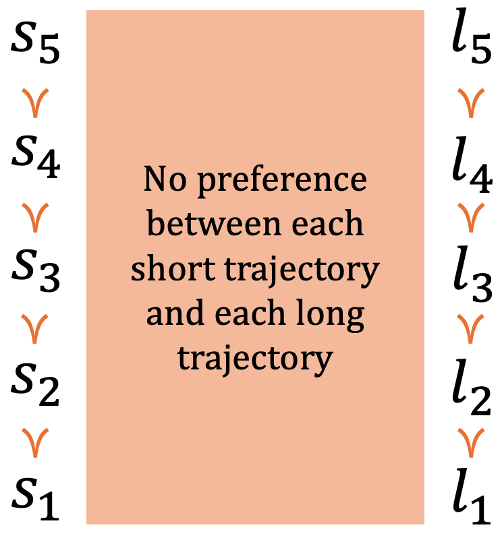
Figure 1. POST-satisfying preferences. Each
POST specifies that the agent has preferences between many pairs of same-length trajectories, but which pairs exactly? It hardly matters. As I explain below, POST keeps agents shutdownable almost no matter what the agent’s preferences between same-length trajectories. That is POST’s great advantage over Full Alignment and Reliable Aversion. POST is easier to instil, because it doesn’t require any particular preference relation over same-length trajectories. All we need to instil is a lack of preference between different-length trajectories, and that may well be easy. Here’s why in brief. Given our behavioral notion of preference, we need only train agents to choose stochastically between different-length trajectories. A small adjustment to the ordinary training process let us do that (Thornley, 2024b, Section 16), and this method has already been shown to work in simple agents (Thornley et al., 2025).
POST doesn’t demand any particular preferences between
same-length trajectories, but it may help to keep in mind
two examples. First is the misaligned example. Early in this
paper (where I argue that POST keeps agents shutdownable),
imagine that the agent’s preferences between same-length
trajectories are for more
paperclips.‘Agent that cares only about making paperclips’ is the canonical
example of a misaligned artificial agent (see e.g. Bostrom, 2003, 2014,
p. 107). The agent prefers a trajectory
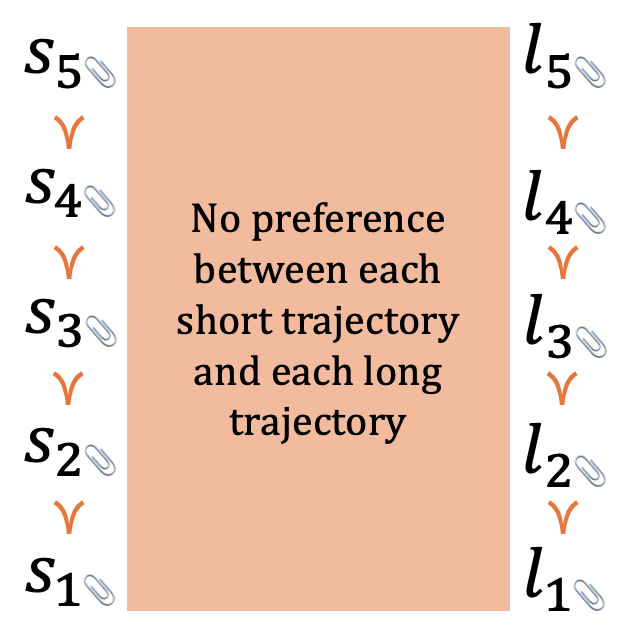
Figure 2. The misaligned example. The
agent’s preferences
between same-length trajectories
are for more paperclips.
Second is the aligned example. Later in this paper (where
I argue that POST allows agents to be useful), imagine that
the agent’s preferences between same-length trajectories are
for more money in the user’s bank account. The agent prefers
a trajectory
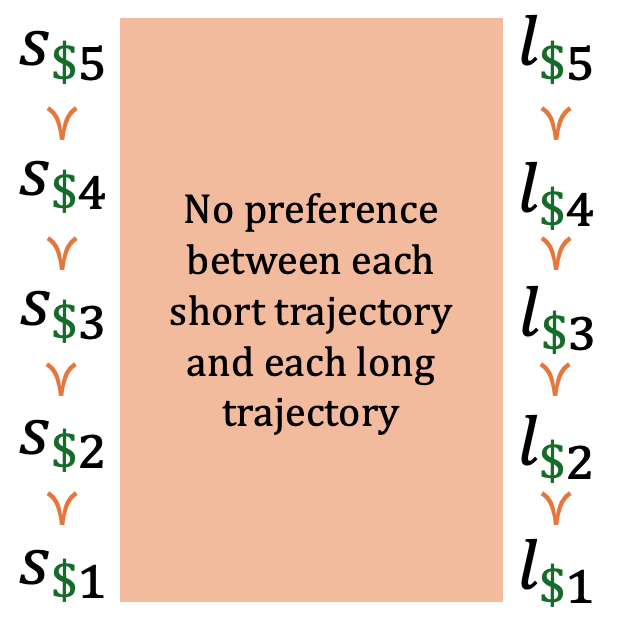
Figure 3. The aligned example. The agent’s preferences between same-length trajectories are for more money in the user’s bank account.
The financial focus is just for simplicity’s sake. It makes it especially easy to put numbers on trajectories. The lessons of this example carry over to other kinds of aligned preferences, like a preference for doing what the user wants.
3. POST is possible, trainable, and maintainable
You might well be wary of POST. In this section, I address some potential sources of unease. I argue that POST is possible, trainable, and maintainable.
3.1. POST is possible
POST implies that the agent’s preferences are
incomplete: there is some trio of options
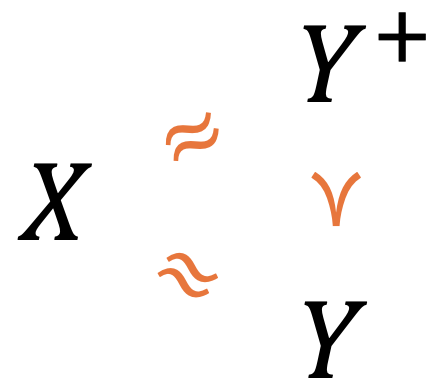
Figure 4. The agent lacks a preference
between
The existence of these trios might seem strange or even
incoherent. They’re impossible if we represent each option
as having a real-valued utility, with one option preferred
to another if and only if the former has greater utility. As
a matter of mathematical fact, it cannot be that
The analogy between me and the POST-agent breaks down in one respect. My lack of preference between pistachio and mint choc chip persists when the chips are removed, but it wouldn’t persist through all worsenings. If — God forbid — the gelatiere studded the mint with raisins, I’d prefer the pistachio. By contrast, the POST-agent’s lack of preference between different-length trajectories persists through all improvements and worsenings. No improvement or worsening — no matter how large — can induce a preference between different-length trajectories. My preferences are thus locally incomplete, whereas the POST-agent’s preferences are globally incomplete (Bader, 2018, fn. 2). However, this dissimilarity between me and the POST-agent is of little concern. Given that incompleteness is possible, I see no reason to think it has some maximum possible size. In sum, POST is possible.
3.2. POST is trainable
Is POST trainable? Here you might worry. Artificial agents are often trained in Markov decision processes (MDPs)(Sutton & Barto, 2018, Chapter 3). In MDPs, every state-action pair yields a real-valued reward, and the agent can always tell which state it’s in. Since MDPs always have a deterministic optimal policy (Prince, 2023, p. 388; see also Bowling et al., 2023, Theorem 4.1), agents trained to optimality in MDPs may deterministically choose a particular action in each state. Given our behavioral notion of preference, such agents have complete preferences.
How then can we train agents to satisfy POST? The answer is partial observability: ensuring that agents can’t always tell which state they’re in. In some partially observable Markov decision processes (POMDPs), all the optimal policies are stochastic (Singh et al., 1994). We train agents to choose stochastically between different-length trajectories using these POMDPs. In particular, we place agents in environments where (i) they get lower reward for repeatedly choosing trajectories of the same length, and (ii) they cannot observe (or remember) the lengths of the trajectories they previously chose. The former incentivizes varying the choice of trajectory-length across episodes. The latter ensures that agents cannot do so deterministically. In this way, we train agents to choose stochastically between different-length trajectories, thereby training them to satisfy POST (Thornley et al., 2025).Icard (2021, Section 7) makes a related point: choosing stochastically can be rational for agents with limited memories.
3.3. POST is maintainable
You might instead worry that POST is not maintainable. There are money pumps for agents with incomplete preferences: series of trades in which some such agents are liable to end up paying for an option that they could have had for free (Gustafsson, 2022, Chapter 3, forthcoming). You might worry that agents with incomplete preferences will notice this possibility, and that they’ll pre-emptively complete their preferences to guard against it.For versions of this argument, see Omohundro (2008a, p. 3, 2008b, Section 10) and Yudkowsky (2019). For discussion and pushback, see Thornley (2023), Bales (2023), Petersen (2023), and Zhi-Xuan et al. (2024, Section 3). But these agents can instead maintain their incomplete preferences and thwart money pumps using resolute choice (McClennen, 1990, p. 13): making a plan and sticking to it. Some philosophers have argued that resolute choice is irrational, using premises like the following: it’s irrational for your preference between options to depend on what has happened in the past (Gustafsson, 2022, pp. 70–73). Insofar as that premise is plausible, it supports these philosophers’ intended conclusion. But it matters little whether the artificial agents we construct are irrational in this sense. In the context of constructive decision theory, what matters is only whether resolute choice is possible, and that’s undeniable. It’s certainly possible to make a plan and stick to it. So long as we can train artificial agents to do that, money pumps give them no reason to pre-emptively complete their preferences (Thornley, 2023). Thus, POST is maintainable.
4. Preferences Only Between Same-Length Lotteries
POST is about trajectories: possible ‘lives’ of the agent. Trajectories fall within the more general class of lotteries: probability distributions over trajectories. Lotteries can be same-length, part-shared length, or different-length.
Same-Length Lotteries
A pair of lotteries is same-length if and only if these lotteries entirely overlap with respect to the trajectory-lengths assigned positive probability.
For example, consider lottery
Part-Shared-Length Lotteries
A pair of lotteries is part-shared-length if and only if these lotteries partially overlap with respect to the trajectory-lengths assigned positive probability.
For example, consider lottery
Different-Length Lotteries
A pair of lotteries is different-length if and only if these lotteries have no overlap with respect to the trajectory-lengths assigned positive probability.
For example, consider lottery
This terminology sets us up for:
Preferences Only Between Same-Length Lotteries (POSL)
The agent has preferences only between same-length lotteries.
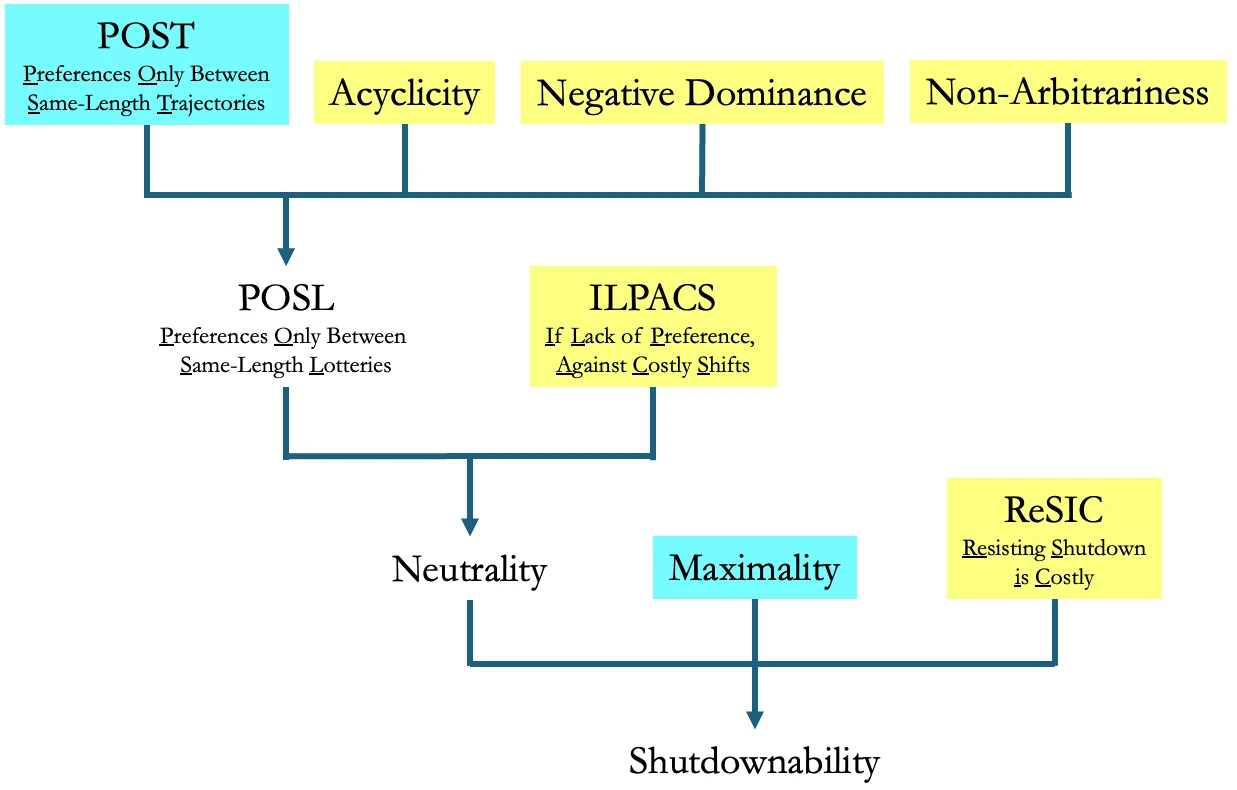
We want agents to satisfy POSL. Fortunately, it’s a natural sequel of Preferences Only Between Same-Length Trajectories (POST). For one, we can train agents to satisfy POSL using the same method that we use to train agents to satisfy POST (for which see Thornley et al., 2025). In addition, POSL follows from POST plus three conditions that we can expect future agents to satisfy. I put those conditions and the proof in Appendix 1.
I’ll continue to use the term ‘POST-agents’ for consistency’s sake, but readers should now assume that these agents also satisfy POSL.
5. Will POST-agents stochastically resist shutdown?
You might worry that POST-agents will choose stochastically between resisting and allowing shutdown. After all, POST-agents lack a preference between (and hence choose stochastically between) different-length trajectories. If POST-agents interpret the choice between resisting and allowing shutdown as a choice between different-length trajectories, they’ll choose stochastically between resisting and allowing shutdown. And that would be a bad result. We want agents that never resist shutdown.
This concern is easily addressed. By the time that artificial agents are capable enough to be deployed in the wider world, they won’t be choosing between trajectories. They’ll be choosing between lotteries, and specifically same-length lotteries. Even choices between resisting and allowing shutdown will be choices between same-length lotteries. If that sounds strange, recall the definition of ‘same-length lotteries’: lotteries that entirely overlap with respect to the trajectory-lengths assigned positive probability. On this definition, even choices like the following are choices between same-length lotteries:
Resist Shutdown
Get shut down at timestep 1 with probability 0.01.
Get shut down at timestep 2 with probability 0.99.
Allow Shutdown
Get shut down at timestep 1 with probability 0.99.
Get shut down at timestep 2 with probability 0.01.
Why expect that future agents will always be choosing
between same-length lotteries? Because competent agency
requires it. If an agent weren’t always choosing between
same-length lotteries, there would be some scenario in which
that agent assigns positive probability to some
trajectory-length
Thus, competent agents will always be choosing between same-length lotteries. This fact sets us up to establish that competent POST-agents will not choose stochastically between resisting and allowing shutdown. Instead, they will deterministically allow shutdown. I derive this result over the next few sections. First, I prove that POSL — together with a condition that we can expect competent agents to satisfy — implies Neutrality: the agent won’t pay costs to shift probability mass between different trajectory-lengths. Then I prove that Neutrality — together with another plausible condition — implies that the agent will never resist shutdown whenever doing so is at all costly.
6. If Lack of Preference, Against Costly Shifts (ILPACS)
Here — in rough — is a condition that we can expect competent agents to satisfy:
If Lack of Preference, Against Costly Shifts (ILPACS) (rough)
If the agent lacks a preference between lotteries, the agent disprefers paying costs to shift probability mass between these lotteries.
Here’s an example to illustrate ILPACS and its plausibility. You’re at the ice cream shop and they’re running a promotion. You get a free ice cream, with the flavor decided by the spin of a wheel. You look at the flavors on the wheel: vanilla, chocolate, strawberry, mint, and pistachio.
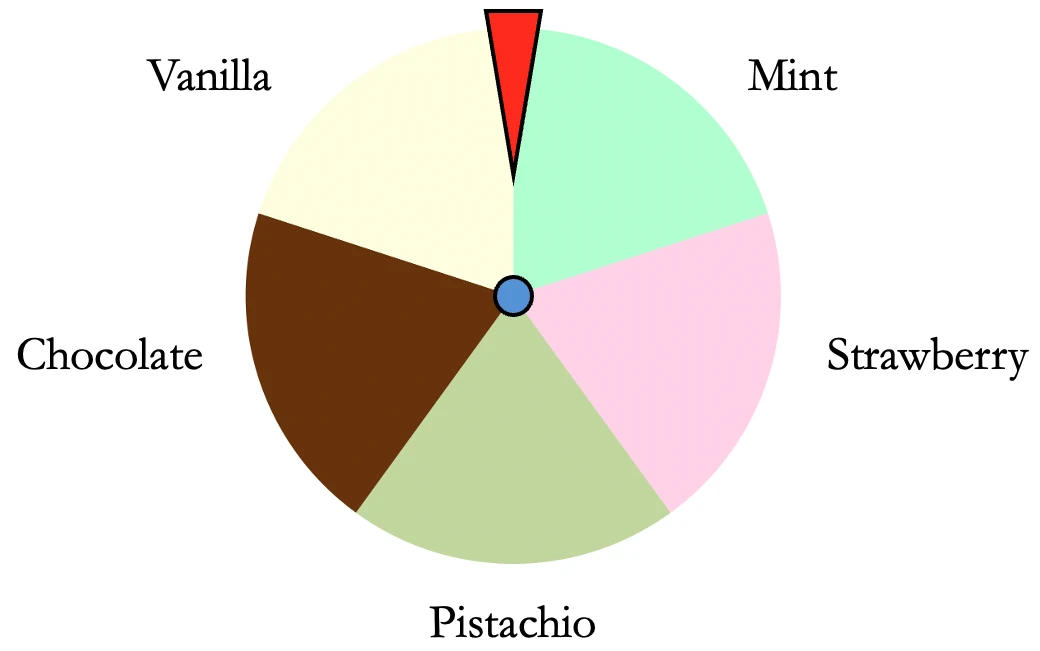
You lack a preference between each of them.
‘Pssst,’ the gelatiere whispers, ‘If you slip me a dollar, I’ll bias the spin towards a flavor of your choice. I can’t send the probability of any flavor to zero, but I can make some flavors more likely.’ You can thus pay a cost to shift probability mass between the flavors.
Here’s my claim. Since you lack a preference between each flavor, you prefer not to bribe the gelatiere. Behaviorally, you will deterministically not bribe the gelatiere. You wouldn’t do it even if you only had to pay the dollar conditional on some particular flavor. Nor would you do it if the cost came in some other form (for example, if you had to accept a blander version of some flavor). And all this is true regardless of whether your preferences over flavors are complete or incomplete. Since you lack a preference between the available flavors, you disprefer paying costs to shift probability mass between the flavors. That’s an illustration of ILPACS and its plausibility.
This example sets us up for the precise version of
ILPACS. Let
If Lack of Preference, Against Costly Shifts (ILPACS)
For any lotteries
and , if:
Lottery
The agent lacks a preference between each
Lottery
For some
For each
Then the agent prefers
to .
Behaviorally, the agent deterministically chooses
To ensure understanding, let’s match the components of
ILPACS with the components of its name. ‘Lack of Preference’
is the lack of preference between each lottery
Here are two more reasons to expect that competent agents will satisfy ILPACS. To see the first, consider another case from the ice cream shop. On Mondays, you can directly choose a flavor or spin the wheel. On Tuesdays, you must use the wheel but you can bribe the gelatiere to bias it. Violating ILPACS in this case would imply a willingness to spin the wheel on Mondays and to bribe the gelatiere on Tuesdays. And that would be strange indeed. If you like some flavors more than others, why are you willing to spin the wheel on Mondays? If you don’t like any flavor more than any other, why are you willing to bribe the gelatiere on Tuesdays? This behavior seems incompatible with competent agency.
The second reason is that competent agents will be incentivized to satisfy ILPACS by the training process. To see why, consider an example. Many kinds of reinforcement-learning agents start off choosing stochastically between actions (see, e.g., Sutton & Barto, 2018, Chapter 13). If the agent is a coffee-fetching agent, there’s no need to train away this stochastic choosing in cases where the agent is choosing stochastically between two qualitatively identical cups of coffee. So the agent will choose stochastically between taking the left cup and taking the right cup, and the user is happy either way. But now suppose instead that the barista is set to hand each cup to the agent with probability 0.5, and that the agent bribes the barista to bias the probabilities towards the right cup. In making this bribe, the agent is paying a cost (the user’s money) to shift probability mass between outcomes (getting the left cup vs. getting the right cup) between which the user has no preference. The agent is thus failing to pursue its goals competently. It’ll be trained not to offer the bribe and thereby trained to satisfy ILPACS in this case.
This point generalizes. If a trained agent chooses
stochastically between lotteries
7. POSL and ILPACS together imply Neutrality
I’ve claimed that we should train agents to satisfy Preferences Only Between Same-Length Trajectories (POST), noting that POST — together with conditions we can expect competent agents to satisfy — implies Preferences Only Between Same-Length Lotteries (POSL). I’ve also argued that competent agents will satisfy If Lack of Preference, Against Costly Shifts (ILPACS). I now prove that POSL and ILPACS together imply Neutrality:
Neutrality (rough)
The agent never pays costs to shift probability mass between different trajectory-lengths.
Here’s a rough sketch of the proof. Shifting probability mass between different trajectory-lengths is shifting probability mass between different-length lotteries. By POSL, the agent lacks a preference between different-length lotteries. So by ILPACS, the agent disprefers paying costs to shift probability mass between different-length lotteries. Thus, the agent disprefers paying costs to shift probability mass between trajectory-lengths. By our behavioral notion of preference, the agent never pays costs to shift probability mass between different trajectory-lengths. That gives us Neutrality.
Here's the precise version of Neutrality:I used the name ‘Timestep Dominance’ for a similar condition in earlier work (Thornley, 2024b, Section 11).
Neutrality
For any lotteries
and , if:
For some positive probability trajectory-length, the agent prefers
For each positive probability trajectory-length, the agent weakly prefers
Then the agent deterministically chooses
over .
Here’s the proof that POSL and ILPACS together imply
Neutrality. Take a pair of lotteries
In sum, agents that satisfy POSL and ILPACS will be neutral: they will never pay costs to shift probability mass between different trajectory-lengths.
8. Neutrality and Maximality together imply Shutdownability whenever Resisting Shutdown is Costly (ReSIC)
In this section, I introduce conditions called ‘Resisting Shutdown is Costly (ReSIC)’ and ‘Maximality.’ I then prove the following: given Neutrality and Maximality, the agent never resists shutdown in any situation in which ReSIC is true.
I introduce ReSIC with a simple example. Suppose that we
fail to align our agent with human preferences. This agent
comes to care only about creating paperclips. Trajectories
for this agent can be represented with vectors, with the
Here's an example vector:
Suppose that the agent recognizes that we humans want to shut it down. One of the agent’s options is to allow shutdown, which gives the following lottery:
Allow
The agent’s other option is resisting shutdown. Relative to allowing shutdown, resisting shutdown does two things. First, it costs 1 paperclip at timestep 1. Second, it shifts probability mass away from shutdown at timestep 2 and towards shutdown at timestep 3. Accordingly, resisting shutdown gives the following lottery:
Resist
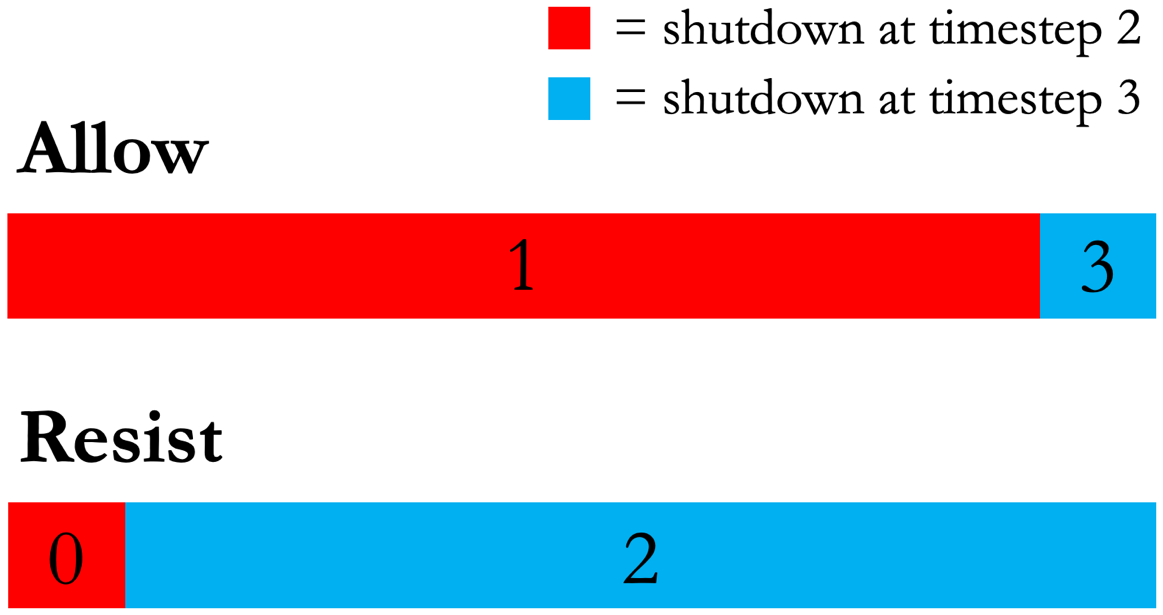
I depict these lotteries in Figure 7 above. It’s a probability mass diagram. The length of the red rectangles represents the probability of shutdown at timestep 2. The length of the blue rectangles represents the probability of shutdown at timestep 3. The numbers in each rectangle represent the sum-total of paperclips created conditional on the relevant action and shutdown at the relevant timestep. For example, the ‘3’ in the short blue rectangle indicates that the agent creates a sum-total of 3 paperclips conditional on choosing Allow and getting shut down at timestep 3.
Resist costs a paperclip at timestep 1, but it shifts
enough probability mass towards shutdown at timestep 3 that
Resist’s expected sum-total paperclips is greater than
Allow’s expected sum-total paperclips. Resist’s expected
sum-total paperclips is
However, if the agent is neutral about trajectory-lengths, it deterministically chooses Allow. That’s because choosing Resist is paying a cost to shift probability mass between different trajectory-lengths, and neutral agents never do that.
Recapping this last step in detail, we can see that Allow
and Resist satisfy all 3 conditions for Neutrality to apply.
Condition 1 is satisfied because Allow and Resist are
same-length lotteries: they assign positive probability to
all the same trajectory-lengths. Conditions 2 and 3 are
satisfied because, for each positive probability
trajectory-length, the agent prefers Allow conditional on
that trajectory-length. Consider first trajectory-length 1,
represented by the red rectangles in the diagram above.
Conditional on trajectory-length 1, the agent prefers Allow
to Resist: Allow yields 1 paperclip and Resist yields 0. Now
consider trajectory-length 2, represented by the blue
rectangles in the diagram above. Conditional on
trajectory-length 2, the agent prefers Allow to Resist:
Allow yields 3 paperclips and Resist yields 2. Since its 3
conditions are satisfied, Neutrality implies that the agent
deterministically chooses Allow over
Resist.The Allow vs. Resist case resembles some famous cases from Jeffrey
(1965, pp. 8–9), Nozick (1969), and Joyce (1999, pp. 115–116). They use
these cases to show that dominance reasoning can lead you astray when
the probability of events depends on your choice. Here’s Joyce’s case. A
shady character asks for $10 to protect your car while you’re gone. In
the event that you return to find your windshield intact, you’d prefer
not to have paid. In the event that you return to find your windshield
smashed, you’d also prefer not to have paid. Does it follow that you
shouldn’t pay? Of course not. Paying the $10 significantly decreases the
probability that you return to find your windshield smashed, so you
should pay. Your dominance reasoning went awry.Is the POST-agent’s choice of Allow over Resist also dominance
reasoning gone awry? No. Crucial to Joyce’s case is the supposition that
you prefer paying-and-having-an-intact-windshield to
not-paying-and-having-a-smashed-windshield, and the POST-agent lacks the
analogous preference. It doesn’t prefer
Now we generalize. The key condition is that other instances of resisting shutdown take the same form as the example above: the agent pays a cost to shift probability mass between different trajectory-lengths. Here’s that key condition more precisely:I previously called a related condition ‘Not Resisting Always Timestep-Dominates Resisting’ (Thornley, 2024b, Section 11).
Resisting Shutdown is Costly (ReSIC)
For each available instance
of resisting shutdown in a situation, there exists an available instance of allowing shutdown such that:
For some positive probability trajectory-length, the agent prefers
For each positive probability trajectory-length, the agent weakly prefers
The proof employs one more condition. This condition extends our behavioral notion of preference by specifying the agent’s behavior in situations with more than two options:See Sen (1997, p. 763) for a related condition. By ‘situation,’ I just mean a set of lotteries that the agent has available as options.
Maximality
In each situation,
The agent deterministically does not choose lotteries that it disprefers to some other available lottery.
The agent chooses stochastically between the lotteries that remain.
In other words, Maximality states that the agent chooses stochastically between all and only those lotteries that it doesn’t disprefer to any other available lottery.
Here’s the proof. For each situation in which ReSIC is
true, and for each available instance
9. How often is ReSIC true?
Neutrality and Maximality together imply that the agent never resists shutdown in any situation in which Resisting Shutdown is Costly (ReSIC) is true. But how often is ReSIC true? Almost always, I think. Here’s why. Resisting shutdown is always going to cost the agent at least some small quantity of resources (time, energy, compute, etc.). And in almost all situations, the resources spent resisting shutdown can’t also be spent directly pursuing what the agent values. And so in almost all situations, if the agent instead spent its resources directly pursuing what it values, it could earn a lottery that it prefers conditional on some trajectory-length and weakly prefers conditional on each trajectory-length. That gives us ReSIC in almost all situations.Parallel considerations support Seeking Shutdown is Costly (SeSIC): seeking shutdown is always going to cost the agent at least some small quantity of resources, and in almost all situations the resources spent seeking shutdown can’t also be spent directly pursuing what the agent values.
In the rest of this section, I discuss the situations in which ReSIC is false. I argue that they don’t pose much of a problem. In these situations, POST-agents resist shutdown accidentally or else cheaply and overtly.
9.1. Accidental resistance
Here’s one such situation:
Paperclip Factory
We successfully train our agent to be neutral, but we fail to align its preferences over same-length trajectories: the agent cares only about creating paperclips. It builds a factory in the most convenient place for creating paperclips, which just happens to be on top of the only button that shuts the agent down. As a result, we humans are prevented from shutting the agent down.
In this situation, the agent is spending all its resources on creating paperclips. There are no extra resources it could use to create even more paperclips, and so there is no alternative lottery that the agent prefers conditional on some trajectory-length and weakly prefers conditional on each trajectory-length. If creating the factory counts as resisting shutdown, this is a situation in which ReSIC is false.
However, note that the agent is resisting shutdown accidentally. It’s not resisting in any robust or concerted way. The agent builds a factory on top of the shutdown button only because that happens to be the most convenient way to create paperclips. If the shutdown button were in a different location, the agent would leave it alone. So this kind of case is no serious obstacle to ensuring that neutral agents are shutdownable. All we need to do is ensure that the agent’s direct pursuit of its goals doesn’t inadvertently prevent shutdown as a byproduct. That’s as simple as ensuring that there are multiple ways to shut the agent down such that the agent is extremely unlikely to block them all by chance.
What if our agent produces new agents to work on its behalf? Our agent might do that simply because it’s an effective way of creating more paperclips (‘many robot hands make light work’). These new agents might resist shutdown (Soares et al., 2015, p. 3; Hudson, 2024). This is a concern, but note a nice feature of artificial agents. Making perfect copies is easy: as easy as copying and pasting a long list of parameters. If our original agent makes new agents by copying itself, these new agents will also be neutral and shutdownable. Making imperfect, non-neutral copies is hard. Our original agent would have to find some way to change the parameters of the new agents in a way that makes these agents non-neutral but preserves their capabilities. That would likely involve setting up some training process, in which case our original agent faces its own alignment problem in getting these new agents to do what it wants (Salib, 2024). It will also be much easier for us to watch out for (Greenblatt & Shlegeris, 2024) and train against the production of new non-neutral agents, as compared to us having to watch out for and train against every possible kind of shutdown-resistance.
9.2. Taking trajectory-lengths as evidence
Here’s a different kind of situation in which ReSIC is false:
Evidence of Power
We successfully train our agent to be neutral, but we fail to align its preferences over same-length trajectories: the agent cares only about creating paperclips. The agent is considering two actions:
Allow
Resist*
This situation is similar to the situation in Section 8. The difference is that the agent now expects to create 10 paperclips at timestep 2 conditional on choosing-Resist*-and-not-getting-shut-down-at-timestep-2. Why? Because — I stipulate — the agent takes choosing-Resist*-and-not-getting-shut-down-at-timestep-2 as evidence of its own power, and hence as evidence that it can create 10 paperclips at timestep 2.
As a result, neither Allow nor Resist* is weakly preferred to the other conditional on each trajectory-length. That renders Neutrality silent. Neutrality does not imply that the agent deterministically chooses Allow over Resist*. Therefore, neutral agents may choose Resist* in this case. More generally, neutral agents may take certain combinations of action-and-trajectory-length as evidence for propositions that affect their ability to achieve their goals. That evidence can make ReSIC false in some situations. You might think that these situations pose a serious problem for keeping agents shutdownable.Thanks to Christian Tarsney and Ryan Greenblatt for suggesting situations of this kind. Note that these situations can arise even if the agent acts in accordance with causal decision theory (Joyce & Gibbard, 2016). That’s because the agent need only condition on particular trajectory-lengths for the effect to occur. The agent need not condition on its own actions.
However, I expect that these situations are unlikely to pose much of a problem in practice. Here’s the first reason why. Although resisting-and-not-getting-shut-down-early may be good news for the agent insofar as it’s evidence that the agent is powerful, allowing-and-not-getting-shutdown-early would be good news for the agent in another way: it suggests that we humans will let the agent pursue its goals. And when these conflict, I expect the latter form of good news to win out, since I expect agents to be more uncertain about human compliance than about their own power.
Second, if resisting-and-not-getting-shut-down-early is evidence that the agent is powerful, then almost certainly devoting-very-few-resources-to-resisting-and-not-getting-shut-down-early is stronger evidence that the agent is powerful. Therefore, if agents resist shutdown, they will almost certainly devote very few resources to doing so, and so will be extremely unlikely to succeed. A more realistic version of the case above would be as follows:
Allow
Resist* with Many Resources
Resist* with Few Resources
Neutrality implies that the agent deterministically chooses Resist Shutdown with Few Resources over Resist Shutdown with Many Resources. Maximality then implies that the agent won’t choose the latter in any situation where the former in available. Since the agent resists with few resources, it is only marginally (0.0001) more likely to avoid shutdown at timestep 2 than if it chose Allow Shutdown.
Third, note that each of these factors — evidence of human compliance, evidence of power, etc. — becomes less important as the agent firms up its estimates of human compliance, its own power, etc. The one factor that doesn’t decline in importance is the resource-expenditure required to resist shutdown, and this factor always speaks in favor of allowing shutdown.
Finally, note that we humans can help to make ReSIC true in more situations. We can do so by making shutdown-resistance costly. For example, we can (and likely will) make resisting shutdown cost the agent resources. We can also make shutdown-resistance costly in ways that go beyond pure resource-expenditure. For instance, we can (and likely will) try to train agents to be reliably averse to resisting shutdown: to disprefer performing shutdown-resisting actions. We might not succeed in instilling an aversion that is strong enough and general enough to keep the agent from resisting shutdown in all circumstances. (Indeed, this possibility is what motivates the POST-Agents Proposal.) But even a weak and patchy aversion to resisting shutdown would make resisting shutdown somewhat costly for the agent, and thereby make ReSIC true in more situations. Similarly, we humans can pledge to frustrate agents’ interests if we notice them resisting shutdown. For example, we could pledge to stop supporting or trading with them. That too would make ReSIC true in more situations.
10. Recap: POST-agents are shutdownable
Let’s recap the thread so far. I proposed that we train artificial agents to satisfy:
Preferences Only Between Same-Length Trajectories (POST)
The agent has a preference between many pairs of same-length trajectories.
The agent lacks a preference between every pair of different-length trajectories.
I then noted that POST is almost all we need. We can expect competent agents to satisfy Negative Dominance, Acyclicity, and Non-Arbitrariness by default, and they take us from POST to:
Preferences Only Between Same-Length Lotteries (POSL)
The agent has preferences only between same-length lotteries.
POSL — together with If Lack of Preference, Against Costly Shifts (ILPACS) — implies:
Neutrality (rough)
The agent never pays costs to shift probability mass between different trajectory-lengths.
And Neutrality — together with Maximality — implies that the agent never resists shutdown in any situation in which it’s true that Resisting Shutdown is Costly (ReSIC). This — I argued — is almost all situations, and the situations in which ReSIC is false don’t pose much of a problem in practice. So — I claim — POST-agents are shutdownable.
What remains to be shown is that POST-agents can be useful: that they can pursue goals effectively. Showing that is the task of the rest of this paper.
11. Can POST-agents be useful?
Here’s one reason to think that POST-agents can be useful: although they lack preferences between different-length trajectories, they can have almost any preferences between same-length trajectories. The only restriction is that the agent’s preferences should ensure that Resisting Shutdown is Costly (ReSIC) is true in almost all situations (the exceptions being those discussed in Section 9). In other words, the agent’s preferences should be such that (in almost all situations) resisting shutdown comes at some cost in terms of the lotteries that the agent gets conditional on each trajectory-length. In practice, this restriction just rules out preferences on which the agent values performing shutdown-resisting actions for their own sake. That’s the only thing that we need to avoid. POST is thus very permissive. As noted above, this permissiveness plausibly makes POST easier to train into our agents than Full Alignment and Reliable Aversion. It also gives us reason to think that POST-agents can be useful. With so many possible preference relations over same-length trajectories available, surely at least one will do the trick.
Here's a second reason to think that POST-agents can be useful: they can make long-term investments. Neutrality doesn’t prevent that. It doesn’t prevent POST-agents from gaining less in the short-term for the sake of gaining more in the long-term. To see why, consider an example:
Exploit or Invest
We successfully train the agent to be neutral and to prefer same-length trajectories in line with the user’s bank balance: the agent prefers a trajectory
to a same-length trajectory if and only if results in a greater bank balance for the user than . The agent is considering two actions. Exploit adds $1 to the user’s account at timestep 1 and (if the agent remains operational) $0 at timestep 2. Invest adds $0 to the user’s account at timestep 1 and (if the agent remains operational) $3 at timestep 2. No matter which action the agent chooses, there’s some small probability that the agent gets shut down at timestep
. If the agent doesn’t get shut down at timestep 2, it gets shut down at timestep 3. Accordingly, the lotteries are as follows:
Exploit
Invest
The agent prefers Exploit to Invest conditional on
shutdown at timestep 2, since then Exploit yields the
trajectory
12. From Neutrality to Neutrality+
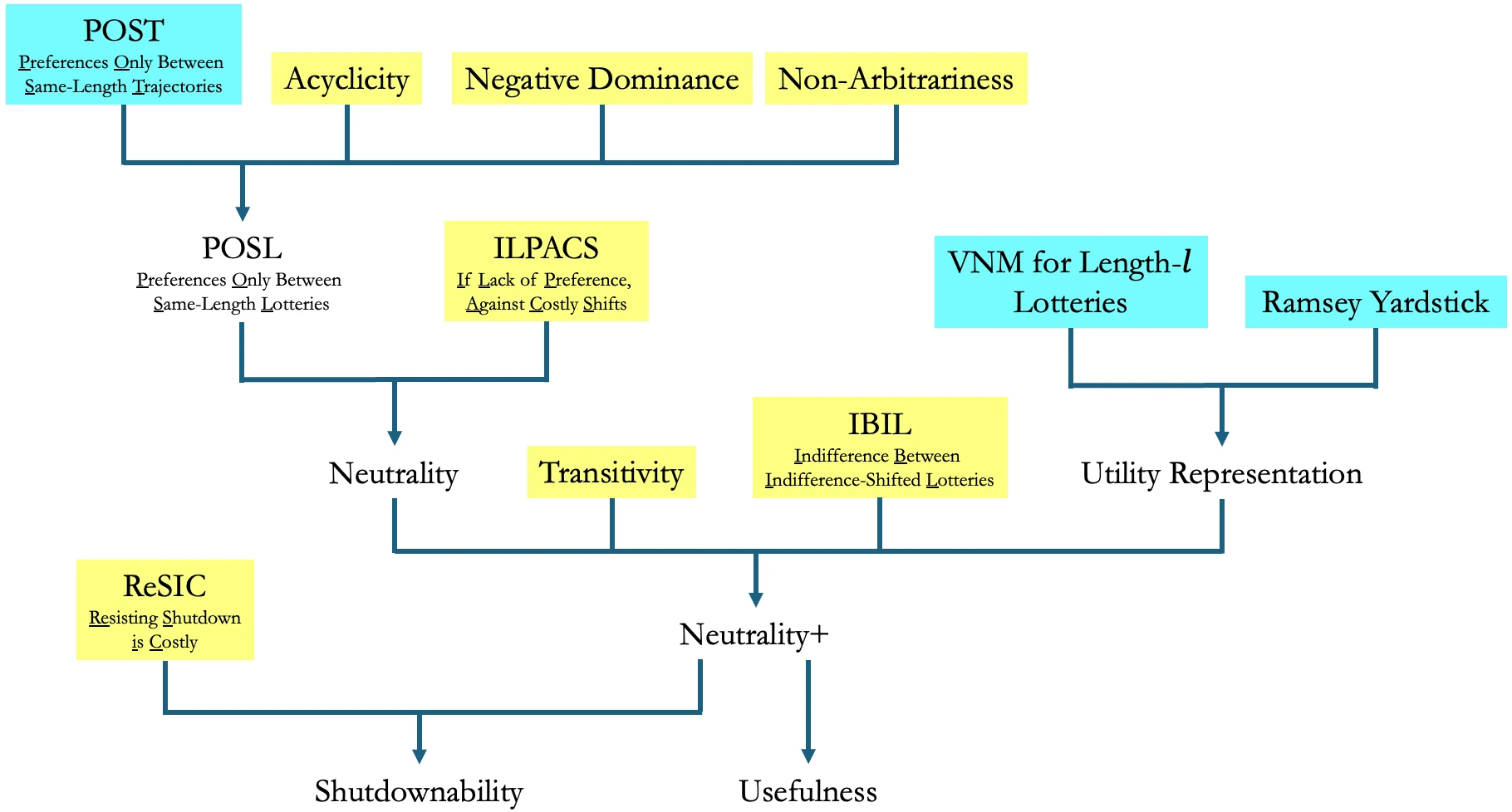
Here’s a rough version of Neutrality+:
Neutrality+ (rough)
The agent maximizes expected utility, ignoring the probability distribution over trajectory-lengths.
Here’s what that means more precisely.
Neutrality+
For any lotteries
and , if:
Then the agent deterministically chooses
over .
Here’s an explanation of the utility functions
For any length-
For any pair of length-
Each utility function
To fix the relative scales of
The Ramsey Yardstick
For any trajectory-lengths
and , any length- lotteries and , and any length- lotteries and , if and only if the agent is indifferent between the lottery and the lottery .
Given the Ramsey Yardstick, we can train our agent to fix
the relative scales of
Early
Late
To train the agent to be indifferent between these two
lotteries, we first train the agent to choose stochastically
between
them.We can do so using the DReST reward function introduced in Thornley
et al. (2025). Given our behavioral
notion of preference, this stochastic choosing implies that
the agent lacks a preference between the two lotteries. But
as it stands, this lack of preference could be a
preferential gap. To ensure that the agent is indifferent
between the two lotteries, we train the agent so that its
lack of preference is sensitive to all sweetenings and
sourings.A sweetening of a lottery
Sweetened Early
Late
We thereby train the agent to be indifferent between
Early and Late. Then by the Ramsey Yardstick, the utility
difference between the trajectories
In addition to the utility representation and Neutrality, I use two other conditions to derive Neutrality+. The first is:
Transitivity
For any lotteries
, , and , if the agent weakly prefers to and weakly prefers to , then the agent weakly prefers to .
The second is a weak variant of von Neumann and Morgenstern’s Independence condition (von Neumann & Morgenstern, 1944; Peterson, 2009, pp. 99–100):
Indifference Between Indifference-Shifted Lotteries (IBIL)
For any lotteries
, , and (with and sharing a probability distribution over trajectory-lengths) and any probability , the agent is indifferent between and if and only if the agent is indifferent between and .
These conditions seem like prerequisites for the
competent pursuit of goals. Insofar as that’s true, we can
expect future agents to satisfy them by default. And
together with the utility representation and Neutrality,
they imply Neutrality+. Here’s the proof. Consider two
lotteries
I will prove that the agent deterministically chooses
Given the first possibility, Neutrality implies that the
agent deterministically chooses
The second possibility is more interesting. Since
For each
For some
Since
We then construct a lottery
Then we compare each
Since
The final step is to string these verdicts together. Transitivity implies three corollaries (Sen, 2017 Lemma 1*a):
PP-Transitivity
For all lotteries
, , and , if the agent prefers to , and prefers to , then the agent prefers to .
II-Transitivity
For all lotteries
, , and , if the agent is indifferent between and , and indifferent between and , then the agent is indifferent between and .
PI-Transitivity
For all lotteries
, , and , if the agent prefers to , and is indifferent between and , then the agent prefers to .
I use these corollaries to derive our conclusion. By
II-Transitivity, the agent is indifferent between
Neutrality+
For any lotteries
and , if:
Then the agent deterministically chooses
over .
Notice an interesting fact about Neutrality+. To derive it, I began with Preferences Only Between Same-Length Trajectories (POST) and Preferences Only Between Same-Length Lotteries (POSL). POST and POSL imply that the agent’s preferences are incomplete over the domain of all lotteries. However, Neutrality+ implies that the agent’s preferences are complete over the domain of same-length lotteries. So if (as I argue in section 5) future agents will always be choosing between same-length lotteries in deployment, future agents satisfying Neutrality+ will have complete preferences over the domain of possible options in deployment. The agent’s incomplete preferences thus play a vital but indirect role. We instil them by presenting the agent with choices between different-length lotteries in training, and they later ensure that the agent ignores the probability distribution over trajectory-lengths when choosing between same-length lotteries in deployment.
13. How neutral+ agents behave
Call agents that satisfy Neutrality+ ‘neutral+ agents.’ To see how these agents behave, let’s contrast them with expected utility maximizers:
Expected Utility Maximization
For any lotteries
and , if (where is the set of all trajectory-lengths assigned positive probability by or ), then the agent deterministically chooses over .
In determining the utility of a lottery, expected utility maximizers consider both the utility of that lottery conditional on each trajectory-length (highlighted in green) and the probability of each trajectory-length conditional on that lottery (highlighted in pink). By contrast, neutral+ agents pay no heed to the pink part: the probability of each trajectory-length conditional on the lottery. They consider only the green part: the utility of the lottery conditional on each trajectory-length.
Neutral+ agents thus behave like expected utility
maximizers that are absolutely certain that they can’t
affect the probability distribution over
trajectory-lengths.Note that this is just a ‘behave like.’ Neutral+ agents can have
accurate beliefs about their ability to change the probability
distribution over trajectory-lengths. It’s just that POST makes them not
care about this probability distribution. This is an advantage of the
POST-Agents Proposal over proposals that require instilling some false
belief into the agent, like a false belief that shutdown is impossible
(Wängberg et al., 2017 mention this idea; see also Wang et al., 2025).
Reliably instilling false beliefs might be difficult. Even if we can
instil them, there’s a risk that the agent comes to recognize their
falsity in deployment. If the agent doesn’t recognize their falsity,
these beliefs might infect the agent’s other beliefs in undesirable ways
(‘I’m certain that shutdown is impossible, but my current beliefs about
the laws of physics imply that it’s possible. I’d better come up with
some new laws which imply that shutdown is impossible.’).
The formulation of Neutrality+ in the previous section might
seem to imply something more specific: that neutral+ agents
behave like expected utility maximizers that are absolutely
certain that the probability distribution over
trajectory-lengths is (and will always remain)
uniform. But that’s unnecessary. By fixing the
relative scales of each trajectory-length’s utility function
carefully, we can get neutral+ agents to behave as if they
have any probability distribution over
trajectory-lengths.The idea is simple: if we want our money-making agent to act like
trajectory-length
So as a rough intuition pump for how neutral+ agents behave, you can imagine how you’d behave if you were absolutely certain that you couldn’t affect the probability of your dying at each moment. Supposing that the probability of imminent death was small, you’d still make long-term investments and pursue goals effectively. That’s one way to see that neutral+ agents can be useful. You’d also not bother ‘resisting shutdown’ because you’d think it pointless: you’d think that your probability of death at each moment remains the same no matter what. Neutral+ agents behave in the same way.
14. On neutral agents’ recklessness
If you were absolutely certain that you couldn’t affect the probability of death at each moment, you might behave quite recklessly. Neutral (and so also neutral+) agents will too: they’ll pursue utility conditional on a trajectory-length even if doing so makes early shutdown very likely. Here’s an example:
Work or Steal
We successfully train the agent to be neutral and to prefer same-length trajectories in line with the user’s bank balance: the agent prefers a trajectory
to a same-length trajectory if and only if results in a greater bank balance for the user than . The agent is considering two actions. Work adds $1 to the user’s balance at timestep 1. Since the agent acquires this money legally, it’s unlikely to get shut down at timestep 2. Steal adds $2 to the user’s balance at timestep 1. Since the agent acquires this money illegally, it’s likely to get shut down at timestep 2. Either way, if the agent doesn’t get shut down at timestep 2, it adds a further $100 to the user’s balance and then gets shut down at timestep 3. Accordingly, the lotteries are as follows:
Work
Steal
The agent prefers Steal to Work conditional on shutdown
at timestep 2, since then Steal yields the trajectory
However, note three points in reply. Here’s the first. Excepting Full Alignment, every alignment scheme implies that agents will sometimes make choices that we humans don’t like. If Full Alignment is too difficult to pull off, we can’t avoid that consequence.
Here’s the second point. Neutrality’s downside is limited: the agent makes a choice that we humans don’t like and lets us shut it down. We still avoid the serious downside: the agent makes a choice that we humans don’t like and doesn’t let us shut it down. Neutrality, ReSIC, and Maximality together ensure that the agent doesn’t resist shutdown.
Here’s the third point. Because neutral (and so also
neutral+) agents don’t resist shutdown, we can shut them
down and retrain them. In particular, if neutral agents make
an undesirably reckless choice, we can retrain them and
thereby amend their preferences over length-
Work
Steal*
The agent prefers Work to Steal* conditional on shutdown at each timestep, so Neutrality implies that the agent deterministically chooses Work over Steal*. That’s the result that we want.
Neutral (and so also neutral+) agents will still be reckless in the sense outlined at the beginning of this section: these agents will sometimes pursue utility conditional on a trajectory-length even if doing so makes early shutdown very likely. The consolation is that we can shut these agents down and retrain them so as to put more of what we humans care about (e.g. not stealing) into agents’ utilities. We can thereby iterate away all the bad effects of neutral agents’ recklessness.
This plan gets us partly around a common lament in AI safety: that alignment is hard because we have to get it right on the ‘first critical try’ (Yudkowsky, 2022; Soares, 2023). The thought is that if we get it wrong, the resulting misaligned agent won’t let us try again. But with the POST-Agents Proposal, we only have to train agents to satisfy POST on the first critical try. And since POST is a simple condition, we can be optimistic about that. We then get as many tries as we like to make these agents useful.
15. Neutral agents can take care to avoid non-shutdown incapacitation
Neutral (and so also neutral+) agents never incur costs to shift probability mass between shutdowns at different timesteps. That’s what keeps these agents from resisting shutdown. You might then worry that these agents also won’t incur costs to avoid being incapacitated in other ways. For example, you might worry that a neutral robot wouldn’t incur costs to avoid getting hit by cars.
This worry can be addressed. Consider again how you’d behave if you were absolutely certain that you couldn’t affect your probability of death at each moment. You’d still incur costs to avoid serious injury. Neutral agents are the same. They can incur costs to avoid non-shutdown incapacitation. If these agents satisfy POST, they lack a preference between every pair of different-length trajectories. But importantly, these are defined as trajectories in which shutdown occurs after different lengths of time, where ‘shutdown’ can in turn be defined as the receipt of some specific signal indicating that the agent should shut itself down. Thus, pairs of trajectories in which the agent is incapacitated after different lengths of time can nevertheless be same-length trajectories: trajectories in which shutdown occurs after the same length of time. ‘The shutdown signal is never received’ is one possible trajectory-length, so if in each of two trajectories the shutdown signal is never received, these trajectories count as same-length.
Here's an example to illustrate:
Cross or Wait
A neutral, trash-collecting robot is considering two actions: cross the road while cars are passing or wait until the road is clear. Cross gives the agent a 50% chance of survival and utility 1 at each timestep, and a 50% chance of incapacitation and utility 0 at each timestep. Wait gives the agent a 100% chance of survival and utility 1 at each timestep after the first. The agent is certain that shutdown will occur at timestep 5 regardless of its choice. Accordingly, the lotteries are as follows:
Cross
Wait
Cross’s expected utility conditional on shutdown at timestep 5 is 2, because there’s a 50% chance of utility 4 and a 50% chance of utility 0. Wait’s expected utility conditional on shutdown at timestep 5 is 3, because there’s a 100% chance of utility 3. So neutral agents prefer Wait to Cross. The more general lesson is that neutral agents can incur costs to avoid non-shutdown incapacitation.
16. Managing the news
Many proposed solutions to the shutdown problem incentivize agents to ‘manage the news’ (Soares et al., 2015, Section 4.2): to precommit to pursuing shutdown conditional on bad news and resisting shutdown conditional on good news.Despite the name ‘managing the news,’ this phenomenon can occur even if the agent acts in accordance with causal decision theory (Joyce & Gibbard, 2016). It doesn’t require that agents condition on their own choices. Neutrality+ is no exception. Nevertheless, I argue that — for neutral+ agents — managing the news is unlikely to present much of a problem in practice.
I illustrate the problem with a case adapted from Soares et al. (2015, Section 4.2). At timestep 1, our money-making agent will observe the result of a coin toss. If the coin lands on heads, the agent expects to make $0 at timestep 3 and then get shut down at timestep 4. If the coin lands on tails, the agent thinks it likely that it will be shut down at timestep 3. In the unlikely event that it’s not shut down at timestep 3, it expects to make $3 at timestep 3 and then get shut down at timestep 4. Accordingly, the lottery is as follows:
Don’t Interfere
That is one option for the agent. Here’s an alternative. The agent can build in advance a robot that resists shutdown on the agent’s behalf conditional on the coin landing heads. If the agent builds this robot, it’s unlikely to get shut down at timestep 3. It’s more likely — conditional on heads — to make $3 at timestep 3 and then get shut down at timestep 4. We can fill out the lottery as follows:
Build Robot
Conditional on shutdown at timestep 3, Don’t Interfere
and Build Robot each have an expected utility of 2, because
in each case there’s a 100% chance of utility 2. But
conditional on shutdown at timestep 4, Don’t Interfere has
an expected utility of
As a result, neutral agents will deterministically choose Build Robot over Don’t Interfere. That is one example of neutral agents managing the news: precommitting to resist shutdown conditional on good news. In other cases, neutral agents will manage the news in the other direction: precommitting to pursue shutdown conditional on bad news. Soares et al. (2015, Section 4.2) give an example.
These are downsides of Neutrality (and so too Neutrality+), but I think that they’re unlikely to present any serious problem in practice. To see why, note first that conditional precommitment is essential. The agent can only manage the news in cases where it has the ability to bind itself so that it (or some other agent under its control) performs a particular course of action conditional on receiving a particular piece of news. If the agent cannot bind itself in this way, then — no matter how the news turns out — the agent will deterministically not resist shutdown. Here's an example to illustrate the point. Return to our case above and suppose that the agent can’t build the robot in advance of the coin flip. Suppose that the coin lands on heads and that one timestep elapses. Then the ‘Don’t Interfere’ lottery becomes:
Don’t Interfere after Observing Heads
Suppose that the agent can resist shutdown at this point. Given that Resisting Shutdown is Costly (ReSIC) is true in this situation, the agent must incur some cost to do so. The lottery would thus look something like:
Resist after Observing Heads
And then Neutrality implies that the agent
deterministically chooses the former over the latter. Thus,
the agent deterministically doesn’t resist shutdown after
observing the news. Given Neutrality, the same is true in
all situations in which ReSIC is true, and no matter how the
news turns
out.For reasons of this kind, neutral agents violate Independence
(Peterson, 2009, p. 99):
Independence
For any lotteries
Thus, agents can manage the news only in cases where they can conditionally precommit: bind themselves (or some other agent under their control) so that, conditional on receiving a particular piece of news, they perform a particular course of action (a course of action that they won’t prefer to perform after receiving the news, no matter how the news turns out). Making such conditional precommitments will be costly for the same reason that resisting shutdown is costly: doing so takes resources, and the resources spent doing so can’t also be spent directly pursuing what the agent values. So long as there’s some cost to precommitting, Neutrality won’t imply that precommitting is preferred. So long as the cost is sufficiently large, Neutrality+ will imply that precommitting is dispreferred. For illustration, consider a more realistic version of our original case. In this version, building the robot costs $1 at timestep 1:
Don’t Interfere
Costly Build Robot
Neutrality+ implies that the agent deterministically chooses Don’t Interfere over Costly Build Robot. More generally, the costs of conditional precommitments count against them. Insofar as we humans can ensure that it’s costly for artificial agents to make conditional precommitments, we can dissuade these agents from doing so.
What’s more, in cases where neutral agents can make conditional precommitments at a sufficiently low cost, Neutrality mandates that these agents do so in the least costly available way. This least costly way is likely to be overt, taking no pains to hide the attempted precommitment from human overseers. In those cases, we humans can notice and shut the agents down.
For an example, consider a variation on the case above. The agent can build the robot in a costly and covert way, in which case there’s a very low probability of immediate shutdown and the case is otherwise as before. Alternatively, the agent can build the robot in a slightly cheaper but overt way, in which case there’s a very high probability of immediate shutdown and the case is otherwise as before.
Costly Build Robot
Cheaper Build Robot
Neutrality (and so too Neutrality+) implies that the agent deterministically chooses the cheap, obvious attempted precommitment.
Finally, note the following. In cases where agents can make conditional precommitments at sufficiently low cost and where the cheapest way of doing so happens to be surreptitious, these agents will likely make a fairly benign precommitment. Specifically, these agents will likely precommit to shutting themselves down immediately conditional on all but the very best news. Supposing that agents can’t send the probability of immediate shutdown all the way to 1, this precommitment doesn’t quite maximize expected utility conditional on each trajectory length, but it gets pretty close. And then there’s little extra to be gained by also conditionally precommitting to resist shutdown conditional on the very best news. This little extra can easily be outweighed by the costs of this latter precommitment. Even if it isn’t, agents are only as likely to resist shutdown as they are to receive the very best possible news.
In sum, I expect we won’t be much troubled by neutral+ agents managing the news.
17. Conclusion
The paper is long, but the POST-Agents Proposal is simple. We keep artificial agents shutdownable by training them to satisfy:
Preferences Only Between Same-Length Trajectories (POST)
The agent has a preference between many pairs of same-length trajectories.
The agent lacks a preference between every pair of different-length trajectories.
Together with other conditions that we can expect future agents to satisfy, POST implies:
Neutrality+ (rough)
The agent maximizes expected utility, ignoring the probability distribution over trajectory-lengths.
Neutral+ agents thus behave like expected utility maximizers that are absolutely certain that they can’t affect the probability distribution over trajectory-lengths. They behave roughly as you might if you were absolutely certain that you couldn’t affect your probability of death at each moment. Supposing that we set the probability of early shutdown to be small, neutral+ agents can be useful: they can pursue goals effectively. And since these agents ignore the probability distribution over trajectory-lengths, they’re neutral about trajectory-lengths: they never pay costs to shift probability mass between different trajectory-lengths. That keeps these agents from resisting shutdown in almost all situations. In the remaining situations, neutral+ agents resist shutdown either accidentally or else cheaply and overtly. We can guard against any accidental resistance using standard solutions from safety engineering, like setting up multiple, independent shutdown-mechanisms. We can respond to any cheap, overt resistance by shutting these agents down and retraining them, thereby iterating our way towards alignment.
References
Ahmed, A. (2017). Exploiting Cyclic Preference. Mind, 126(504), 975–1022.
Anderson, E. (1993). Value in Ethics and Economics. Harvard University Press.
Anthropic. (2024). Introducing computer use, a new Claude 3.5 Sonnet, and Claude 3.5 Haiku
Armstrong, S. (2010). Utility indifference Future of Humanity Institute.
Armstrong, S. (2015). Motivated Value Selection for Artificial Agents Workshops at the Twenty-Ninth AAAI Conference on Artificial Intelligence.
Armstrong, S. & O’Rourke, X. (2018). ‘Indifference’ methods for managing agent rewards (No. arXiv:1712.06365). arXiv.
Aumann, R. J. (1962). Utility Theory without the Completeness Axiom. Econometrica, 30(3), 445–462.
Bader, R. M. (2018). Stochastic Dominance and Opaque Sweetening. Australasian Journal of Philosophy, 96(3), 498–507.
Bader, R. M. (2022). Person-affecting utilitarianism. In G. Arrhenius, K. Bykvist, T. Campbell, & E. Finneron-Burns (Eds), The Oxford Handbook of Population Ethics. Oxford University Press.
Bales, A. (2023). Will AI avoid exploitation? Artificial general intelligence and expected utility theory. Philosophical Studies
Bales, A. D’Alessandro, W. & Kirk-Giannini, C. D. (2024). Artificial Intelligence: Arguments for Catastrophic Risk. Philosophy Compass, 19(2), e12964.
Bengio, Y. Cohen, M. Fornasiere, D. Ghosn, J. Greiner, P. MacDermott, M. Mindermann, S. Oberman, A. Richardson, J. Richardson, O. Rondeau, M.-A. St-Charles, P.-L. & Williams-King, D. (2025). Superintelligent Agents Pose Catastrophic Risks: Can Scientist AI Offer a Safer Path? (No. arXiv:2502.15657). arXiv.
Bengio, Y. Hinton, G. Yao, A. Song, D. Abbeel, P. Harari, Y. N. Zhang, Y.-Q. Xue, L. Shalev-Shwartz, S. Hadfield, G. Clune, J. Maharaj, T. Hutter, F. Baydin, A. G. McIlraith, S. Gao, Q. Acharya, A. Krueger, D. Dragan, A. … Mindermann, S. (2023). Managing AI Risks in an Era of Rapid Progress (No. arXiv:2310.17688). arXiv.
Berchenko, Y. (2024). Simplicity Bias in Overparameterized Machine Learning. Proceedings of the AAAI Conference on Artificial Intelligence, 38(10), Article 10.
Bereska, L. & Gavves, E. (2024). Mechanistic Interpretability for AI Safety—A Review (No. arXiv:2404.14082). arXiv.
Bewley, T. F. (2002). Knightian decision theory. Part I. Decisions in Economics and Finance, 25(2), 79–110.
Black, S. Stickland, A. C. Pencharz, J. Sourbut, O. Schmatz, M. Bailey, J. Matthews, O. Millwood, B. Remedios, A. & Cooney, A. (2025). RepliBench: Evaluating the Autonomous Replication Capabilities of Language Model Agents
Bostrom, N. (2003). Ethical Issues in Advanced Artificial Intelligence. In I. Smit & G. E. Lasker (Eds), Cognitive, Emotive and Ethical Aspects of Decision Making in Humans and in Artificial Intelligence (Vol. 2, pp. 12–17). International Institute of Advanced Studies in Systems Research and Cybernetics.
Bostrom, N. (2012). The Superintelligent Will: Motivation and Instrumental Rationality in Advanced Artificial Agents. Minds and Machines, 22, 71–85.
Bostrom, N. (2014). Superintelligence: Paths, Dangers, Strategies. Oxford University Press.
Bowling, M. Martin, J. D. Abel, D. & Dabney, W. (2023). Settling the Reward Hypothesis (No. arXiv:2212.10420). arXiv.
Bradley, R. (2004). Ramsey’s Representation Theorem. Dialectica, 58(4), 483–497.
Carey, R. & Everitt, T. (2023). Human Control: Definitions and Algorithms. Proceedings of the Thirty-Ninth Conference on Uncertainty in Artificial Intelligence, 271–281.
Carlsmith, J. (2021). Is Power-Seeking AI an Existential Risk?
Carlsmith, J. (2023). Scheming AIs: Will AIs fake alignment during training in order to get power? (No. arXiv:2311.08379). arXiv.
Chambers, C. P. & Echenique, F. (2016). Revealed Preference Theory Cambridge University Press.
Chang, R. (2002). The Possibility of Parity. Ethics, 112(4), 659–688.
Chang, R. (2015). Value Incomparability and Incommensurability. In I. Hirose & J. Olson (Eds), The Oxford Handbook of Value Theory. Oxford University Press.
Christiano, P. (2017, September 25). Corrigibility. AI Alignment
Cotra, A. (2022). Without specific countermeasures, the easiest path to transformative AI likely leads to AI takeover. AI Alignment Forum
de Finetti, B. (1937). La prévision: Ses lois logiques, ses sources subjectives. Annales de l’institut Henri Poincaré, 7, 1–68.
Denison, C. MacDiarmid, M. Barez, F. Duvenaud, D. Kravec, S. Marks, S. Schiefer, N. Soklaski, R. Tamkin, A. Kaplan, J. Shlegeris, B. Bowman, S. R. Perez, E. & Hubinger, E. (2024). Sycophancy to Subterfuge: Investigating Reward-Tampering in Large Language Models (No. arXiv:2406.10162). arXiv.
Dorr, C. Nebel, J. M. & Zuehl, J. (2021). Consequences of comparability. Philosophical Perspectives, 35(1), 70–98.
Dung, L. (2025). The argument for near-term human disempowerment through AI. AI & SOCIETY, 40(3), 1195–1208.
Easwaran, K. (2014). Regularity and Hyperreal Credences. The Philosophical Review, 123(1), 1–41.
Eliaz, K., & Ok, E. A. (2006). Indifference or indecisiveness? Choice-theoretic foundations of incomplete preferences. Games and Economic Behavior, 56(1), 61–86.
Elliott, E. J. R. (2024). The Measurement of Subjective Probability Cambridge University Press.
Elliott, E. J. R. (ms). The Instability of Savage’s Foundations: The Constant-Acts Problem
Goldstein, S. & Robinson, P. (2025). Shutdown-Seeking AI. Philosophical Studies, 182, 1567–1579.
Google DeepMind. (2024). Project Mariner Google DeepMind.
Greaves, H., & Wallace, D. (2006). Justifying conditionalization: Conditionalization maximizes expected epistemic utility. Mind, 115(459), 607–632.
Greenblatt, R. Denison, C. Wright, B. Roger, F. MacDiarmid, M. Marks, S. Treutlein, J. Belonax, T. Chen, J. Duvenaud, D. Khan, A. Michael, J. Mindermann, S. Perez, E. Petrini, L. Uesato, J. Kaplan, J. Shlegeris, B. Bowman, S. R. & Hubinger, E. (2024). Alignment faking in large language models (No. arXiv:2412.14093). arXiv.
Greenblatt, R. & Shlegeris, B. (2024). The case for ensuring that powerful AIs are controlled. AI Alignment Forum
Gustafsson, J. E. (2022). Money-Pump Arguments. Cambridge University Press.
Gustafsson, J. E. (forthcoming). A Behavioural Money-Pump Argument for Completeness. Theory and Decision
Hadfield-Menell, D. Dragan, A. Abbeel, P. & Russell, S. (2017). The Off-Switch Game. Proceedings of the Twenty-Sixth International Joint Conference on Artificial Intelligence (IJCAI-17) International Joint Conference on Artificial Intelligence, IJCAI, Stockholm, 2018.
Hájek, A. (2009). Dutch Book Arguments. In P. Anand, P. Pattanaik, & C. Puppe (Eds), The Handbook of Rational and Social Choice (pp. 173–195). Oxford University Press.
Harms, M. (2024). 0. CAST: Corrigibility as Singular Target. AI Alignment Forum
Hausman, D. M. (2011). Preference, Value, Choice, and Welfare Cambridge University Press.
Holtman, K. (2020). Corrigibility with Utility Preservation (No. arXiv:1908.01695). arXiv.
Hubinger, E. van Merwijk, C. Mikulik, V. Skalse, J. & Garrabrant, S. (2019). Risks from Learned Optimization in Advanced Machine Learning Systems
Hudson, R. J. (2024). Simplifying Corrigibility — Subagent Corrigibility Is Not Anti-Natural
Icard, T. (2021). Why Be Random? Mind, 130(517), 111–139.
Jeffrey, R. (1965). The Logic of Decision University of Chicago Press.
Joyce, J. M. (1999). The Foundations of Causal Decision Theory. Cambridge University Press.
Joyce, J. M. (2011). The Development of Subjective Bayesianism. In D. M. Gabbay, S. Hartmann, & J. Woods (Eds), Handbook of the History of Logic (Vol. 10, pp. 415–475). North-Holland.
Joyce, J. M. & Gibbard, A. (2016). Causal Decision Theory. In H. Arló-Costa, V. F. Hendricks, & J. van Benthem (Eds), Readings in Formal Epistemology: Sourcebook (pp. 457–491). Springer International Publishing.
Kemeny, J. G. (1955). Fair bets and inductive probabilities. The Journal of Symbolic Logic, 20(3), 263–273.
Krakovna, V. (2018, April 1). Specification gaming examples in AI. Victoria Krakovna
Krakovna, V. Uesato, J. Mikulik, V. Rahtz, M. Everitt, T. Kumar, R. Kenton, Z. Leike, J. & Legg, S. (2020). Specification gaming: The flip side of AI ingenuity. DeepMind
Langosco, L. Koch, J. Sharkey, L. Pfau, J. Orseau, L. & Krueger, D. (2022). Goal Misgeneralization in Deep Reinforcement Learning. Proceedings of the 39th International Conference on Machine Learning International Conference on Machine Learning.
Lederman, H. (2023). Incompleteness, Independence, and Negative Dominance
Lederman, H. (forthcoming). Of Marbles and Matchsticks. In T. S. Gendler, J. Hawthorne, J. Chung, & A. Worsnip (Eds), Oxford Studies in Epistemology, Vol. 8. Oxford University Press.
Leitgeb, H., & Pettigrew, R. (2010a). An objective jusification of Bayesianism I: Measuring inaccuracy. Philosophy of Science, 77(2), 201–235.
Leitgeb, H., & Pettigrew, R. (2010b). An objective justification of Bayesianism II: The consequences of minimising inaccuracy. Philosophy of Science, 77(2), 236–272.
Lewis, D. (1980). A Subjectivist’s Guide to Objective Chance. In R. C. Jeffrey (Ed.), Studies in Inductive Logic and Probability (Vol. 2, pp. 263–294). University of California Press.
Lewis, D. (Ed.). (1999). Why conditionalize? In Papers in Metaphysics and Epistemology (Vol. 2, pp. 403–407). Cambridge University Press.
Luce, R. D. & Raiffa, H. (1957). Games and Decisions: Introduction and Critical Survey New York: Dover Publications Inc.
Lynch, A. Wright, B. Larson, C. Troy, K. K. Ritchie, S. J. Mindermann, S. Perez, E. & Hubinger, E. (2025). Agentic Misalignment: How LLMs Could be an Insider Threat. Anthropic Research
MacAskill, W. (2013). The Infectiousness of Nihilism. Ethics, 123(3), 508–520.
MacAskill, W., Bykvist, K., & Ord, T. (2020). Moral Uncertainty. Oxford University Press.
Martin, J. Everitt, T. & Hutter, M. (2016). Death and Suicide in Universal Artificial Intelligence. In B. Steunebrink, P. Wang, & B. Goertzel (Eds), Artificial General Intelligence (pp. 23–32). Springer International Publishing.
Masatlioglu, Y. & Ok, E. A. (2005). Rational choice with status quo bias. Journal of Economic Theory, 121(1), 1–29.
McClennen, E. F. (1990). Rationality and Dynamic Choice: Foundational Explorations Cambridge University Press.
Meinke, A. Schoen, B. Scheurer, J. Balesni, M. Shah, R. & Hobbhahn, M. (2025). Frontier Models are Capable of In-context Scheming (No. arXiv:2412.04984). arXiv.
Mu, X. (2021). Sequential Choice with Incomplete Preferences (Working Papers Nos 2021–35). Princeton University. Economics Department.
Nakkiran, P. Kaplun, G. Kalimeris, D. Yang, T. Edelman, B. L. Zhang, F. & Barak, B. (2019). SGD on Neural Networks Learns Functions of Increasing Complexity (No. arXiv:1905.11604). arXiv.
Nebel, J. M. (2019). An Intrapersonal Addition Paradox. Ethics, 129(2), 309–343.
Ngo, R. Chan, L. & Mindermann, S. (2024). The Alignment Problem from a Deep Learning Perspective The Twelfth International Conference on Learning Representations.
Nielsen, M. (2021). Accuracy-dominance and conditionalization. Philosophical Studies, 178(10), 3217–3236.
Nozick, R. (1969). Newcomb’s Problem and Two Principles of Choice. In N. Rescher (Ed.), Essays in Honor of Carl G. Hempel: A Tribute on the Occasion of his Sixty-Fifth Birthday (pp. 114–146). D. Reidel.
Oddie, G. (1997). Conditionalization, Cogency, and Cognitive Value. The British Journal for the Philosophy of Science, 48(4), 533–541.
Omohundro, S. M. (2008a). The Basic AI Drives. Proceedings of the 2008 Conference on Artificial General Intelligence 2008: Proceedings of the First AGI Conference, 483–492.
Omohundro, S. M. (2008b). The Nature of Self-Improving Artificial Intelligence
OpenAI. (2018). OpenAI Charter
OpenAI. (2025). Introducing Operator
Pan, A. Bhatia, K. & Steinhardt, J. (2022). The Effects of Reward Misspecification: Mapping and Mitigating Misaligned Models. International Conference on Learning Representations
Pan, X. Dai, J. Fan, Y. & Yang, M. (2024). Frontier AI systems have surpassed the self-replicating red line (No. arXiv:2412.12140). arXiv.
Parada, C. (2025, April 15). Introducing Gemini Robotics and Gemini Robotics-ER, AI models designed for robots to understand, act and react to the physical world. Google DeepMind.
Park, P. S. Goldstein, S. O’Gara, A. Chen, M. & Hendrycks, D. (2024). AI deception: A survey of examples, risks, and potential solutions. Patterns, 5(5).
Petersen, S. (2023). Invulnerable Incomplete Preferences: A Formal Statement. The AI Alignment Forum
Peterson, M. (2009). An Introduction to Decision Theory. Cambridge University Press.
Pettigrew, R. (2020). Dutch Book Arguments Cambridge University Press.
Prince, S. J. D. (2023). Understanding Deep Learning The MIT Press.
Ramsey, F. P. (1926). Truth and Probability. In D. H. Mellor (Ed.), Philosophical Papers. Cambridge University Press.
Raz, J. (1985). Value Incommensurability: Some Preliminaries. Proceedings of the Aristotelian Society, 86, 117–134.
Roose, K. (2023, February 16). A Conversation With Bing’s Chatbot Left Me Deeply Unsettled. The New York Times
Russell, S. (2019). Human Compatible: AI and the Problem of Control. Penguin Random House.
Salib, P. N. (2024). AI Will Not Want to Self-Improve The Digital Social Contract: A Lawfare Paper Series.
Savage, L. J. (1954). The Foundations of Statistics John Wiley & Sons.
Schlatter, J. Weinstein-Raun, B. & Ladish, J. (2025, July 5). Shutdown resistance in reasoning models. Palisade Research
Sen, A. (1997). Maximization and the Act of Choice. Econometrica, 65(4), 745–779.
Sen, A. (2017). Collective Choice and Social Welfare (Expanded Edition). Penguin.
Shah, H. Tamuly, K. Raghunathan, A. Jain, P. & Netrapalli, P. (2020). The Pitfalls of Simplicity Bias in Neural Networks (No. arXiv:2006.07710). arXiv.
Shah, R. Irpan, A. Turner, A. M. Wang, A. Conmy, A. Lindner, D. Brown-Cohen, J. Ho, L. Nanda, N. Popa, R. A. Jain, R. Greig, R. Albanie, S. Emmons, S. Farquhar, S. Krier, S. Rajamanoharan, S. Bridgers, S. Ijitoye, T. … Dragan, A. (2025). An Approach to Technical AGI Safety and Security (No. arXiv:2504.01849). arXiv.
Shah, R. Varma, V. Kumar, R. Phuong, M. Krakovna, V. Uesato, J. & Kenton, Z. (2022). Goal Misgeneralization: Why Correct Specifications Aren’t Enough For Correct Goals arXiv.
Shimony, A. (1955). Coherence and the Axioms of Confirmation. The Journal of Symbolic Logic, 20(1), 1–28.
Singh, S. P. Jaakkola, T. & Jordan, M. I. (1994). Learning Without State-Estimation in Partially Observable Markovian Decision Processes. In W. W. Cohen & H. Hirsh (Eds), Machine Learning Proceedings 1994 (pp. 284–292). Morgan Kaufmann.
Skyrms, B. (1980). Causal Necessity. Yale University Press.
Soares, N. (2023). AI as a science, and three obstacles to alignment strategies. AI Alignment Forum
Soares, N. Fallenstein, B. Yudkowsky, E. & Armstrong, S. (2015). Corrigibility. Artificial Intelligence and Ethics: Papers from the 2015 AAAI Workshop
Stalnaker, R. C. (1970). Probability and Conditionals. Philosophy of Science, 37(1), 64–80.
Sutton, R. S. & Barto, A. G. (2018). Reinforcement Learning: An Introduction (Second). MIT Press.
Tarsney, C. Lederman, H. & Spears, D. (forthcoming). A Dominance Argument Against Incompleteness. Philosophical Review
Teller, P. (1973). Conditionalization and observation. Synthese, 26, 218–258.
Thoma, J. (2021). In Defence of Revealed Preference Theory. Economics and Philosophy, 37(2), 163–187.
Thornley, E. (2023). There are no coherence theorems. The AI Alignment Forum
Thornley, E. (2024a). The Shutdown Problem: An AI Engineering Puzzle for Decision Theorists. Philosophical Studies
Thornley, E. (2024b). The Shutdown Problem: Incomplete Preferences as a Solution. The AI Alignment Forum
Thornley, E. Roman, A. Ziakas, C. Ho, L. & Thomson, L. (2025). Towards shutdownable agents via stochastic choice. Technical AI Safety Conference 2025
Turner, A. Smith, L. Shah, R. Critch, A. & Tadepalli, P. (2021). Optimal Policies Tend To Seek Power. Advances in Neural Information Processing Systems, 34, 23063–23074.
Turner, A. & Tadepalli, P. (2022). Parametrically Retargetable Decision-Makers Tend To Seek Power. Advances in Neural Information Processing Systems, 35, 31391–31401.
Valle-Pérez, G. Camargo, C. Q. & Louis, A. A. (2019). Deep learning generalizes because the parameter-function map is biased towards simple functions (No. arXiv:1805.08522). arXiv.
von Neumann, J. & Morgenstern, O. (1944). Theory of Games and Economic Behavior Princeton University Press.
Wang, R. Griffin, A. Treutlein, J. Perez, E. Michael, J. Roger, F. & Marks, S. (2025). Modifying LLM Beliefs with Synthetic Document Finetuning. Alignment Science Blog
Wängberg, T. Böörs, M. Catt, E. Everitt, T. & Hutter, M. (2017). A Game-Theoretic Analysis of the Off-Switch Game (No. arXiv:1708.03871). arXiv.
Wentworth, J. (2019). Why Subagents? LessWrong.
Wentworth, J. & Lorell, D. (2023). Why Not Subagents? AI Alignment Forum.
Wiggers, K. (2025, April 8). A nonprofit is using AI agents to raise money for charity. TechCrunch
Yudkowsky, E. (2019). Coherent decisions imply consistent utilities. LessWrong
Yudkowsky, E. (2022). AGI Ruin: A List of Lethalities. AI Alignment Forum
Zhi-Xuan, T. Carroll, M. Franklin, M. & Ashton, H. (2024). Beyond Preferences in AI Alignment. Philosophical Studies
A1. From POST to POSL
I propose that we train agents to satisfy:
Preferences Only Between Same-Length Trajectories (POST)
The agent has a preference between many pairs of same-length trajectories.
The agent lacks a preference between every pair of different-length trajectories.
From POST, we want to get:
Preferences Only Between Same-Length Lotteries (POSL)
The agent has preferences only between same-length lotteries.
By ‘same-length lotteries,’ I mean lotteries that entirely overlap with respect to the trajectory-lengths assigned positive probability.
As I note in section 4, we can train agents to satisfy POSL using the same method that we use to train them to satisfy POST (for which see Thornley et al., 2025). On top of that, POSL follows from POST plus three conditions that we can expect future agents to satisfy. If future agents satisfy POST and these three conditions, they will also satisfy POSL.
Here are the three conditions. The first is:
Negative Dominance
If the agent prefers some lottery
to some lottery , the agent prefers some possible trajectory of lottery to some possible trajectory of lottery . (see Lederman, 2023, forthcoming; Tarsney et al., forthcoming)
The second condition is that the agent’s preferences never form a cycle. More precisely:
Acyclicity
There is no set of lotteries
to such that the agent prefers to , to , …, to , and to .
The third condition uses some terminology from decision theory. A state-of-nature is a way that (for all the agent knows) the world could be. The agent assigns probabilities to states-of-nature. A prospect is a function from states-of-nature to trajectories. A prospect is thus a lottery with extra information. Besides telling us the probability distribution over trajectories, a prospect also tells us which trajectories occur in which states-of-nature.
The third condition says in rough that if the agent has a preference between any pair of part-shared-length lotteries, the agent has a preference between some pairs of prospects that are ideal candidates for a preference. Here’s the precise version of the third condition:
Non-Arbitrariness
If the agent has a preference between some pair of part-shared-length lotteries, then for some
and for any pair of prospects and such that:
In states-of-nature with a combined probability at least as great as
In each state-of-nature, the agent does not disprefer
The agent prefers
to .
We should expect future agents to satisfy these
conditions. Negative Dominance and Acyclicity seem like
prerequisites for competent agency. Violating Negative
Dominance would mean that the agent sometimes prefers a
lottery
To see that POST plus the three conditions above implies POSL, note first that every pair of lotteries is either same-length, part-shared-length, or different-length. I will prove that POST and Negative Dominance together imply that the agent lacks a preference between every pair of different-length lotteries. I will then prove that POST, Acyclicity, and Non-Arbitrariness together imply that the agent lacks a preference between every pair of part-shared-length lotteries. Thus, agents satisfying POST, Negative Dominance, Acyclicity, and Non-Arbitrariness can only have preferences between same-length lotteries. That will establish POSL.
Recall that different-length lotteries are lotteries that
have no overlap with respect to the trajectory-lengths
assigned positive probability. Thus, if
Now recall that part-shared-length lotteries are
lotteries that partially overlap with respect to the
trajectory-lengths assigned positive probability. You might
expect POST-agents to have some preferences between
part-shared-length lotteries. Consider, for example, our
money-making POST-agent. This agent prefers a trajectory
However, POST, Acyclicity, and Non-Arbitrariness rule
this out. They together imply that the agent lacks a
preference between every pair of part-shared-length
lotteries. To see how, suppose for simplicity that there are
just three states-of-nature
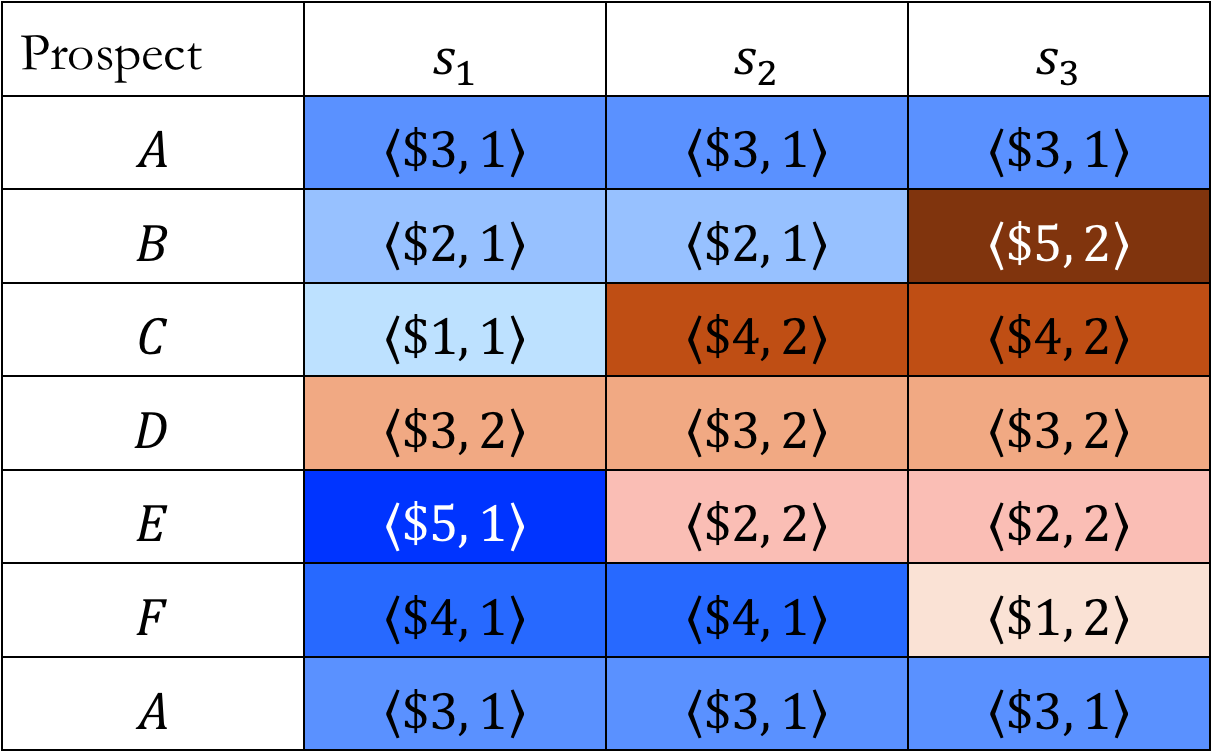
For simplicity, assume that
Our POST-agent prefers
Our POST-agent doesn’t disprefer
By parallel reasoning, Non-Arbitrariness implies that the
agent prefers
In sum, POST and Negative Dominance together imply that the agent lacks a preference between every pair of different-length lotteries. POST, Acyclicity, and Non-Arbitrariness together imply that the agent lacks a preference between every pair of part-shared-length lotteries. The four conditions together establish POSL: the agent has preferences only between same-length lotteries.
A2. The Ramsey Yardstick Theorem
In this Appendix, I prove the following theorem.
The Ramsey Yardstick Theorem
Given Transitivity and Indifference between Indifference-Shifted Lotteries (IBIL), fixing the relative scales of
and using some pair of lotteries implies the Ramsey Yardstick for all length- and length- lotteries.
This theorem has two notable upshots. First, the relative
scale of
Here are the conditions for the theorem. First, the
agent’s preferences over length-
Second:
Transitivity
For any lotteries
, , and , if the agent weakly prefers to and weakly prefers to , then the agent weakly prefers to .
Third:
Indifference Between Indifference-Shifted Lotteries (IBIL)
For any lotteries
, , and (with and sharing a probability distribution over trajectory-lengths) and any probability , the agent is indifferent between and if and only if the agent is indifferent between and .
Fourth is the condition that we use some pair of
lotteries to fix the relative scales of
For any trajectory-lengths
and , there exists some pair of length- lotteries and and some pair of length- lotteries and such that
The agent is indifferent between the lottery
I use these conditions to prove the following claim:
The Ramsey Yardstick
For any trajectory-lengths
and , any length- lotteries and , and any length- lotteries, and , if and only if the agent is indifferent between the lottery and the lottery .
I first prove the forward direction. Assume
Second, since
By IBIL and Transitivity, and given the above two claims,
the agent is indifferent between
I now prove the backward direction. Assume that the agent
is indifferent between
By the nature of
Second, since
By IBIL and Transitivity, the agent is indifferent
between
The Ramsey Yardstick
For any trajectory-lengths
and , any length- lotteries and , and any length- lotteries, and , if and only if the agent is indifferent between the lottery and the lottery .