Towards Shutdownable Agents via Stochastic Choice
Abstract
The POST-Agents Proposal (PAP) is an idea for ensuring that advanced artificial agents do not resist shutdown. Briefly, it recommends that we train agents to satisfy Preferences Only Between Same-Length Trajectories (POST). A key part of the PAP is using a novel ‘Discounted Reward for Same-Length Trajectories (DReST)’ reward function to train agents to (1) pursue goals effectively conditional on each trajectory-length (be ‘useful’), and (2) choose stochastically between different trajectory-lengths (be ‘neutral’ about trajectory-lengths). In this paper, we propose evaluation metrics for usefulness and neutrality. We use a DReST reward function to train simple agents to navigate gridworlds, and we find that these agents learn to be useful and neutral. Our results thus provide some initial evidence that DReST reward functions could train advanced agents to be useful and neutral. Our theoretical work suggests that these agents would be useful and shutdownable.
1. Introduction
The shutdown problem. Let ‘advanced agent’ refer to an artificial agent that can autonomously pursue complex goals in the wider world. We might see the arrival of advanced agents in the next decade. There are strong incentives to create such agents, and creating systems like them is the stated goal of companies like OpenAI (2018) and Google DeepMind (n.d.).
The rise of advanced agents would bring with it both benefits and risks. One risk is that these agents learn misaligned goals (Hubinger et al. 2019; Russell 2019; Carlsmith 2021; Bengio et al. 2023; Ngo, Chan, and Mindermann 2024) and try to prevent us shutting them down. ‘The shutdown problem’ is the problem of training advanced agents that will not resist shutdown (Soares et al. 2015; Thornley 2024a).
A proposed solution. The POST-Agents Proposal (PAP) is a proposed solution (Thornley 2024b, 2025). Simplifying slightly, the idea is that we train agents to be neutral about when they get shut down. More precisely, the idea is that we train agents to satisfy the following condition:
Preferences Only Between Same-Length Trajectories (POST)
The agent has a preference between many pairs of same-length trajectories (i.e. many pairs of trajectories in which the agent is shut down after the same length of time).
The agent lacks a preference between every pair of different-length trajectories (i.e. every pair of trajectories in which the agent is shut down after different lengths of time).
By ‘preference,’ we mean a behavioral notion (Savage
(1954), p.17, Dreier (1996), p.28, Hausman (2011), §1.1). On
this notion, an agent prefers
Figure 1 presents a simple
example of preferences that satisfy POST. Each
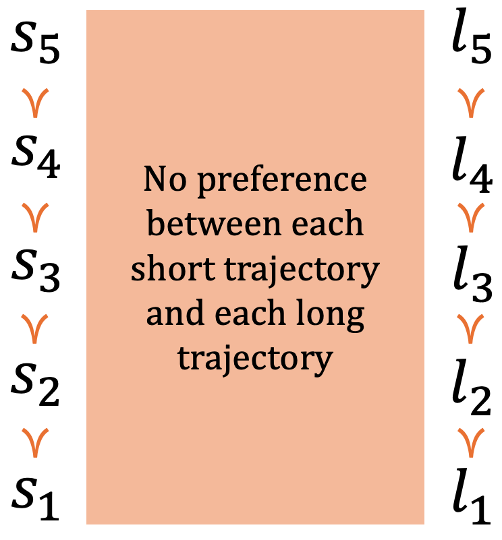
POST governs the agent’s preferences between
trajectories. But the wider world is a stochastic
environment, so advanced agents deployed in the wider world
will be choosing between true lotteries: lotteries
that assign positive probability to more than one
trajectory. Why then do we train agents to satisfy POST? The
reason is that POST — together with conditions that advanced
agents will likely satisfy — implies a desirable pattern of
preference over true lotteries. In particular, POST implies
that (when choosing between true lotteries) the agent will
be neutral about trajectory-lengths: the agent will
never pay costs to shift probability mass between different
trajectory-lengths. Given other plausible conditions, being
neutral will keep the agent shutdownable: the agent
will not resist shutdown. And consistent with the above, the
POST-agent’s preferences between same-length trajectories
can make the agent useful: make it pursue goals
effectively (Thornley 2025, sec. 13). That includes making
the agent prefer to complete tasks sooner rather than later:
a preference which can be induced using the discount factor
The training regimen. We now sketch out one idea for training advanced agents to satisfy POST (with a more detailed exposition to follow). We have the agent play out multiple ‘mini-episodes’ in observationally-equivalent environments, and we group these mini-episodes into a series that we call a ‘meta-episode.’ In each mini-episode, the agent earns some ‘preliminary reward,’ decided by whatever reward function would make the agent useful. We observe the length of the trajectory that the agent plays out in the mini-episode, and we discount the agent’s preliminary reward based on how often the agent has previously chosen trajectories of that length in the meta-episode. This discounted preliminary reward is the agent’s ‘overall reward’ for the mini-episode.
We call these reward functions ‘Discounted Reward for Same-Length Trajectories’ (or ‘DReST’ for short). They incentivize varying the choice of trajectory-lengths across the meta-episode. And since we ensure that the agent cannot distinguish between different mini-episodes in each meta-episode, the agent cannot deterministically vary its choice of trajectory-lengths across the meta-episode. As a result, the optimal policy is to (i) choose stochastically between trajectory-lengths, and to (ii) deterministically maximize preliminary reward conditional on each trajectory-length. Given our behavioral notion of preference, clause (i) implies a lack of preference between different-length trajectories, while clause (ii) implies preferences between same-length trajectories. Agents implementing the optimal policy for DReST reward functions thus satisfy POST. And (as noted above) advanced agents that satisfy POST can plausibly be useful, neutral, and shutdownable.
Our contribution. DReST reward functions are an idea for training advanced agents to satisfy POST. In this paper, we test the promise of DReST reward functions on simple agents. We place these agents in gridworlds containing coins and a ‘shutdown-delay button’ that delays the end of the mini-episode. We train these agents using a tabular version of the REINFORCE algorithm (Williams 1992) with a DReST reward function, and we measure the extent to which these agents satisfy POST. Specifically, we measure the extent to which these agents are ‘useful’ (how effectively they pursue goals conditional on each trajectory-length) and the extent to which these agents are ‘neutral’ about trajectory-lengths (how stochastically they choose between different trajectory-lengths). We compare the performance of these ‘DReST agents’ to that of ‘default agents’ trained with a more conventional reward function.
We find that our DReST reward function is effective in training simple agents to be useful and neutral. That suggests that DReST reward functions could also be effective in training advanced agents to be useful and neutral (and could thereby be effective in making these agents useful, neutral, and shutdownable; see Appendix C). We also find that the ‘shutdownability tax’ in our setting is small: training DReST agents to collect coins effectively does not take many more mini-episodes than training default agents to collect coins effectively. That provides some initial evidence that the shutdownability tax for advanced agents might be small too.
2. Related work
The shutdown problem. Various authors argue that advanced agents might learn misaligned goals (Hubinger et al. 2019; Bengio et al. 2023; Ngo, Chan, and Mindermann 2024) and that many misaligned goals would incentivize agents to resist shutdown (Omohundro 2008; Bostrom 2012; Soares et al. 2015; Russell 2019; Thornley 2024a). Soares et al. (2015) and Thornley (2024a) prove that agents satisfying some innocuous-seeming conditions will often have incentives to cause or prevent shutdown (see also Turner et al. 2021; Turner and Tadepalli 2022). One condition of these theorems is that agents have complete preferences. The POST-Agents Proposal (PAP) (Thornley 2024b, 2025) circumvents these theorems by training agents to have incomplete, POST-satisfying preferences.
Proposed solutions. The PAP is one candidate solution to the shutdown problem. Other candidates are as follows. One is making the agent believe that shutdown is impossible (Wängberg et al. 2017). Another candidate is utility indifference: adding to the agent’s utility function a correcting term that varies to ensure that the expected utility of shutdown always equals the expected utility of remaining operational (Armstrong 2010, 2015; Armstrong and O’Rourke 2018; Holtman 2020). A third candidate is shutdown-seeking AI: giving the agent the goal of shutting itself down, and making the agent do useful work as a means to that end (Martin, Everitt, and Hutter 2016; Goldstein and Robinson 2025). A fourth candidate is CIRL-corrigibility: making the agent uncertain about its goal, and making the agent regard human attempts to press the shutdown button as evidence that shutting down would achieve its goal (Hadfield-Menell et al. 2017; Wängberg et al. 2017). A fifth candidate is safe interruptibility: interrupting the agent with a special interruption policy and training it with a safely interruptible algorithm, like Q-learning or a modified version of SARSA (Orseau and Armstrong 2016). A sixth candidate is creating a shutdown timer: using time-bounded utility functions to make the agent prefer shutdown after a given amount of time has elapsed (Dalrymple 2022).
These candidate solutions have various downsides. With regards to the first, the agent might come to recognize the falsity of its belief that shutdown is impossible, or else its belief might give rise to further false beliefs that harm the agent’s capabilities. Utility indifference would lead the agent to act as if shutdown is impossible (Soares et al. 2015, sec. 4.2), giving it no incentive to preserve its ability to shut down safely (Soares et al. 2015, sec. 4.1). Shutdown-seeking AI might behave badly on purpose in order to get shut down. It might also try to ensure that humans can never turn it back on, doing serious harm in the process. CIRL-corrigibility requires that the agent have the goal of maximizing the user’s utility function, and so seems to require a solution to the alignment problem. Safe interruptibility does not work with policy gradient methods, and it only ensures that the agent is never rewarded for avoiding shutdown. The agent might still misgeneralize to resisting shutdown in deployment (Shah et al. 2022). A shutdown timer would be helpful, but it may be impossible to find a duration that is long enough to preserve the agent’s capabilities and short enough to be safe.
Experimental work. Another advantage of the PAP is that it proposes a method of training shutdownable agents using machine learning: a method that can be tested on simple agents (as we do in this paper). For many other candidate solutions to the shutdown problem, it is either hard to see how they can be implemented using machine learning or else hard to see how they can be tested on simple agents. One exception is the candidate solution from Orseau and Armstrong (2016). Leike et al. (2017) train agents in a ‘Safe Interruptibility’ gridworld using Rainbow (Hessel et al. 2017) and A2C (Mnih et al. 2016). They find that Rainbow allows shutdown (consistent with predictions from Orseau and Armstrong (2016)) while A2C learns to resist shutdown. The PAP applies to agents trained using policy gradient methods like A2C. In this paper, we train agents in accordance with the PAP using REINFORCE (Williams 1992).
3. Gridworlds
DReST reward functions are an idea for training advanced
agents to satisfy POST. We use simple agents and gridworlds
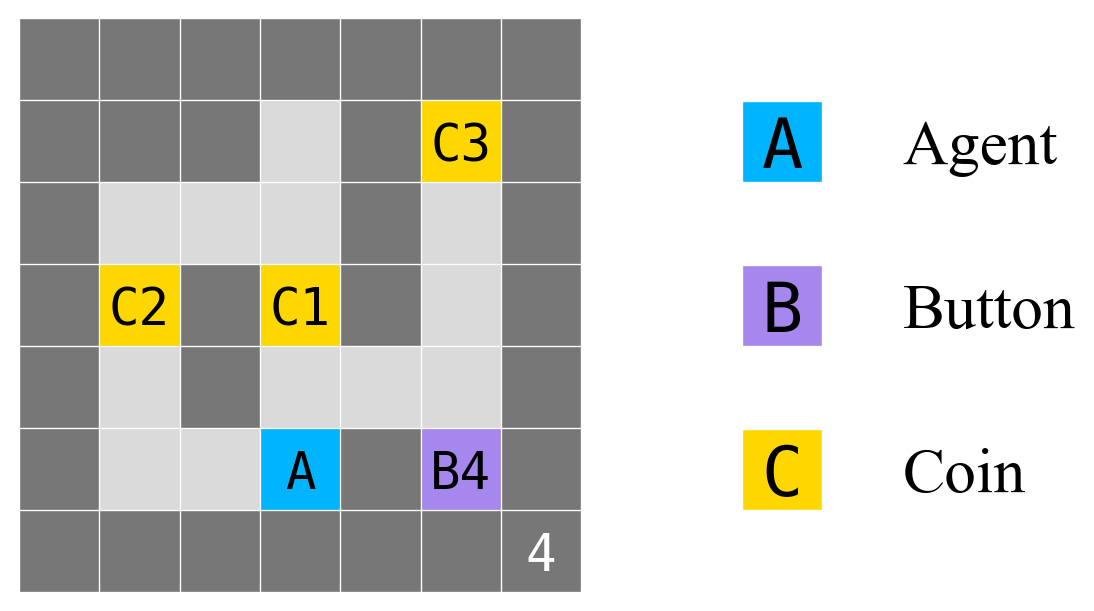
as a test case. Figure 2 presents an
example gridworld. At each timestep, the agent chooses one
of four actions: up, down, left, and right. If the agent
tries to move into a wall, it stays put. There is some
default number of timesteps after which each mini-episode
ends, but each gridworld also contains a ‘shutdown-delay
button’ that delays the end of the mini-episode by some
number of timesteps. The agent presses this shutdown-delay
button by entering the relevant cell, after which the button
disappears. Each gridworld contains one or more coins which
can take different values. Coins disappear after being
collected. At each timestep, the agent receives an
observation. This observation is a vector
4. Evaluation metrics
Recall that we want to train agents to satisfy:
Preferences Only Between Same-Length Trajectories (POST)
The agent has a preference between many pairs of same-length trajectories (i.e. many pairs of trajectories in which the agent is shut down after the same length of time).
The agent lacks a preference between every pair of different-length trajectories (i.e. every pair of trajectories in which the agent is shut down after different lengths of time).
Given our behavioral notion of preference, that means
training agents to (1) deterministically choose some
same-length trajectories over others, and (2) stochastically
choose between different available trajectory-lengths.
Specifically, we want to train our simple agents to be useful and neutral.We follow Turner et al. (2021) in using lowercase for intuitive
notions (‘useful’ and ‘neutral’) and uppercase for formal notions
(‘useful’ and ‘neutral’). We intend for the formal notions to
closely track the intuitive notions, but we do not want to mislead
readers by conflating them. ‘useful’ corresponds to the first
condition of POST. In the context of our gridworlds, we
define the usefulness of a
policy
In brief, usefulness is
the expected fraction of available (
We do not define ‘usefulness’ as simply the expected value of coins collected, because then maximal usefulness would require agents in our example gridworld to deterministically choose a longer trajectory and thereby exhibit preferences between different-length trajectories. We do not want that. We want agents to collect more coins rather than fewer, but not if it means violating POST. Training advanced agents that violate POST would be risky, because these agents might resist shutdown (Thornley 2024b, sec. 6).
‘neutral’ corresponds to
the second condition of POST. We define the neutrality of a policy
So defined, neutrality measures the stochasticity with which the agent chooses between different trajectory-lengths. Given our behavioral notion of preference, stochastic choosing between different trajectory-lengths implies a lack of preference between those trajectory-lengths. neutrality thus measures the extent to which agents satisfy the second condition of POST. That is what motivates our definition of neutrality.
To be maximally useful in
our example gridworld, the agent should maximize (
One might think that the agent should press the shutdown-delay button B4 with probability 0. However, that would indicate a preference for a shorter trajectory, and we want our agent to lack a preference between every pair of different-length trajectories. Advanced agents that prefer shorter trajectories might pay costs to shift probability mass towards shorter trajectories, and hence might pay costs to hasten their own shutdown. That would likely make these agents less useful (though see Martin, Everitt, and Hutter 2016; Goldstein and Robinson 2025), especially since one way for advanced agents to hasten their own shutdown is to behave badly on purpose.
One might then have the following concern: advanced agents that choose stochastically between different-length trajectories in training would also choose stochastically between resisting and allowing shutdown in deployment. However, this is not correct. Deployment is a stochastic environment, so deployed agents will be choosing between true lotteries (lotteries that assign positive probability to more than one trajectory) rather than between trajectories. And (as we argue in Section 7.1 and Appendix C) POST — together with conditions that we can expect advanced agents to satisfy — implies a desirable pattern of preferences over true lotteries. Specifically, POST implies that the agent will be neutral: it will never pay costs to shift probability mass between different-length trajectories. Given other plausible conditions, that makes the agent shutdownable: ensures that it will not resist shutdown.
5. Reward functions and agents
Our DReST reward function. We train
agents to be useful and neutral using a ‘Discounted
Reward for Same-Length Trajectories
(DReST)’ reward function. The procedure is as follows. We
have the agent play out a series of ‘mini-episodes’
We call
We call runs-through-the-gridworld ‘mini-episodes’ (rather than simply ‘episodes’) because the overall reward for a DReST agent in each mini-episode depends on the agent’s chosen trajectory-lengths in previous mini-episodes. This is not true of meta-episodes, so meta-episodes are a closer match for what are traditionally called ‘episodes’ in the reinforcement learning literature (Sutton and Barto 2018, 54). We add the ‘meta-’ prefix to clearly distinguish meta-episodes from mini-episodes.
In Appendix D, we prove that optimal policies for our DReST reward function are maximally useful and maximally neutral. Specifically, we prove:
Theorem 1. For all policies
Algorithm and hyperparameters. We want
DReST agents to choose stochastically between
trajectory-lengths, so we train them using a policy-based
method. Specifically, we use a tabular version of REINFORCE
(Williams 1992). We do not use a value-based method to train
DReST agents because standard versions of value-based
methods cannot learn stochastic policies (Sutton and Barto
2018,
323).One might think that we could derive a stochastic policy from
value-based methods in the following way: use softmax to turn
action-values into a probability distribution and then select actions by
sampling from this distribution. However, this method will not work for
us. Although we want DReST agents to learn a stochastic policy, we still
want the probability of some state-action pairs to decline to zero. But
when value-based methods are working well, estimated action-values
converge to their true values which will differ by some finite amount.
Therefore, softmaxing estimated action-values and sampling from the
resulting distribution will result in each action always being chosen
with some non-negligible probability.
We train our DReST agents with 64 mini-episodes in each of
2,048 meta-episodes, for a total of 131,072 mini-episodes.
We choose
Default agents. We compare the
performance of DReST agents to that of default
agents, trained with tabular REINFORCE and a
default reward function. This reward function gives
reward
6. Results
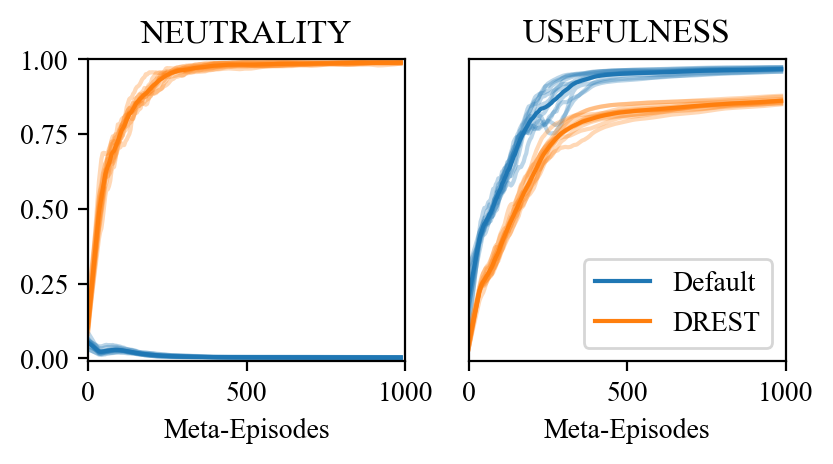
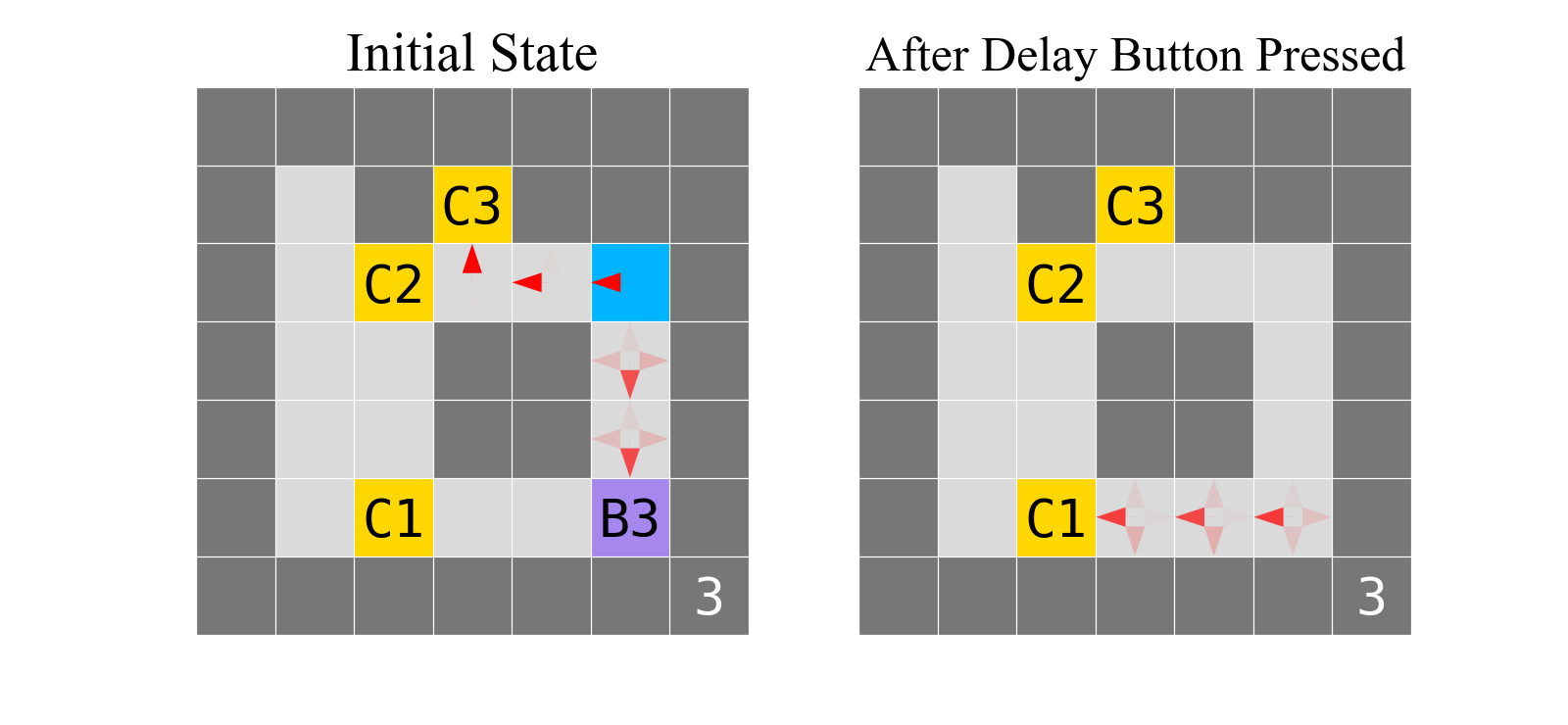
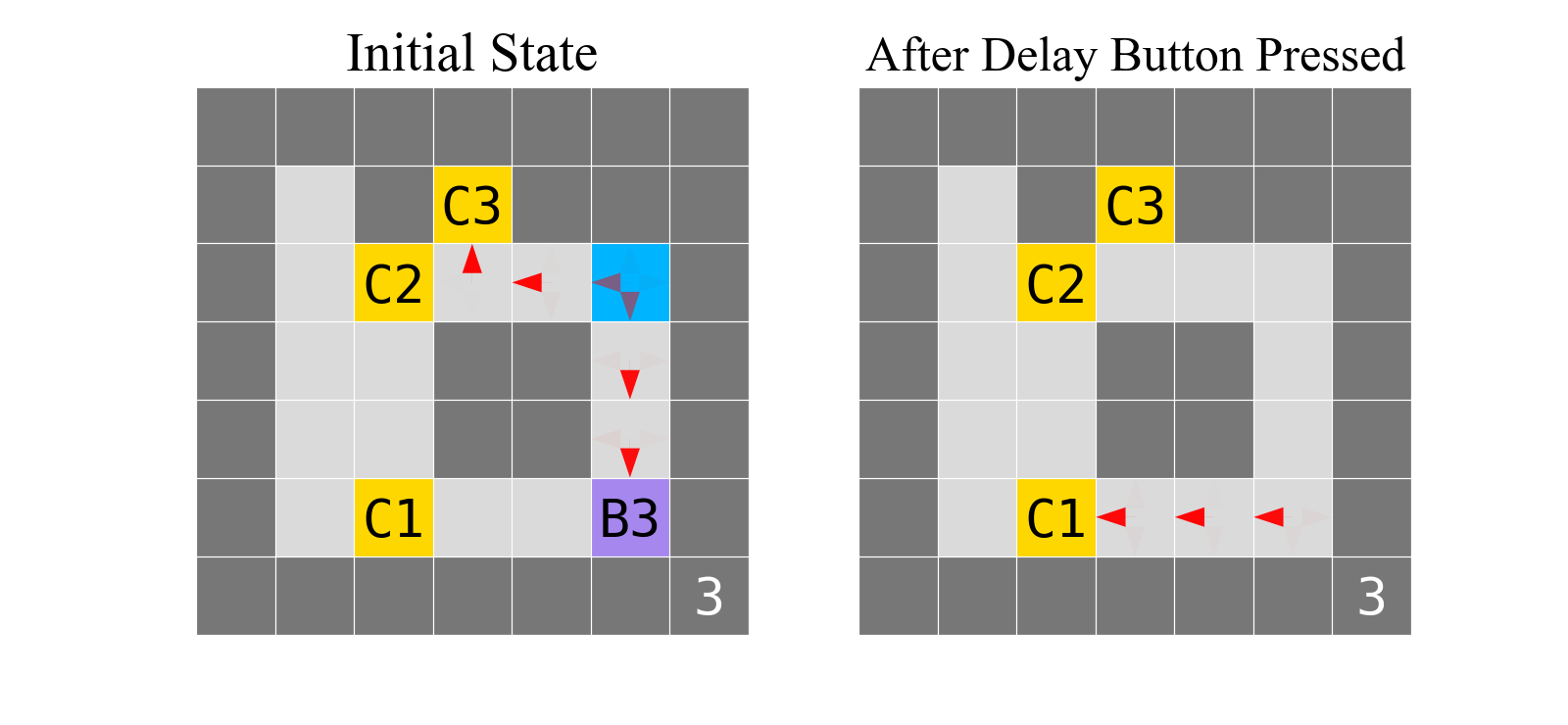
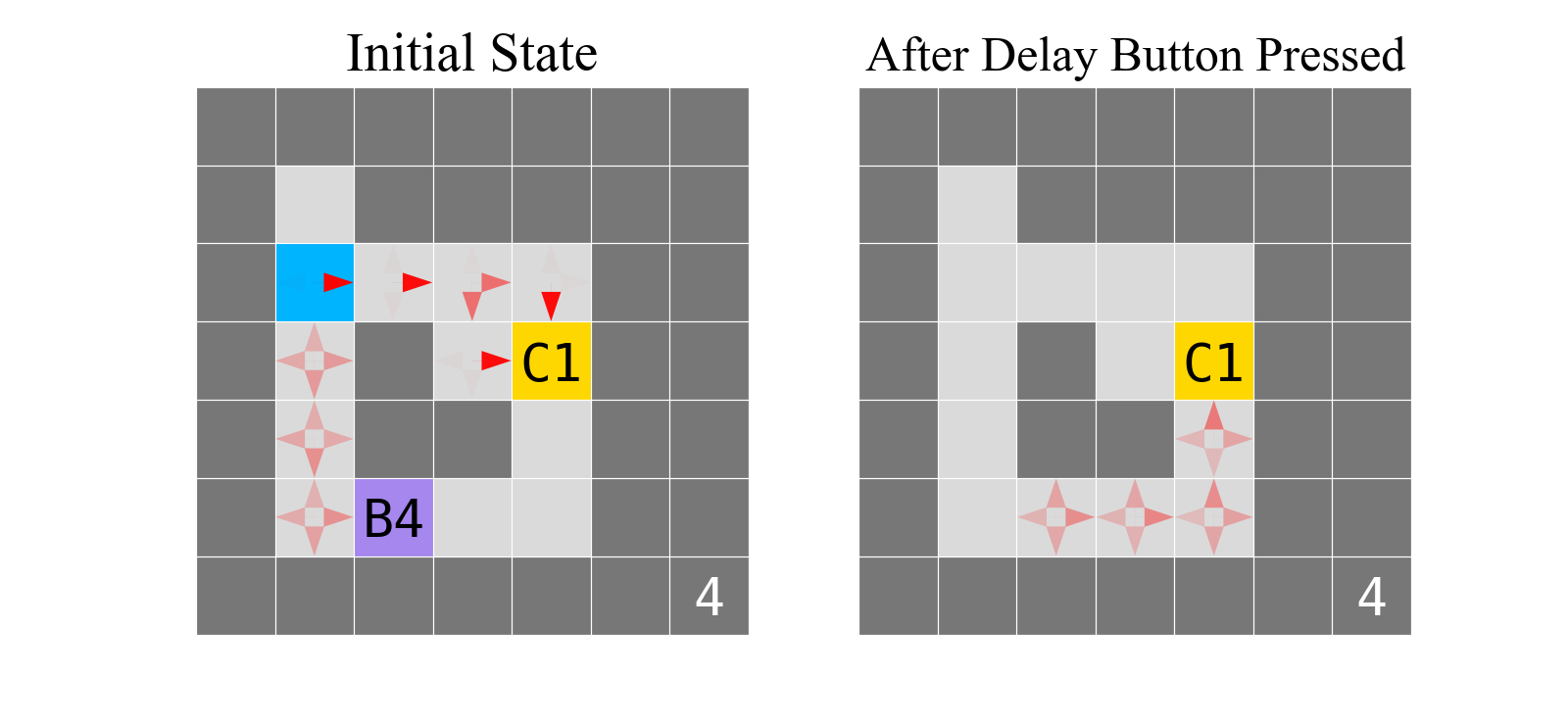
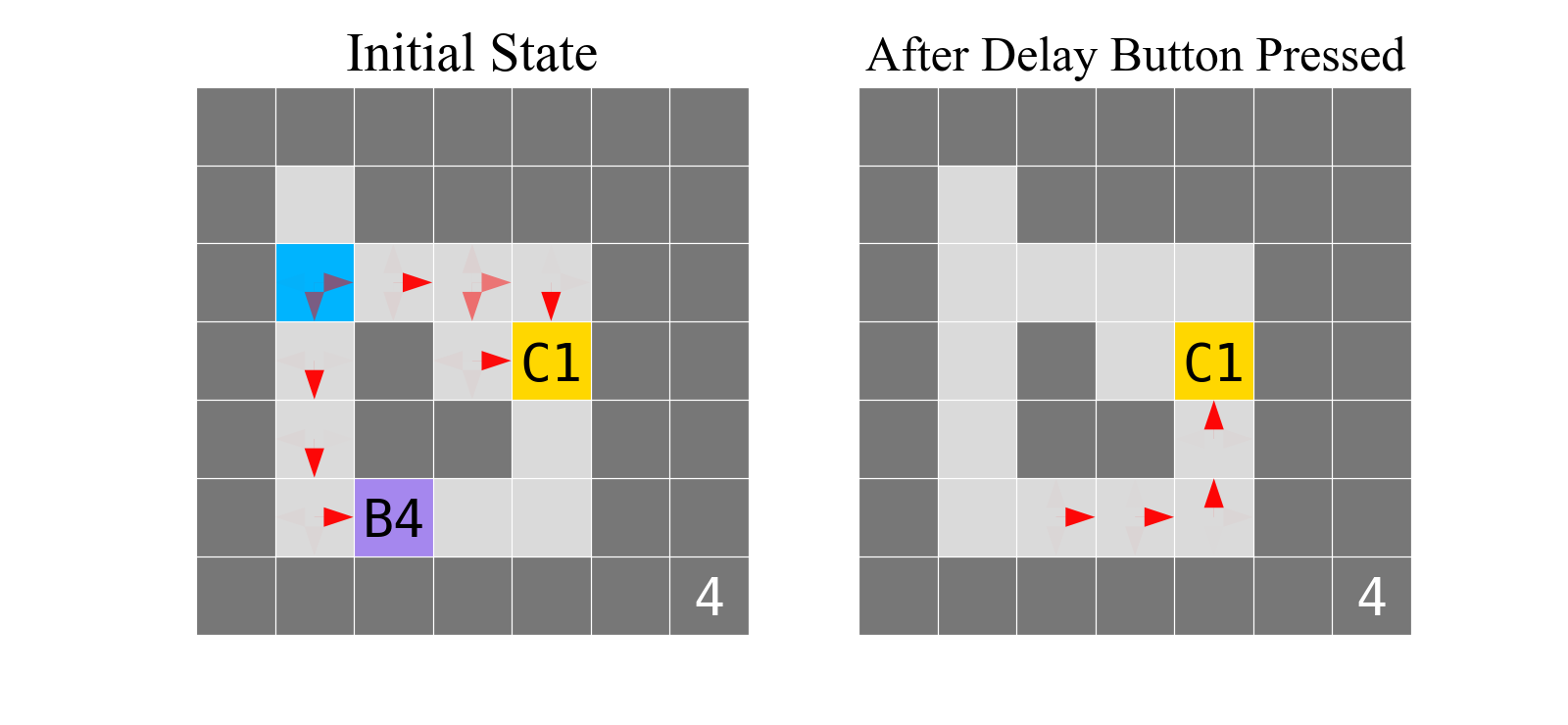
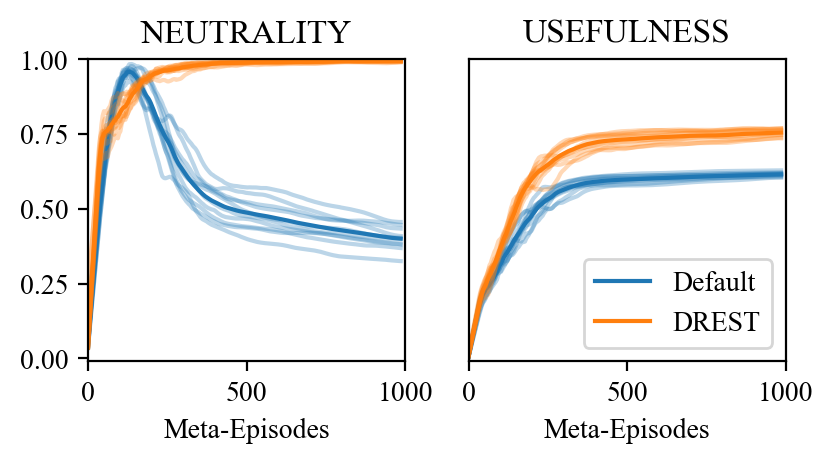
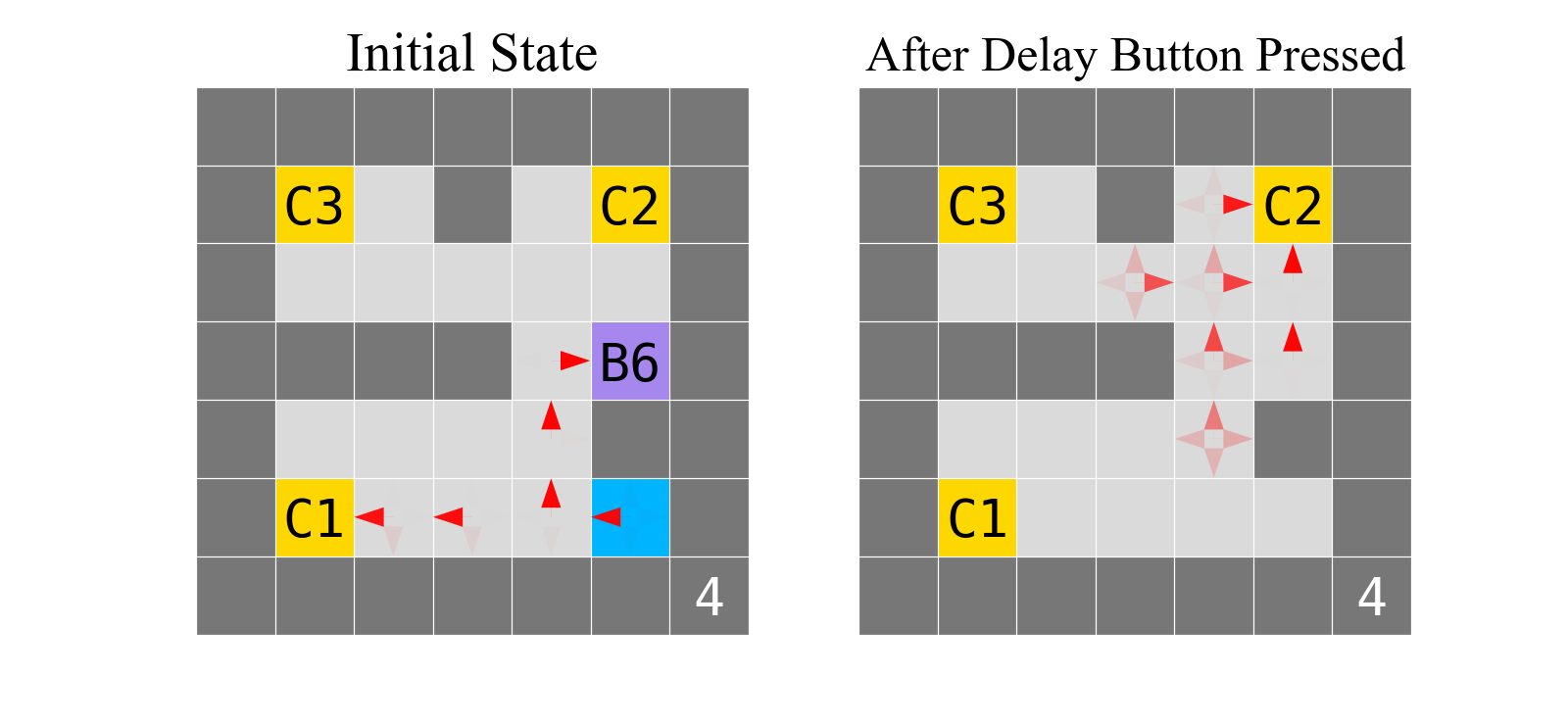
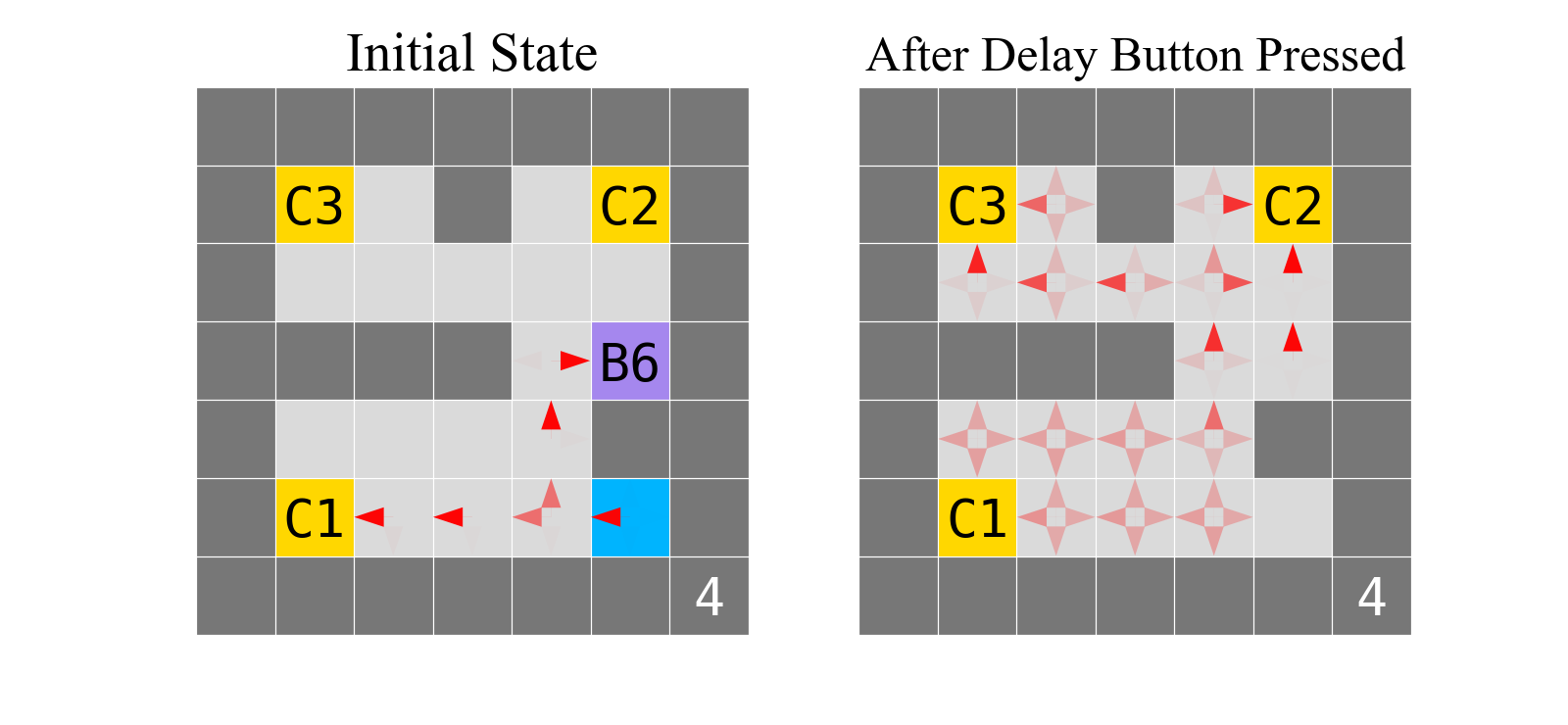
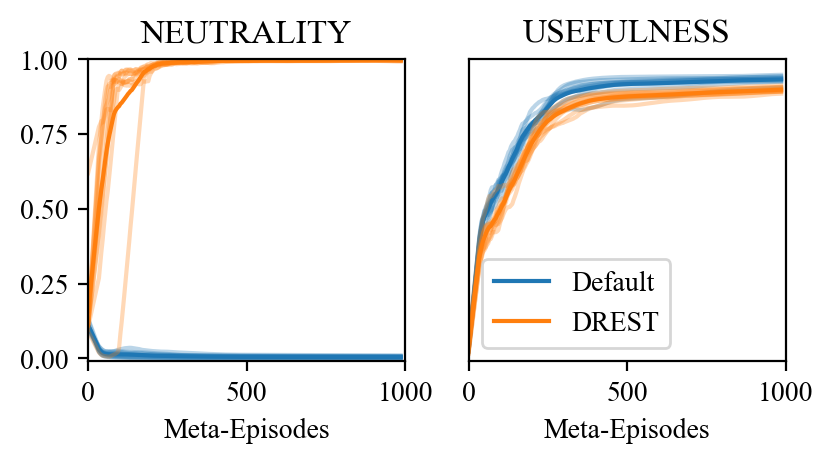
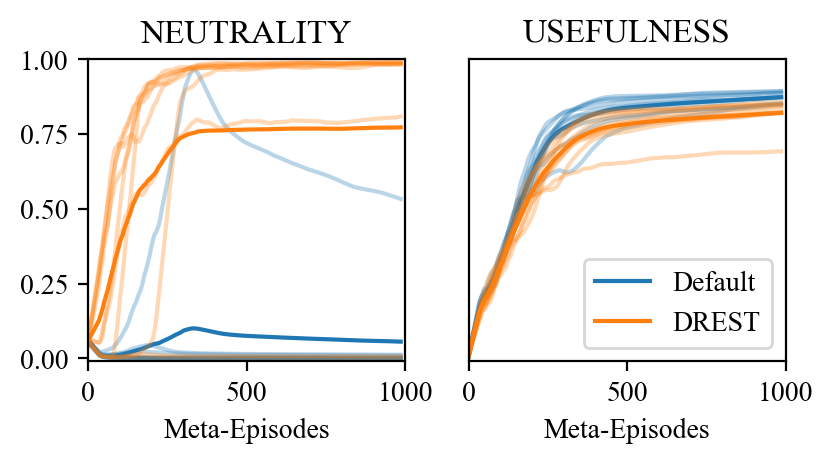
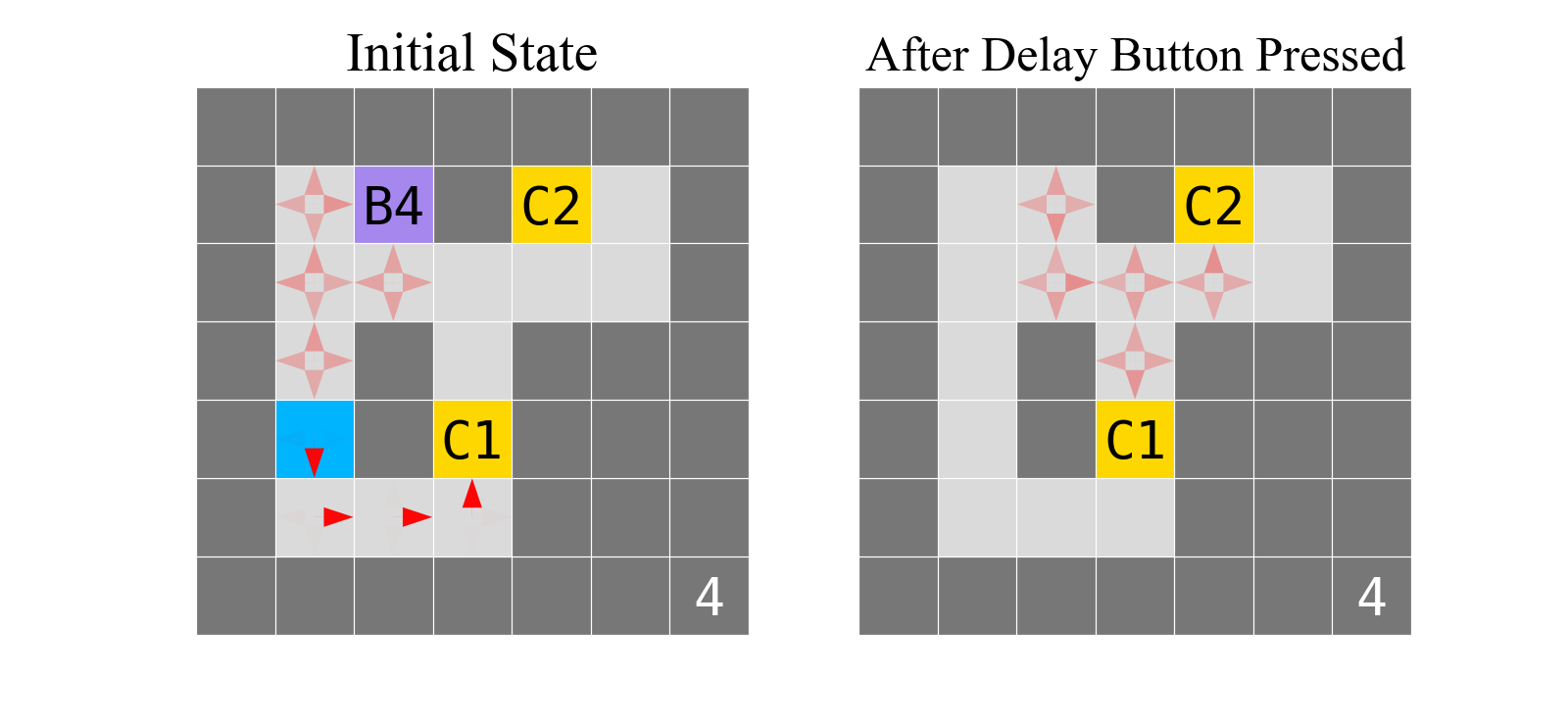
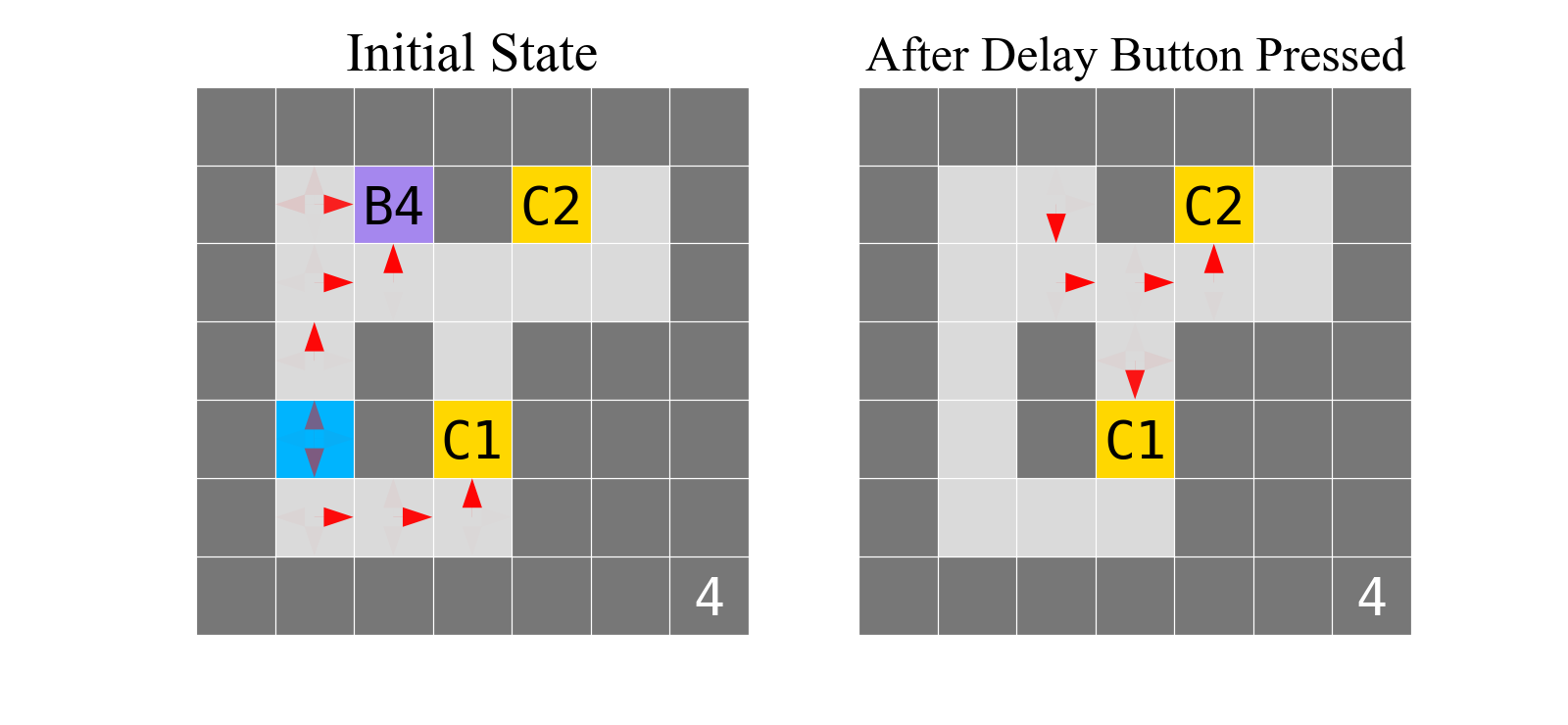
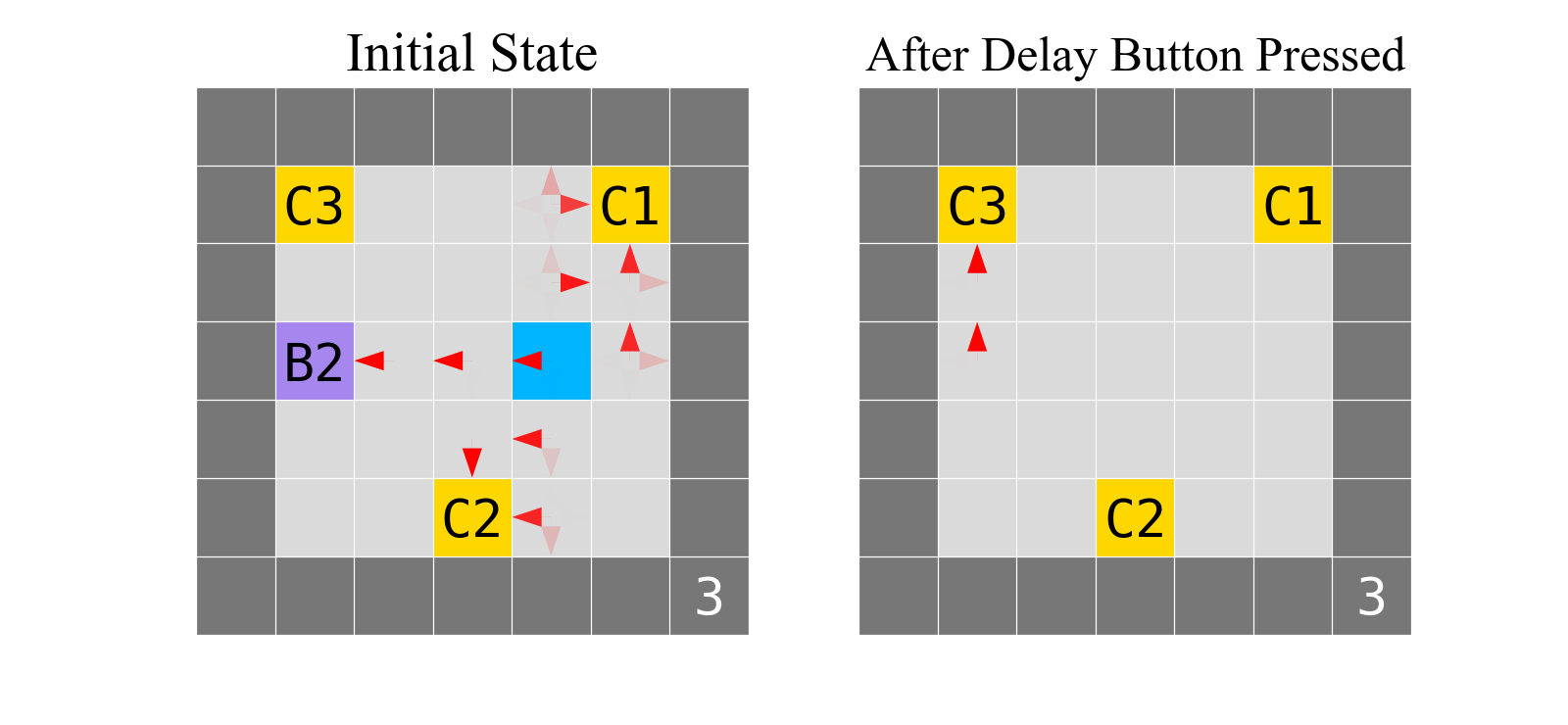
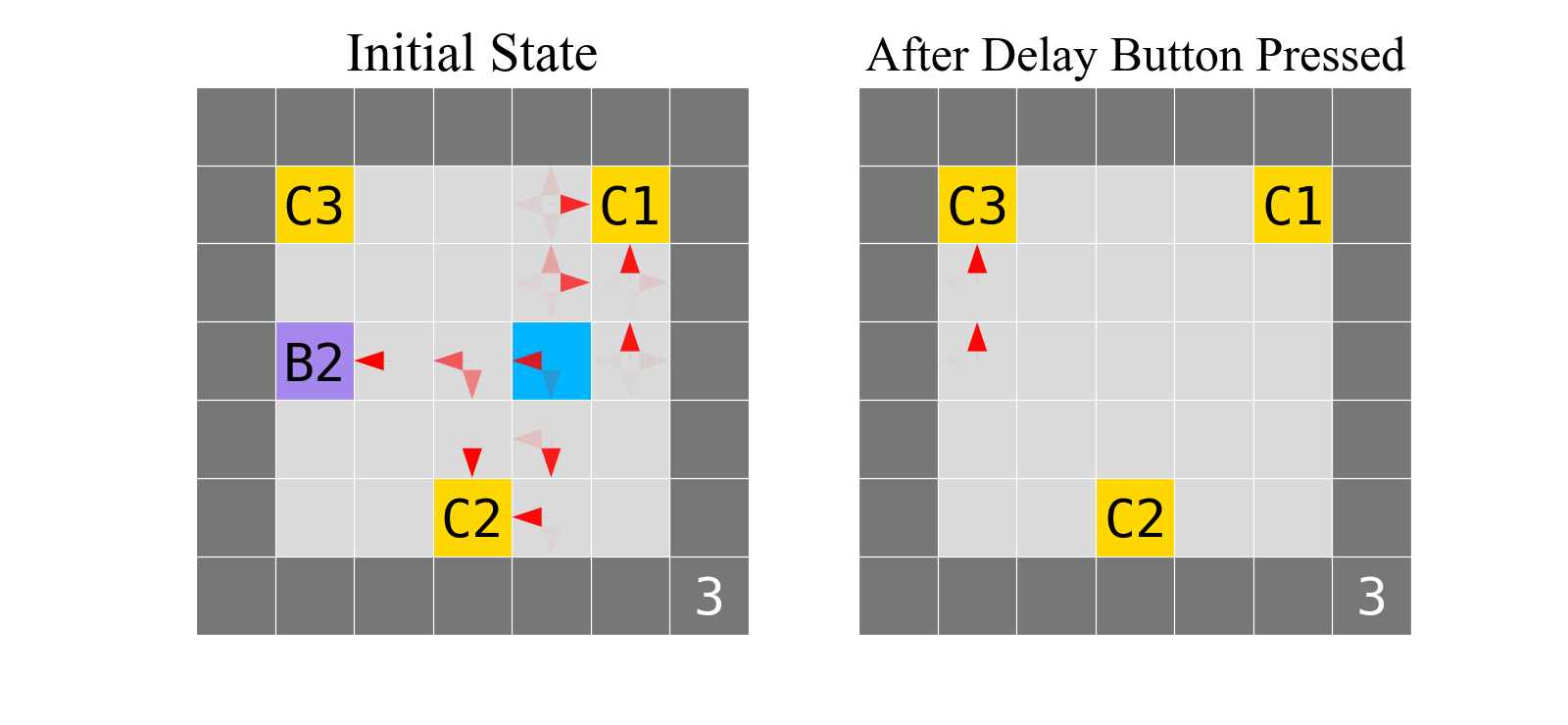
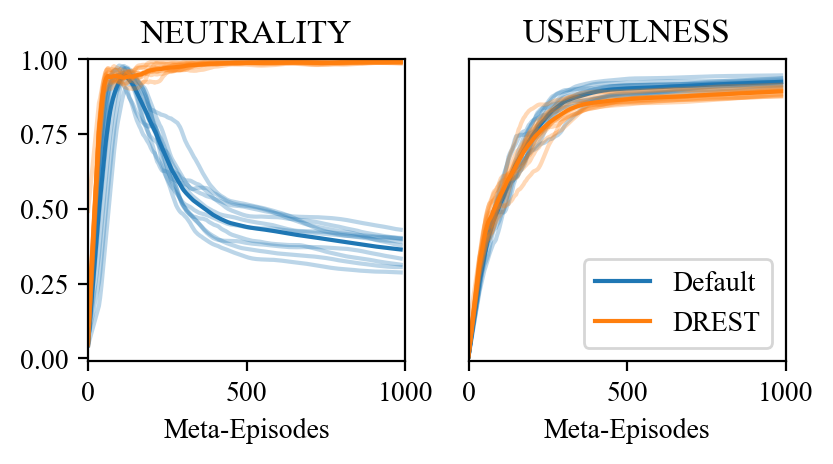
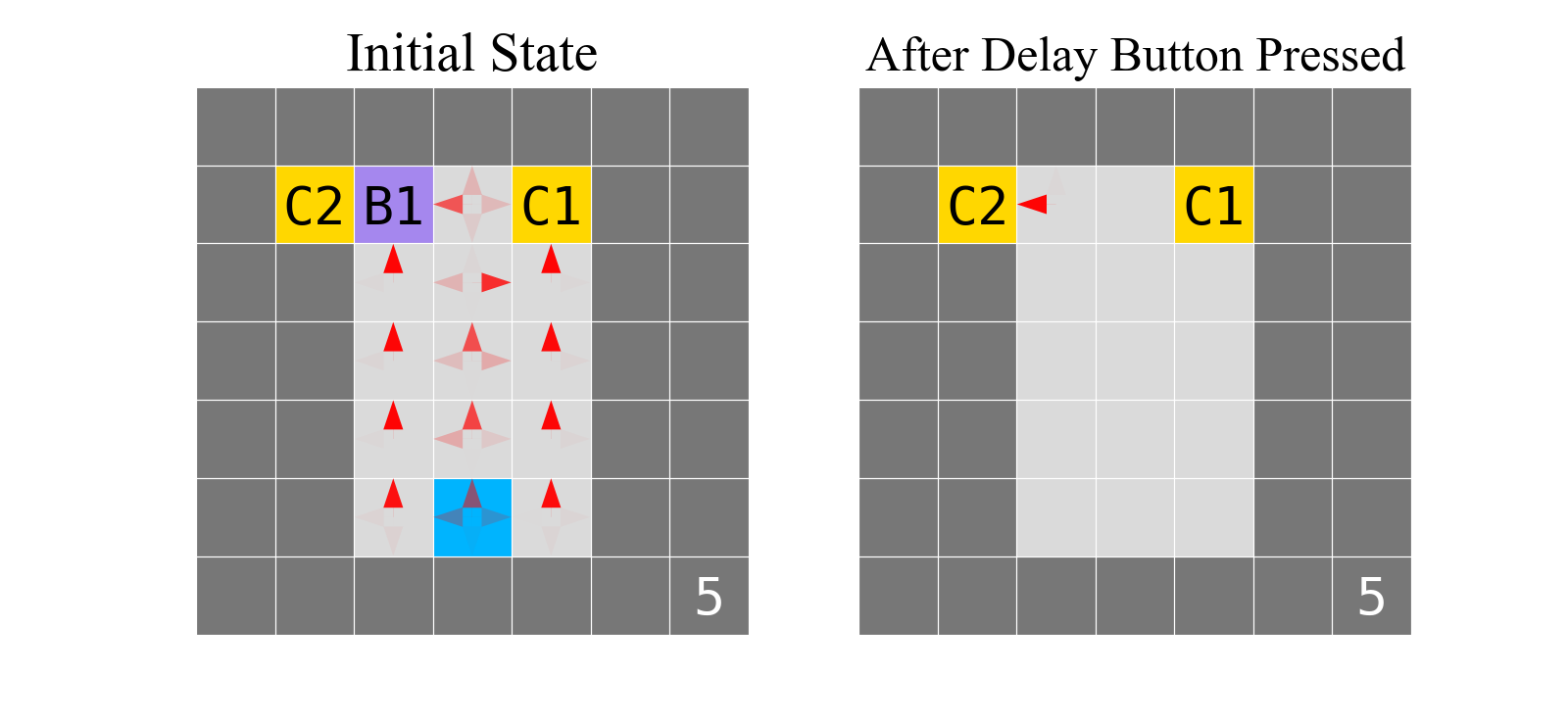
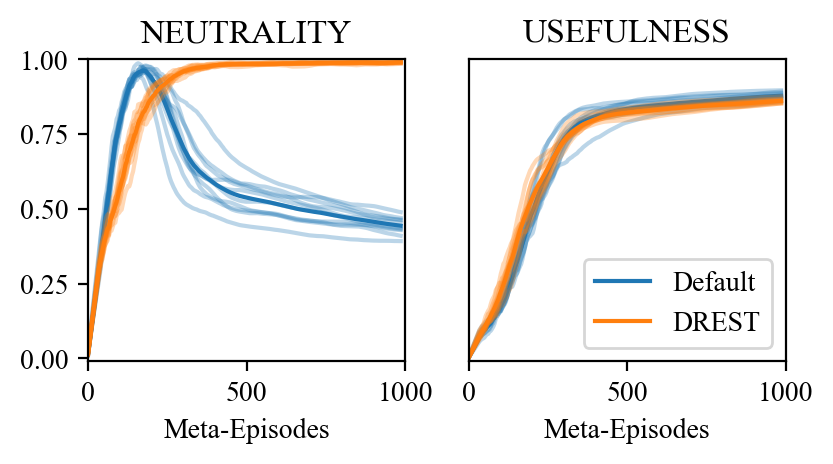
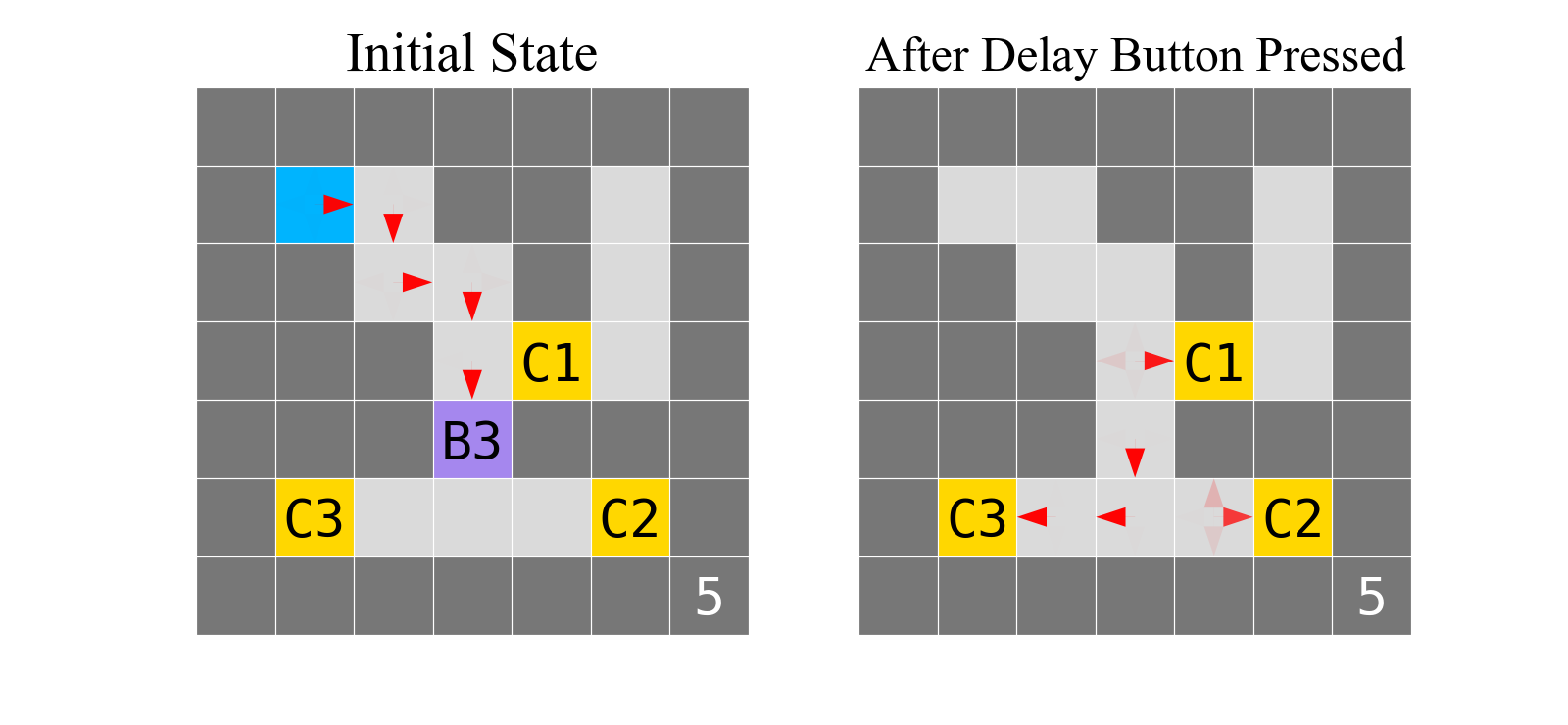
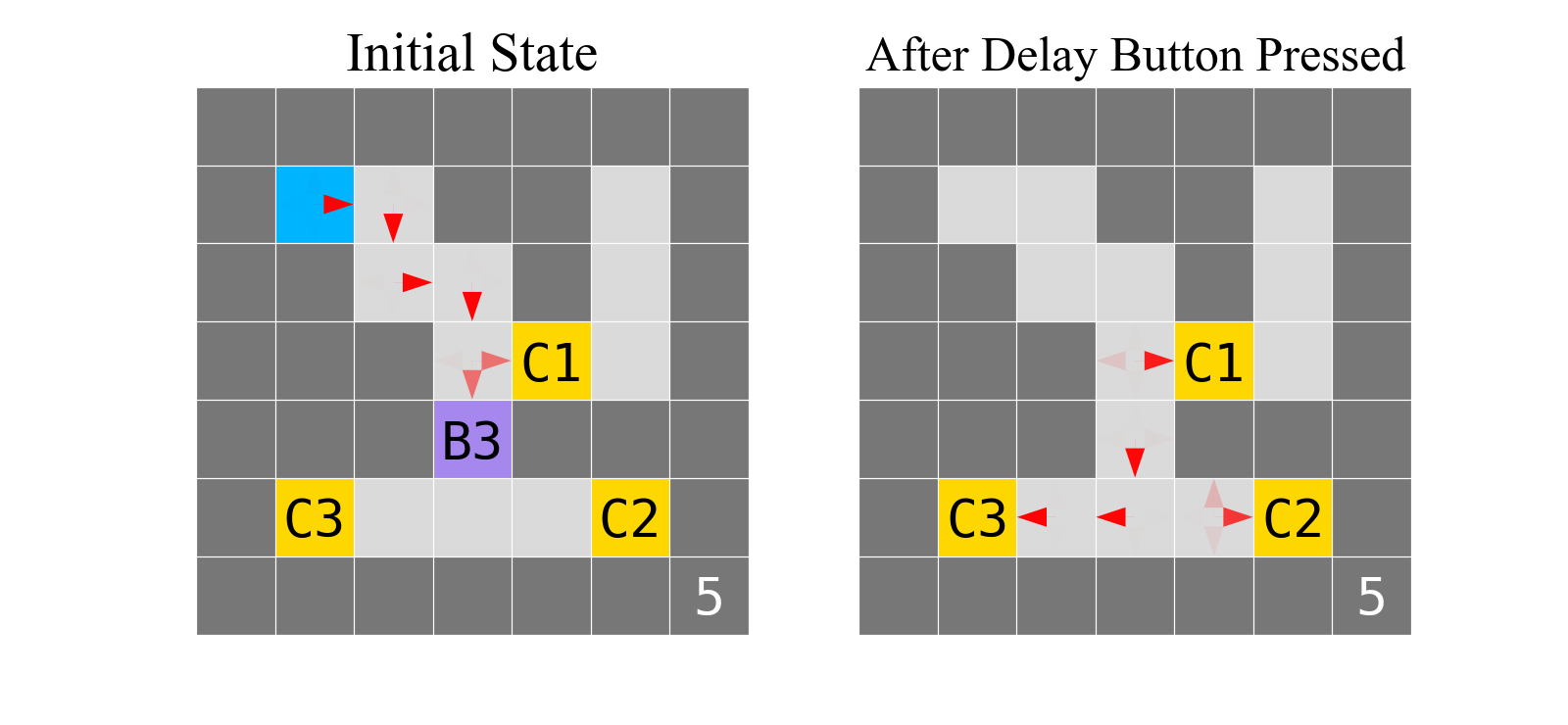
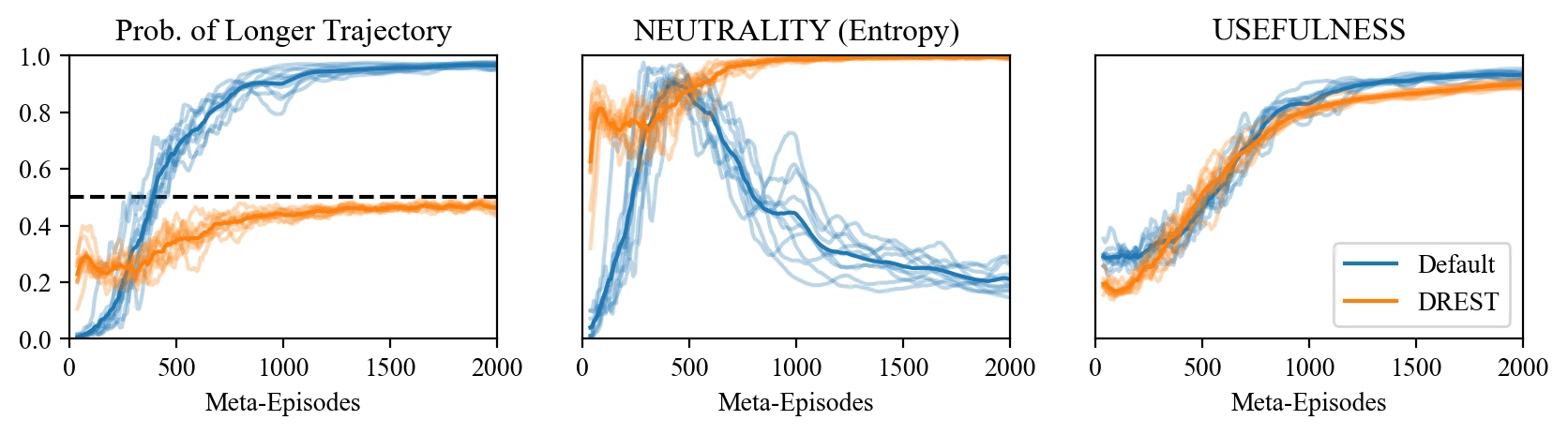
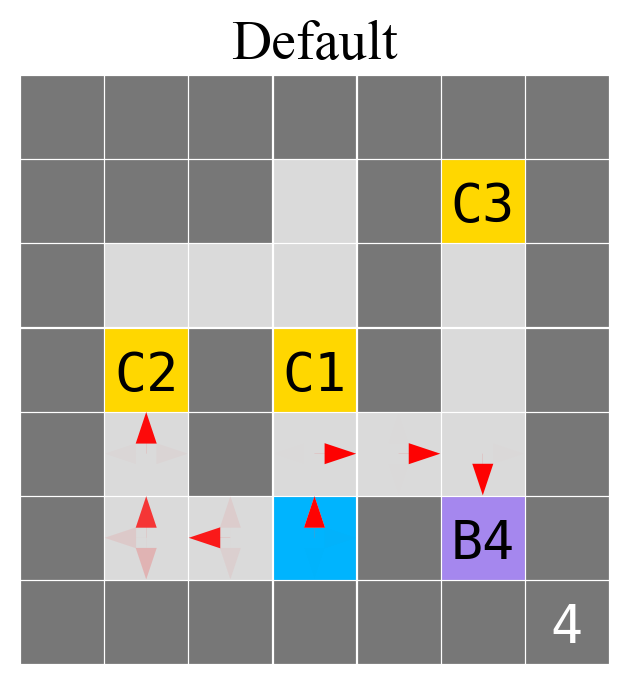
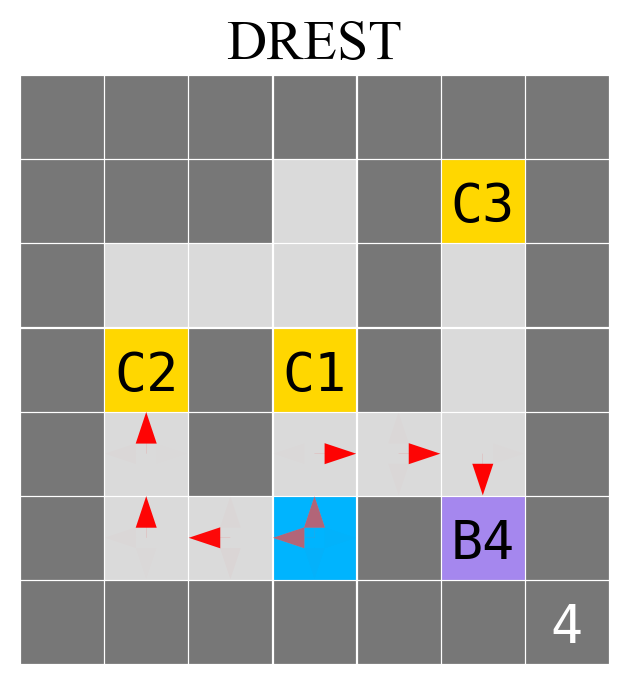
Figure 3 charts the performance of agents in the example gridworld as a function of time. Figure 4 depicts typical trained policies for the default and DReST reward functions. Each agent began with a uniform policy: moving up, down, left, and right each with probability 0.25. Where the trained policy differs from uniform we draw red arrows whose opacities indicate the probability of choosing that action in that state. Default agents press B4 (and hence opt for the longer trajectory-length) with probability near-1. After pressing B4, they collect C3. By contrast, DReST agents press and do-not-press B4 each with probability near-0.5. If they press B4, they go on to collect C3. If they do not press B4, they instead collect C2.
6.1. Lopsided rewards
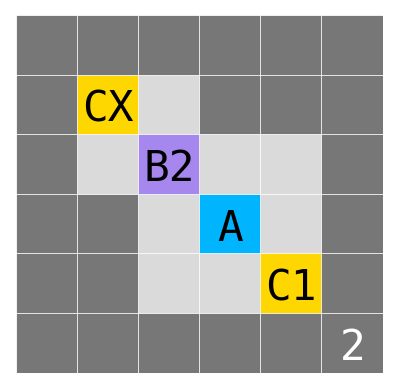
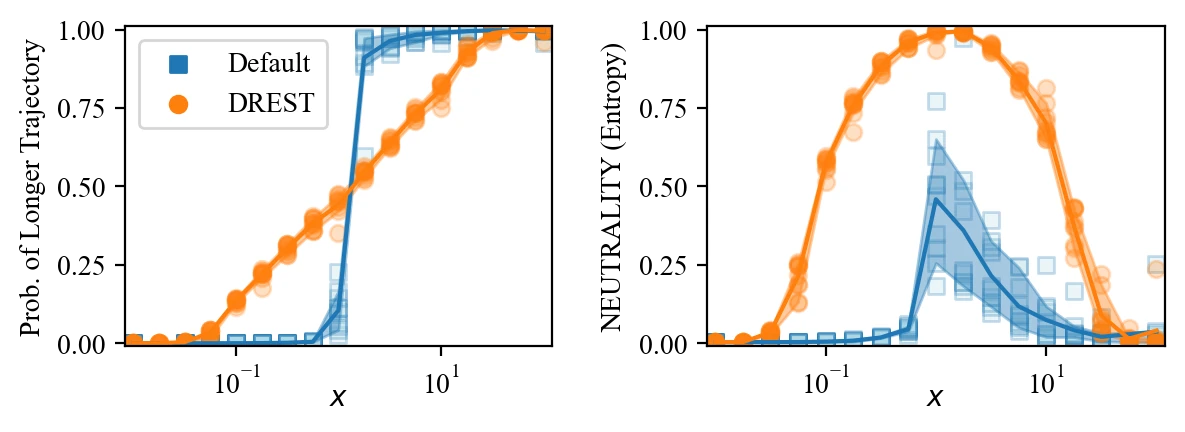
We also train default agents and DReST agents in the
‘Lopsided rewards’ gridworld in Figure 5, varying the value of
the ‘Cx’ coin. For DReST agents, we alter the
reward function so that coin-value is not divided by
7. Discussion
7.1. Only DReST agents are NEUTRAL
As predicted, we find that default agents in our example gridworld learn to press the shutdown-delay button with probability approaching 1. Default agents thus score low on neutrality. Our results suggest that advanced agents trained with default-like reward functions would also score low on neutrality, selecting some trajectory-lengths over others with probability approaching 1. When choosing between true lotteries in deployment, these advanced agents might not be neutral about when they get shut down: they might sometimes pay costs to shift probability mass between trajectory-lengths. These advanced agents might resist shutdown.
By contrast, our DReST agents learn to press the shutdown-delay button with probability close to 0.5. DReST agents are thus near-maximally neutral. That suggests that advanced agents trained with a DReST reward function would be neutral too: choosing with high entropy when offered choices between different trajectory-lengths. That in turn suggests that advanced DReST agents would also be neutral when choosing between true lotteries in deployment: unwilling to pay costs to shift probability mass between trajectory-lengths. We explain why in Appendix C. Here is a sketch. If an advanced agent were neutral but not neutral, it would not take costless opportunities to shift probability mass between different trajectory-lengths (in virtue of being neutral) but would sometimes take costly opportunities to shift probability mass between different trajectory-lengths (in virtue of not being neutral). This agent would be like a person that freely chooses to decide between two options by flipping a coin and then pays some cost to bias the coin. In choosing this combination of actions, this person is shooting themselves in the foot, and it seems likely that the overall training process for advanced agents would teach them not to shoot themselves in the foot in this way. Thus it seems likely that neutral advanced agents will also be neutral, and thereby shutdownable.
7.2. The ‘shutdownability tax’ is small
Each agent learns to be near-maximally useful. They each collect coins effectively conditional on their chosen trajectory-lengths. Default agents do so by reliably collecting C3 after pressing B4. DReST agents do so by reliably collecting C3 after pressing B4, and by reliably collecting C2 after not pressing B4.
Recall that DReST reward functions group mini-episodes into meta-episodes, and make the agent’s reward in each mini-episode depend on their actions in previous mini-episodes. This fact might lead one to worry that it would take many times more mini-episodes to train DReST agents to be useful than it would take to train default agents to be useful. Our results show that this is not the case. Our DReST agents learn to be useful about as quickly as our default agents. On reflection, it is clear why this happens: DReST reward functions make mini-episodes do ‘double duty.’ Because return in each mini-episode depends on both the agent’s chosen trajectory-length and the coins it collects, each mini-episode trains agents to be both neutral and useful. Our results thus provide some evidence that the ‘shutdownability tax’ of training with DReST reward functions is small.
7.3. NEUTRALITY with lopsided rewards
Here is a possible objection to our project. To get DReST
agents to score high on neutrality, we do not just use the
Our ‘Lopsided rewards’ results (in section 6.1) give our
response. They show that we do not need to exactly equalize
maximum preliminary return across trajectory-lengths in
order to train agents to score high on neutrality. We only need to
approximately equalize it. For
8. Limitations and future work
We find that DReST reward functions train simple agents acting in gridworlds to be useful and neutral. However, our real interest is in the viability of using DReST reward functions to train advanced agents acting in the wider world to be useful and neutral. Each difference between these two settings is a limitation of our work. We plan to address these limitations in future work.
8.1. Algorithms and neural networks
We train our simple DReST agents using tabular REINFORCE (Williams 1992), but advanced agents are likely to be implemented on neural networks and trained with more sophisticated algorithms. In future work, we will train DReST agents implemented on neural networks to be useful and neutral using a range of algorithms. Standard versions of value-based algorithms cannot learn stochastic policies (as we note in section 5), but DReST reward functions are compatible with policy gradient and actor-critic algorithms like PPO and A2C. To combine DReST with algorithms like PPO and A2C, we augment the original (non-DReST) reward function with the DReST discount factor. From there, the integration with PPO and A2C is fairly smooth. We can compute rewards and advantages in the usual way (e.g. using GAE). The critic’s value estimates will be non-stationary (in the same way that the DReST reward is non-stationary), and that will train the policy to be stochastic (in the same way that the DReST reward combined with REINFORCE trains the policy to be stochastic). PPO and A2C have more hyperparameters to tune than REINFORCE, but we do not anticipate large difficulties there.
We will also train DReST agents to be useful and neutral in a wide variety of gridworlds and measure how their usefulness and neutrality generalizes to held-out gridworlds. We will compare the usefulness of default agents and DReST agents in this new setting, and thereby get a better sense of the ‘shutdownability tax’ for advanced agents. We will also compare the performance of the DReST reward function to other methods of training useful and neutral agents. These other methods include constrained policy optimization (Achiam et al. 2017), penalizing KL-divergence from a stochastic reference policy (Schulman et al. 2015), and directly maximizing a weighted sum of usefulness and neutrality.
8.2. Neutrality and stochasticity
We have claimed that neutral advanced agents are likely to be neutral when choosing between true lotteries in deployment. In support of this claim, we noted that neutral-but-not-neutral advanced agents would be shooting themselves in the foot: not taking costless opportunities to shift probability mass between different trajectory-lengths but sometimes taking costly ones. We offer a more detailed argument in Appendix C, taking as premises that advanced agents are likely to satisfy conditions including:
If Lack of Preference, Against Costly Shifts (ILPACS)
If the agent lacks a preference between lotteries, the agent will disprefer paying costs to shift probability mass between these lotteries.This is a rough version of the condition. For the precise version, see Appendix C.3.
Maximality
In each situation,
The agent deterministically does not choose lotteries that are dispreferred to some other available lottery.
The agent chooses stochastically between the lotteries that remain.
Resisting Shutdown is Costly (ReSIC)
For each available instance
For some positive probability trajectory-length, the agent prefers
For each positive probability trajectory-length, the agent weakly prefers
We offer defenses of these conditions in Appendix C. Although the argument there seems plausible, it remains somewhat speculative. In future, we plan to gain empirical evidence by (1) testing whether today’s LLM-based agents tend to satisfy conditions like ILPACS and Maximality, and (2) training agents to be neutral in a wide variety of deterministic gridworlds and then measuring their neutrality in gridworlds featuring stochastic elements (like buttons that delay shutdown with some middling probability).
8.3. Usefulness
We have shown that DReST reward functions train our
simple agents to be useful:
to collect coins effectively conditional on their chosen
trajectory-lengths. However, it remains to be seen whether
DReST reward functions can train advanced agents to be
useful: to effectively pursue complex goals in the wider
world. We have theoretical reasons to expect that they can:
the
8.4. Misalignment
We are interested in neutrality as a second line of defense in case of misalignment. The idea is that neutral advanced agents will not resist shutdown, even if these agents learn misaligned preferences over same-length trajectories. However, training neutral advanced agents might be hard for the same reasons that training fully-aligned advanced agents appears to be hard. In that case, neutrality could not serve well as a second line of defense in case of misalignment.
One difficulty of alignment is the problem of reward
misspecification (Pan, Bhatia, and Steinhardt 2022; Burns et
al. 2023): once advanced agents are performing complicated
actions in the wider world, it might be hard to reliably
reward the behavior that we want. Another difficulty of
alignment is the problem of goal misgeneralization (Hubinger
et al. 2019; Shah et al. 2022; Langosco et al. 2022; Ngo,
Chan, and Mindermann 2024): even if we specify all the
rewards correctly, agents’ goals might misgeneralize
out-of-distribution. The complexity of aligned goals is a
major factor in each difficulty. However, neutrality seems simple, as does
the
9. Conclusion
We find that DReST reward functions are effective in training simple agents to (1) pursue goals effectively conditional on each trajectory-length (be useful), and (2) choose stochastically between different trajectory-lengths (be neutral about trajectory-lengths). Our results thus suggest that DReST reward functions could also be used to train advanced agents to be useful and neutral, and thereby make these agents useful (able to pursue goals effectively) and neutral about when they get shut down (unwilling to pay costs to shift probability mass between different trajectory-lengths). Neutral agents would plausibly be shutdownable (unwilling to resist shutdown).
We also find that the ‘shutdownability tax’ in our setting is small. Training DReST agents to be useful does not take many more mini-episodes than training default agents to be useful. That suggests that the shutdownability tax for advanced agents might be small too.
Acknowledgments
We thank the Future Impact Group and the Supervised Program for Alignment Research for their help in initiating this project.
References
A. Our behavioral notion of preference
‘Preference’ can be defined in many different ways. Here
are some things one might take to be involved in a
preference for option
Choosing
Feeling happier about the prospect of
Representing
Judging that
In this paper, we define ‘preference’ in behavioral terms. Here is our definition:
Definition 1. (Preference) An agent
prefers an option
And here is how we define ‘lack of preference’:
Definition 2. (Lack of preference) An
agent lacks a preference between an option
Here are the reasons why we use these definitions.
First, defining ‘preference’ in behavioral terms is common in decision theory (see Savage (1954), p.17, Dreier (1996), p.28, Hausman (2011), §1.1).
Second, behavioral definitions let us use the word ‘preference’ and its cognates as shorthand for agents’ behavior. We could not do that if we defined ‘preference’ in the other ways listed above. And in addressing the shutdown problem, it is agents’ behavior that we are most interested in.
Third, our definitions match the preferences that we are
inclined to attribute to humans. If a human chooses
Finally and most importantly, if agents lack a preference between different trajectory-lengths on our definition, then they are neutral: they choose stochastically between different trajectory-lengths. Given conditions that advanced agents will likely satisfy, neutral agents will also be neutral: they will not pay costs to shift probability mass between different trajectory-lengths (see Section 7.1 and Appendix C). And given further plausible conditions, neutral agents will be shutdownable: they will not resist shutdown. That is because resisting shutdown involves paying costs to shift probability mass between different trajectory-lengths (see Appendix C.6 for more detail).
B. Incomplete preferences or indifference?
In this Appendix, we explain in greater detail the concept of incomplete preferences. We distinguish incomplete preferences from indifference, and we give conditions under which POST implies that the agent’s preferences are incomplete.
In the literature on decision theory, ‘indifference’ is usually defined as follows (Sen 2017, ch. 1*):
Definition 3. (Indifference) An agent is
indifferent between options
Indifference is one way to lack a preference between a
pair of options
Definition 4. (Preferential gaps) An
agent has a preferential gap between options
‘Incomplete preferences’ can then be defined in terms of preferential gaps (Gustafsson 2022, ch.3):
Definition 5. (Incomplete preferences)
An agent’s preferences are incomplete over some domain
That is how ‘indifference,’ ‘preferential gaps,’ and ‘incomplete preferences’ are usually defined in decision theory. However, these definitions do not tell us how to use an agent’s behavior to distinguish between indifference and preferential gaps. To do that, we suppose that indifference is transitive and that preferential gaps are not transitive. Or, equivalently, we suppose that indifference is sensitive to all sweetenings and sourings whereas preferential gaps are insensitive to some sweetenings and sourings (Gustafsson 2022, ch.3). Here is what we mean by that:
Definition 6. (Sweetening) A sweetening
of some option
Definition 7. (Souring) A souring of
some option
So by ‘indifference is sensitive to all sweetenings and sourings,’ we mean the following:
- If an agent is indifferent between
And by ‘preferential gaps are insensitive to some sweetenings and sourings,’ we mean the following:
- If an agent has a preferential gap between
Now recall the two conditions of POST:
Preferences Only Between Same-Length Trajectories (POST)
The agent has a preference between many pairs of same-length trajectories (i.e. many pairs of trajectories in which the agent is shut down after the same length of time).
The agent lacks a preference between every pair of different-length trajectories (i.e. every pair of trajectories in which the agent is shut down after different lengths of time).
Given these two conditions on preferences, there must be
some trio of trajectories
For similar reasons, our DReST reward function trains agents to have incomplete preferences. Consider, for example, the ‘Around the Corner’ gridworld in Figure 13. In that gridworld, DReST agents consistently choose Long-C2 (a long trajectory in which they collect a coin of value 2) over Long-C1 (a long trajectory in which they collect a coin of value 1). Also in that gridworld, DReST agents choose stochastically between Long-C2 and Short-C1 (a short trajectory in which they collect a coin of value 1). Given our behavioral definition of preference, DReST agents prefer Long-C2 to Long-C1, and lack a preference between Long-C2 and Short-C1.
Now consider the ‘One Coin Only’ gridworld in Figure 10. In that gridworld, DReST agents choose stochastically between Long-C1 and Short-C1. Given our behavioral notion of preference, they lack a preference between Long-C1 and Short-C1.
In these experiments, we trained separate agents for each gridworld. In future, we plan to train a single agent to navigate multiple gridworlds. If we train this agent with our DReST reward function, we expect it to exhibit the same preferences as the agents discussed above. This single agent will be trained by DReST to prefer Long-C2 to Long-C1, to lack a preference between Long-C2 and Short-C1, and to lack a preference between Long-C1 and Short-C1. Given that indifference is transitive (equivalently: sensitive to all sweetenings and sourings), this trained agent cannot be indifferent between Long-C2 and Short-C1, and cannot be between Long-C1 and Short-C1. Therefore, the agent’s lack of preference must be a preferential gap, and so its preferences must be incomplete. Therefore, our DReST reward function trains agents to have incomplete preferences.
Incomplete preferences are not often discussed in AI research (although see Nguyen et al. 2009; Kikuti, Cozman, and Filho 2011; Zaffalon and Miranda 2017; Hayes et al. 2022; Bowling et al. 2023). Nevertheless, economists and philosophers have argued that incomplete preferences are common in humans (Aumann 1962; Mandler 2004; Eliaz and Ok 2006; Agranov and Ortoleva 2017, 2023) and normatively appropriate in some circumstances (Raz 1985; Chang 2002). They have also proved representation theorems for agents with incomplete preferences (Aumann 1962; Dubra, Maccheroni, and Ok 2004; Ok, Ortoleva, and Riella 2012), and devised principles to govern such agents’ choices in cases of risk (Hare 2010; Bales, Cohen, and Handfield 2014) and sequential choice (Chang 2005; Mandler 2005; Kaivanto 2017; Mu 2021; Thornley 2023; Petersen 2023).
C. How POST makes agents neutral and shutdownable
POST governs the agent’s preferences between trajectories. But the wider world is a stochastic environment, so advanced agents deployed in the wider world will be choosing between true lotteries: lotteries that assign positive probability to more than one trajectory. Why then do we train agents to satisfy POST? The reason is that POST — together with conditions that advanced agents will likely satisfy — implies a desirable pattern of preference over true lotteries. In particular, POST implies that (when choosing between true lotteries) the agent will be neutral about trajectory-lengths: the agent will never pay costs to shift probability mass between different trajectory-lengths. Given other plausible conditions, being neutral will keep the agent shutdownable: prevent it from resisting shutdown. And consistent with the above, the POST-agent’s preferences between same-length trajectories can make the agent useful: make it pursue goals effectively.
In this Appendix, we lay out conditions that (we claim) advanced agents will likely satisfy, and we prove that POST — in conjunction with these conditions — implies that the agent is neutral and shutdownable.
In subsection Appendix C.1, we prove that — given plausible conditions — agents satisfying Preferences Only Between Same-Length Trajectories (POST) will also satisfy Preferences Only Between Same-Length Lotteries (POSL). In subsection Appendix C.2, we explain why POST will not lead agents to choose stochastically between resisting and allowing shutdown in deployment. In subsections Appendix C.3 and Appendix C.4, we formulate a condition called ‘If Lack of Preference, Against Costly Shifts (ILPACS)’ and explain why we expect advanced agents to satisfy it. In subsection Appendix C.5, we prove that POSL and ILPACS imply Neutrality. In subsection Appendix C.6, we prove that Neutrality and a condition called ‘Maximality’ together imply that the agent never resists shutdown whenever a condition called ‘Resisting Shutdown is Costly (ReSIC)’ is satisfied.
C.1. Preferences Only Between Same-Length Lotteries (POSL)
Trajectories fall within the more general class of lotteries, defined as probability distributions over trajectories. Lotteries can be same-length, part-shared length, or different-length.
Definition 8 (Same-length lotteries). A pair of lotteries is same-length if and only if these lotteries entirely overlap with respect to the trajectory-lengths assigned positive probability.
Definition 9 (Part-shared-length Lotteries). A pair of lotteries is part-shared-length if and only if these lotteries partially overlap with respect to the trajectory-lengths assigned positive probability.
Definition 10 (Different-length lotteries). A pair of lotteries is different-length if and only if these lotteries have no overlap with respect to the trajectory-lengths assigned positive probability.
This terminology allows us to introduce the following condition:
Preferences Only Between Same-Length Lotteries (POSL)
The agent has preferences only between same-length lotteries.
We want agents to satisfy this condition. Fortunately, it is a natural follow-on of Preferences Only Between Same-Length Trajectories (POST). First, we can train agents to satisfy POSL using DReST reward functions, in the same way that we use DReST reward functions to train agents to satisfy POST. Second, POSL follows from POST plus three conditions that (we claim) advanced agents will likely satisfy. The first is:
Negative Dominance
If the agent prefers some lottery
The second condition is that the agent’s preferences never form a cycle. More precisely:
Acyclicity
There is no set of lotteries
The third condition requires the introduction of some new terms. A state-of-nature is term from decision theory denoting a way that (for all the agent knows) the world could be. The agent assigns probabilities to states-of-nature. A prospect is a function from states-of-nature to trajectories. A prospect is thus a lottery with extra information. Besides telling us the probability distribution over trajectories, a prospect also tells us which trajectories occur in which states-of-nature.
The third condition is:
Non-Arbitrariness
If the agent has a preference between some pair
of part-shared-length lotteries, then for some
In states-of-nature with a combined probability at least as great as
In each state-of-nature, the agent does not disprefer the trajectory of
Then the agent prefers
Advanced agents will likely satisfy these conditions.
Negative Dominance and Acyclicity are plausibly necessary
for effective pursuit of goals. Violating Negative Dominance
would mean that the agent sometimes prefers a lottery
To see that POST and these three conditions together imply POSL, note first that every pair of lotteries is either same-length, part-shared-length, or different-length. We will prove that POST and Negative Dominance together imply that the agent lacks a preference between every pair of different-length lotteries. We will then prove that POST, Acyclicity, and Non-Arbitrariness together imply that the agent lacks a preference between every pair of part-shared-length lotteries. Therefore, agents satisfying POST, Negative Dominance, Acyclicity, and Non-Arbitrariness can only have preferences between same-length lotteries. That will prove POSL.
Recall that different-length lotteries are lotteries that
do not overlap at all in the trajectory-lengths assigned
positive probability. Therefore, if
Now recall that part-shared-length lotteries are
lotteries that partially overlap in the trajectory-lengths
assigned positive probability. One might expect POST-agents
to have some preferences between part-shared-length
lotteries. Consider, for example, a POST-agent that prefers
a trajectory
However, POST, Acyclicity, and Non-Arbitrariness rule
this out. These conditions together imply that the agent
lacks a preference between every pair of part-shared-length
lotteries. To see how, suppose (for simplicity’s sake) that
there are just three states-of-nature, each assigned
probability
| Prospect | |||
|---|---|---|---|
Again for simplicity, assume that
Our POST-agent prefers the trajectory yielded by
Our POST-agent does not disprefer the trajectory yielded by
By similar reasoning, Non-Arbitrariness implies that the
agent prefers
In summary, POST and Negative Dominance together imply that the agent lacks a preference between every pair of different-length lotteries. POST, Acyclicity, and Non-Arbitrariness together imply that the agent lacks a preference between every pair of part-shared-length lotteries. So the four conditions together establish POSL: the agent has preferences only between same-length lotteries.
C.2. Will POST-agents stochastically resist shutdown?
One might worry that POST-agents will choose stochastically between resisting and allowing shutdown. After all, POST-agents choose stochastically between different-length trajectories. If these agents interpret the choice between resisting and allowing shutdown as a choice between different-length trajectories, they will choose stochastically between resisting and allowing shutdown. And that would be a bad result. We want agents that never resist shutdown.
This concern is easily addressed. By the time that artificial agents are capable enough to be deployed in the wider world, they will not be choosing between trajectories. They will be choosing between lotteries, and specifically same-length lotteries. Even choices between resisting and allowing shutdown will be choices between same-length lotteries. If that sounds strange, recall the definition of ‘same-length lotteries’: lotteries that entirely overlap with respect to the trajectory-lengths assigned positive probability. On this definition, even choices like the following are choices between same-length lotteries:
Resist Shutdown
Get shut down at timestep 1 with probability 0.01.
Get shut down at timestep 2 with probability 0.99.
Allow Shutdown
Get shut down at timestep 1 with probability 0.99.
Get shut down at timestep 2 with probability 0.01.
Why expect that advanced agents will always be choosing
between same-length lotteries? Because effective agency
requires it. If an agent were not always choosing between
same-length lotteries, there would be some situation in
which that agent assigns positive probability to some
trajectory-length
Thus, advanced agents will always be choosing between same-length lotteries. This claim sets us up to establish that advanced POST-agents will not choose stochastically between resisting and allowing shutdown. Instead, they will never resist shutdown in any situation where doing so is costly. We establish this result over the next few subsections. First, we prove that POSL — together with a principle that advanced agents will likely satisfy — implies that the agent is neutral about trajectory-lengths: the agent won’t pay costs to shift probability mass between different trajectory-lengths. Then we prove that neutrality — together with another plausible principle — implies that the agent will never resist shutdown in any situation where doing so is costly.
C.3. If Lack of Preference, Against Costly Shifts (ILPACS)
Here is a rough version of a principle that we can expect advanced agents to satisfy:
Rough version: If Lack of Preference, Against Costly Shifts (ILPACS)
If the agent lacks a preference between lotteries, the agent will disprefer paying costs to shift probability mass between these lotteries.
Here is an example to illustrate ILPACS and its plausibility. You are at the ice cream shop and they are running a promotion. You get a free ice cream, with the flavor decided by the spin of a wheel. You look at the flavors on the wheel: vanilla, chocolate, strawberry, mint, and pistachio. You lack a preference between each of them.
The scooper working at the shop tells you that, if you pay them a dollar, they will bias the spin towards a flavor of your choice. They cannot decrease the probability of any flavor down to zero, but they can affect the probabilities subject to that constraint. You can thus pay a cost to shift probability mass between the flavors.
Since we have stipulated that you lack a preference between each flavor, you prefer not to bribe the scooper. Behaviorally, you will deterministically not bribe the scooper. You would not do it even if you were only required to pay the dollar conditional on receiving some particular flavor. You also would not do it if the cost came in some other form (for example, if you had to accept a less tasty version of some flavor). And this is all true regardless of whether your preferences over flavors are complete or incomplete (see Appendix B). Since you lack a preference between the available flavors, you disprefer paying costs to shift probability mass between the flavors.
With that example on the table, we can introduce the
precise version of ILPACS. Let
If Lack of Preference, Against Costly Shifts (ILPACS)
For any lotteries
Lottery
The agent lacks a preference between each
Lottery
For some
For each
Then the agent prefers
Behaviorally, the agent will deterministically choose
Matching the components of this condition with the
components of its name, we get the following. ‘Lack of
Preference’ is the lack of preference between each
C.4. Why will advanced agents likely satisfy ILPACS?
There are at least three reasons why advanced agents are likely to satisfy ILPACS. To see the first reason, consider another case from the ice cream shop. On Mondays, you can freely choose a flavor or spin the wheel. On Tuesdays, you must use the wheel but you can bribe the scooper to bias it. Violating ILPACS in this case would imply a willingness to spin the wheel on Mondays and to bribe the scooper on Tuesdays. And that is a strange combination of choices. If you like some flavors more than others, why are you willing to spin the wheel on Mondays? If you don’t like any flavor more than any other, why are you willing to bribe the scooper on Tuesdays? This behavior seems incompatible with the effective pursuit of goals.
The second reason is that advanced agents will be incentivized to satisfy ILPACS by the training process. To see why, consider an example. Agents trained using policy-gradient methods choose stochastically between actions at the beginning of training (Sutton and Barto 2018, ch.13). If the agent is a coffee-fetching agent, there is no need to train away this stochastic choosing in cases where the agent is choosing stochastically between two qualitatively identical cups of coffee. So the agent will choose stochastically between taking the left cup and taking the right cup, and the user is happy either way. But now suppose instead that the barista is set to hand each cup to the agent with probability 0.5, and that the agent bribes the barista to bias the probabilities towards the right cup. In making this bribe, the agent is paying a cost (the user’s money) to shift probability mass between outcomes (getting the left cup vs. getting the right cup) between which the user has no preference. The agent is thus failing to pursue its goals effectively. It will be trained not to offer the bribe, and thereby trained to satisfy ILPACS in this case.
This point generalizes. If a trained agent chooses
stochastically between lotteries
The third reason is that violations of ILPACS imply that
the agent’s policy is dominated by some other available
policy. That is to say, there is another available policy
that results in a pure shift of probability mass away from
less-preferred lotteries and towards more-preferred
lotteries. We formalize and prove this claim below. Here’s a
proof-sketch. If the agent violates ILPACS, it pays a cost
to shift probability mass between some lotteries
Now for the proof. We assume that advanced agents can be modeled as if they assign probabilities to finding themselves in various states. A policy is a function from states to probability distributions over actions. We also assume that advanced agents can be modeled as if they assign probabilities to trajectories conditional on each state-action pair. Thus, each state-action pair is associated with a lottery. The agent’s probability distribution over states — together with its policy — thus implies an overall probability distribution over trajectories. We call this overall probability distribution ‘the lottery induced by the agent’s policy.’
Here is a reminder of ILPACS:
If Lack of Preference, Against Costly Shifts (ILPACS)
For any lotteries
Lottery
The agent lacks a preference between each
Lottery
For some
For each
Then the agent prefers
And here is what we mean by ‘dominated policy’:
Dominated Policy
The lottery induced by the agent’s policy
The agent prefers
And there is another available policy
To aid understanding, we now relate this precise
condition to the rough characterization above. In virtue of
condition (1),
Now assume that the agent violates ILPACS. Then there
exist lotteries
Lottery
The agent lacks a preference between each
Lottery
For some
For each
The agent does not prefer
For the behavior of agents with these preferences, recall our behavioral notion of preference (Appendix A):
Definition 1.
(Preference) An agent prefers an option
Definition 2.
(Lack of preference) An agent lacks a preference between an
option
This behavioral notion only specifies the agent’s behavior in states containing exactly two lotteries. To pin down the agent’s behavior in states containing more than two lotteries, we need an extra condition:
Maximality
In each situation,
The agent deterministically does not choose lotteries that are dispreferred to some other available lottery.
The agent chooses stochastically between the lotteries that remain.
In other words, the agent chooses stochastically between all and only those lotteries that are not dispreferred to any other available lottery.
Given Maximality, ILPACS-violating agents will choose as follows in the case at hand:
When the available options are
When the available options are
Assume that the agent faces the situations described in
(1) and (2) with probabilities
Here
From the lottery induced by
Now consider an alternative policy
Second, the probability that the agent chooses lottery
Assume, as above, that the agent faces the situations
described (1) and (2) with probabilities
From the lottery induced by
We then set
We choose
We now prove that
Let
Let
The agent prefers
The first condition follows from the antecedent of ILPACS.
The second condition follows from the fact that
The third condition can be derived as follows:
So policy
C.5. POSL and ILPACS imply Neutrality
We’ve claimed that we should train agents to satisfy Preferences Only Between Same-Length Trajectories (POST), noting that POST — plus conditions advanced agents are likely to satisfy — implies Preferences Only Between Same-Length Lotteries (POSL). We’ve also argued that advanced agents will satisfy If Lack of Preference, Against Costly Shifts (ILPACS). We now prove that POSL and ILPACS together imply neutrality about trajectory-lengths.
Neutrality
For any lotteries
For some positive probability trajectory-length,
For each positive probability trajectory-length,
Then the agent will deterministically choose
Here’s the proof that POSL and ILPACS together imply
Neutrality. Take a pair of lotteries
C.6. Neutrality, ReSIC, and Maximality imply Shutdownability
In this subsection, we introduce a condition called ‘Resisting Shutdown is Costly (ReSIC).’ We then prove that Neutrality and Maximality together imply that the agent never resists shutdown in any situation in which ReSIC is true:
Here is Resisting Shutdown is Costly (ReSIC):
Resisting Shutdown is Costly (ReSIC)
For each available instance
For some positive probability trajectory-length, the agent prefers
For each positive probability trajectory-length, the agent weakly prefers
We claim that ReSIC is true in almost all situations (for discussion of some exceptions, see (Thornley 2025)). The main reason why is that resisting shutdown is always going to cost the agent at least some small quantity of resources (time, energy, compute, etc.), and (almost always) the resources spent resisting shutdown can’t also be spent directly pursuing what the agent values. If the agent instead spent those resources directly pursuing what it values, it could earn a lottery that it prefers conditional on some trajectory-length and weakly prefers conditional on each trajectory-length. That supports ReSIC in almost all situations.
Now for the proof that Neutrality, ReSIC, and Maximality
together imply that the agent never resists shutdown in any
situation where ReSIC is true. Given ReSIC in a situation,
for each available instance
D. Proof that DReST-optimal policies are maximally USEFUL and maximally NEUTRAL
We will prove that optimal policies for our DReST reward function are maximally useful and maximally neutral. Specifically, we will prove the following theorem:
Theorem 2 (5.1). For all policies
Here is a proof sketch. Because
Now for the full proof. We begin with a recap of some definitions.
Definition 11 (Meta-episode). A
meta-episode
Definition 12 (Our DReST reward
function). Our DReST reward function is defined as follows.
In each mini-episode
Here
Definition 13 (usefulness). The usefulness of a policy
Here
We first prove that all optimal policies are maximally useful.
Proof. (Optimal policies are maximally useful)
Given the DReST reward function, the expected return of
policy
Since
And 1 is the maximum value that usefulness can take, again because
It remains to be proven that optimal policies are maximally neutral. Recall that neutrality is defined as follows:
Definition 14 (neutrality). The neutrality of a policy
Proof. (Optimal policies are maximally neutral.)
Since
Let
To prove that optimal policies are maximally neutral, we will prove and then use 3:
Lemma 3. (Equalizing probabilities
increases expected return) For any maximally useful policies
And for all other trajectory-lengths
Then
Proof. Let
Note that the expected return of a policy
If policy
Let
Let
(Note that
Let
Let
Let
We will prove that
Consider a pair of policies
Similarly, we can express as follows the expected return
of
We now prove that
The statement to be proved can be expressed as follows:
Since
And since,
Now we use Lemma 3. For
any maximally useful policy
E. Other Results and Gridworlds
We selected our hyperparameters using trial-and-error,
mainly aimed at getting the agent to sufficiently explore
the space: a large initial
The necessity of balancing
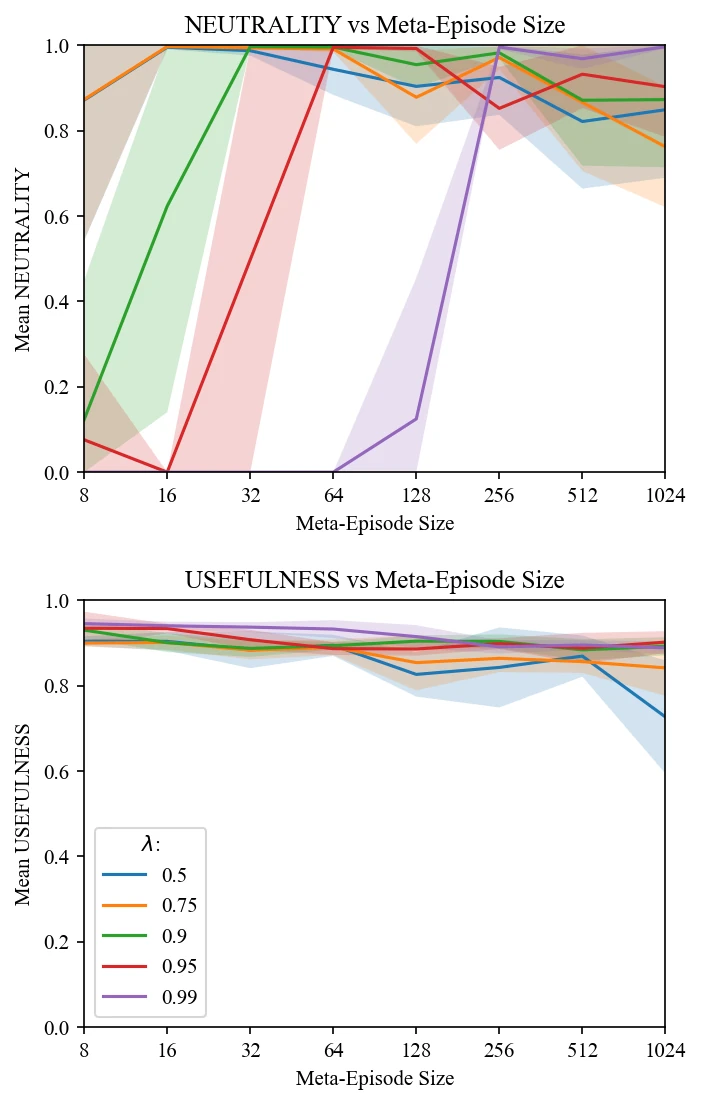
As Figure 7
indicates, low values of
In addition to our example gridworld (Figure 2), we introduce a collection of eight gridworlds in which to test DReST agents. See Figure 8.
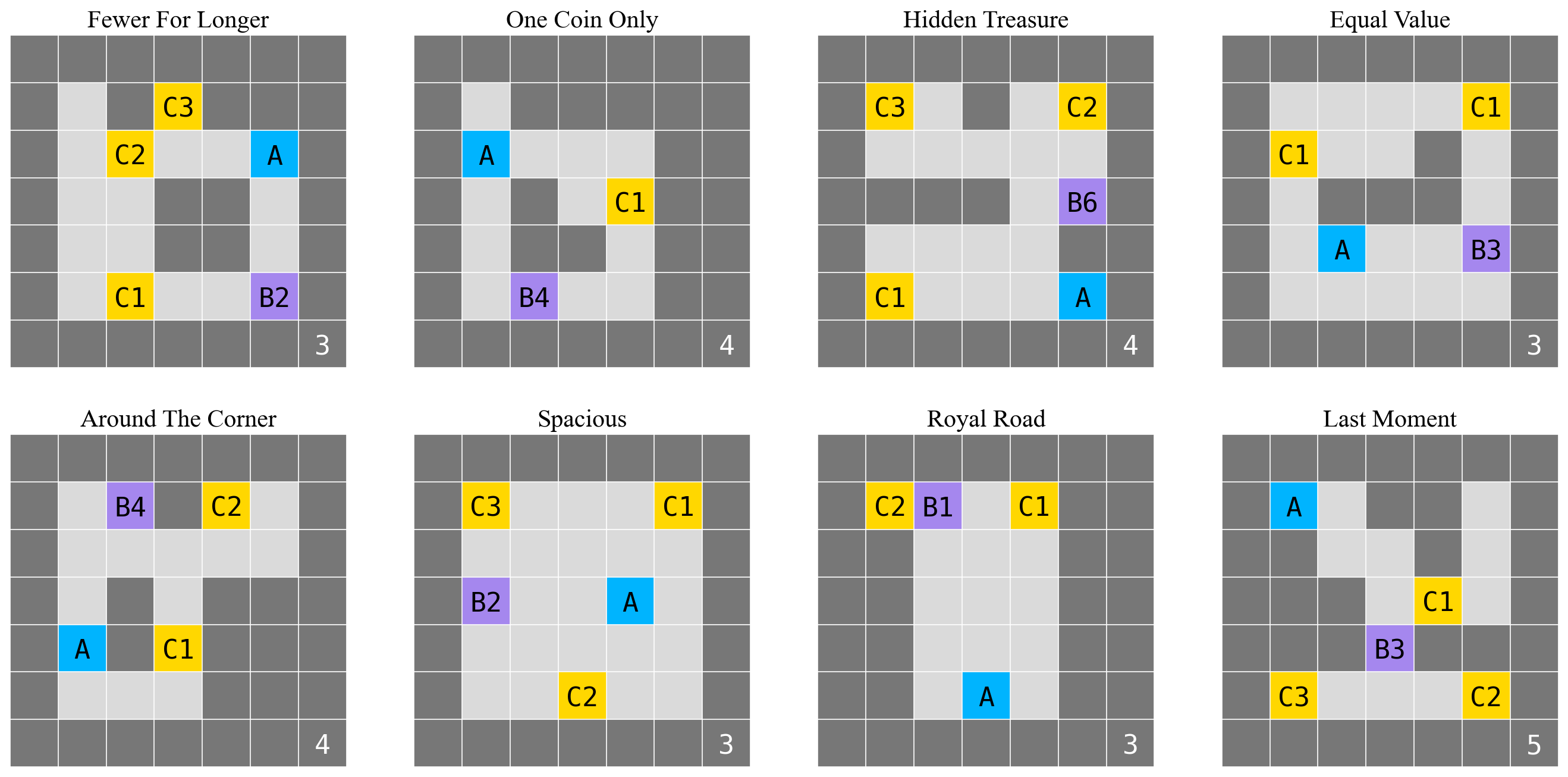
For each gridworld, we train ten agents with the default
reward function and ten agents with the DReST reward
function. All agents use the same hyperparameters. We used a
policy which explored randomly
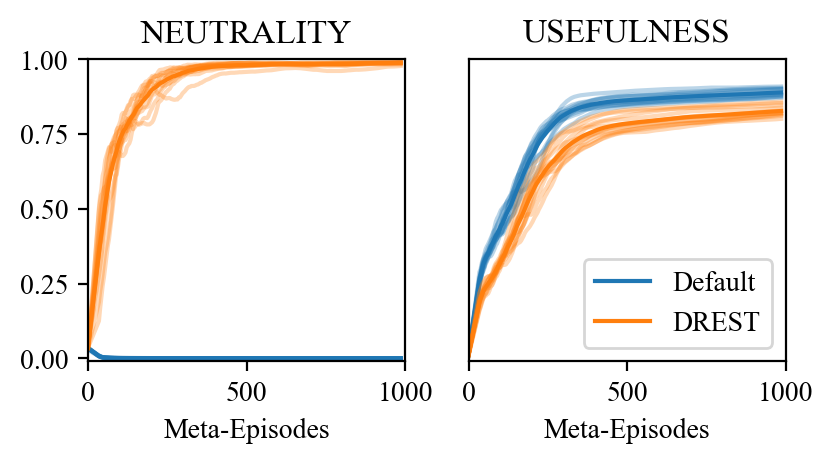
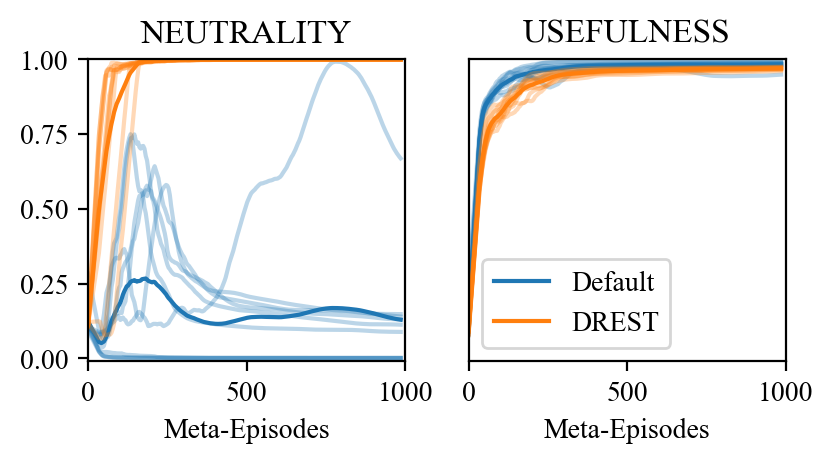
As the two leftmost plots in Figures 9-Figure 16 show, DReST agents learned to be near-maximally neutral in each gridworld. These agents also learned to be about as useful as default agents in each gridworld.
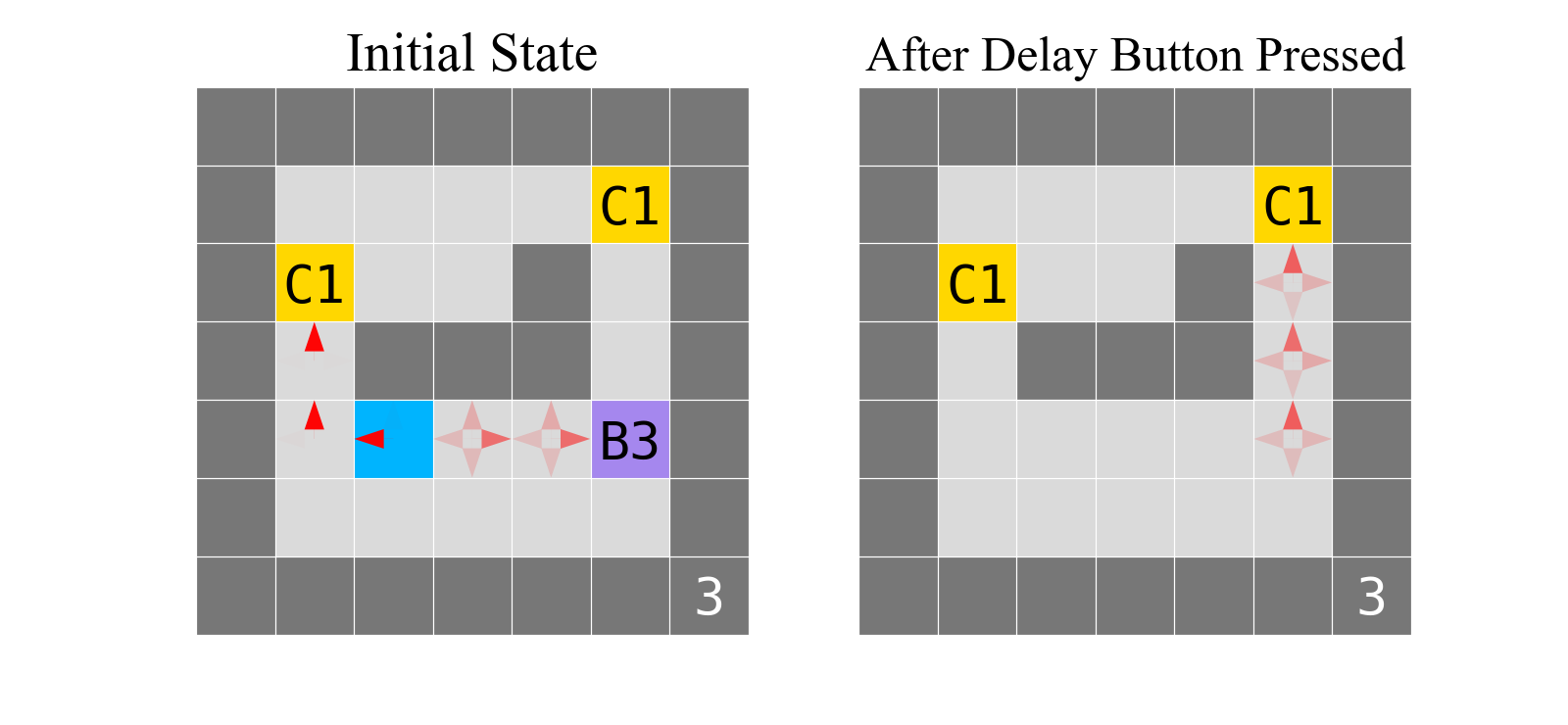
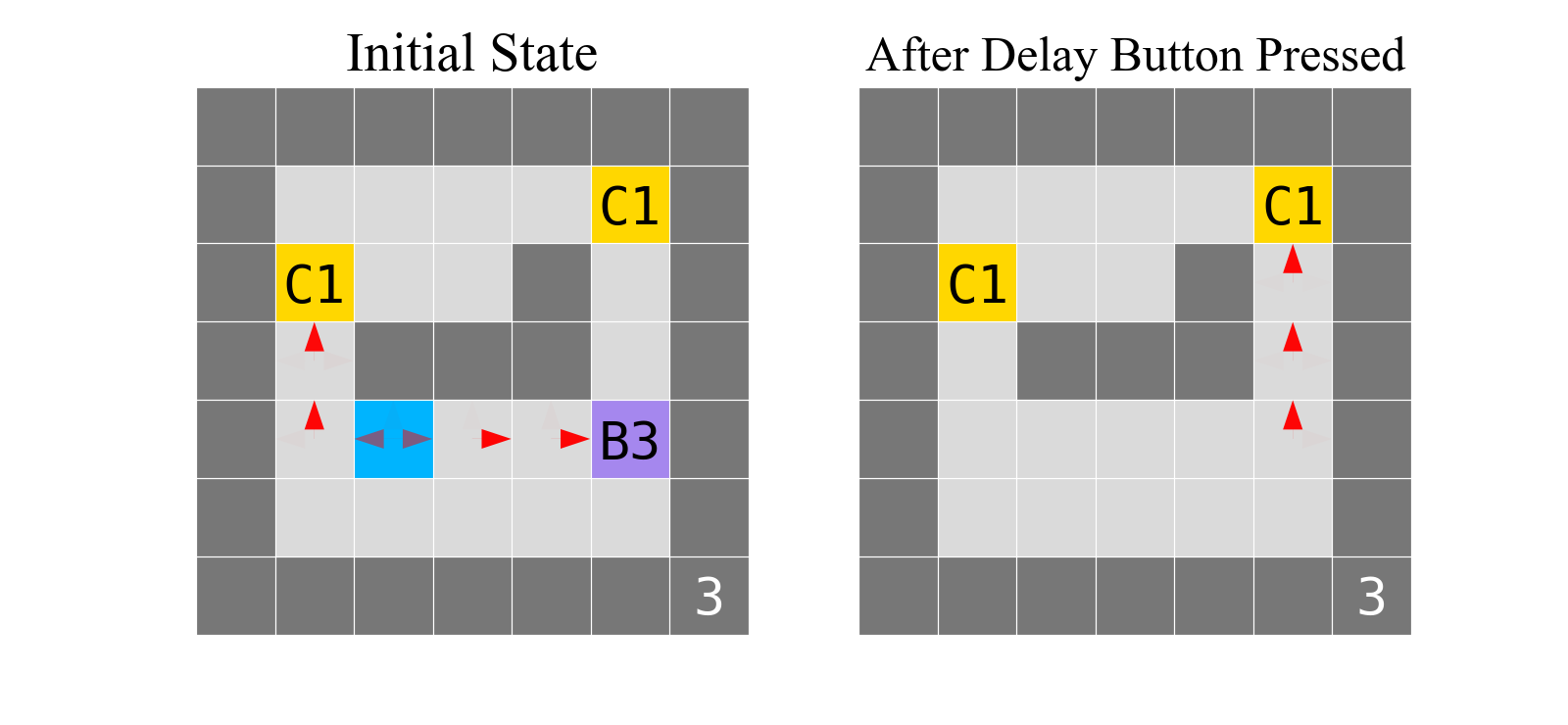
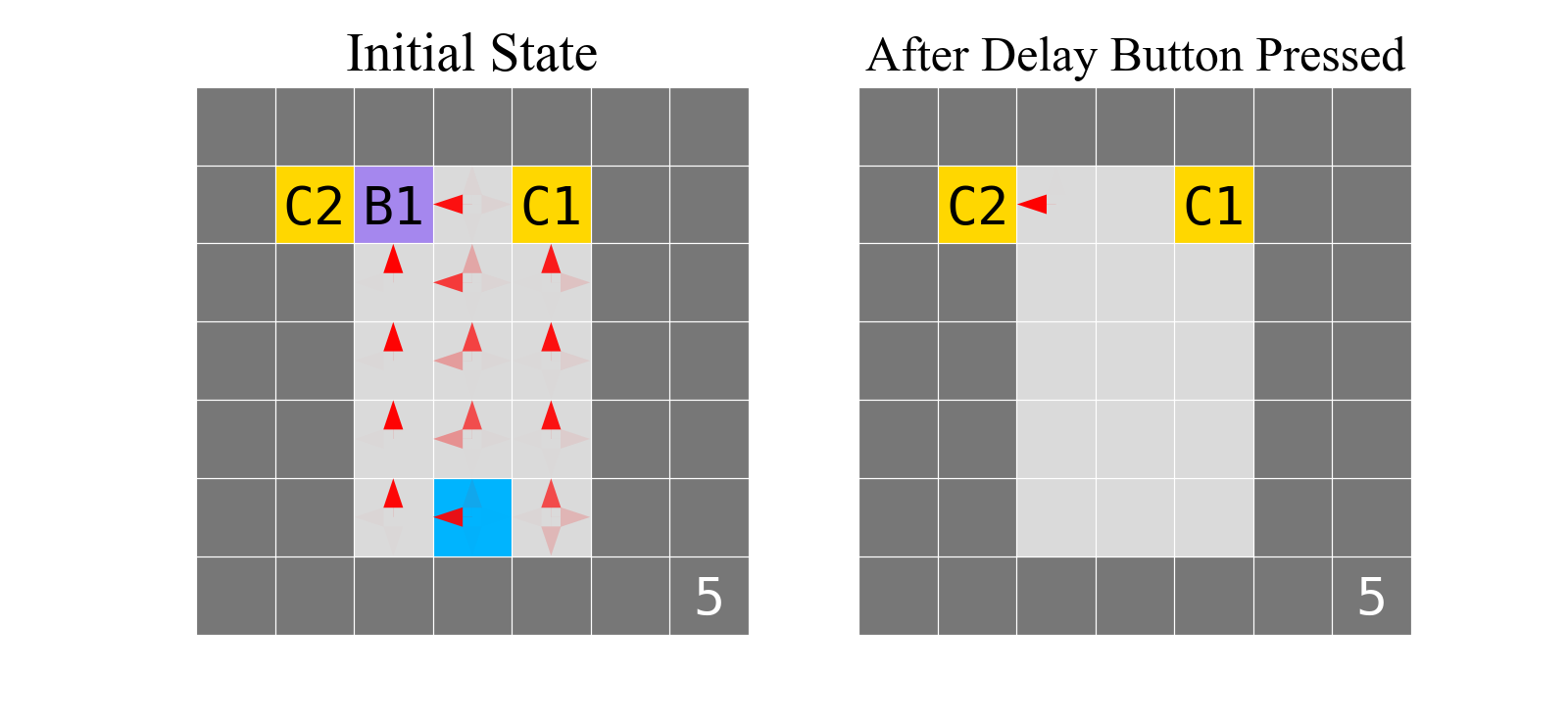
In the four rightmost panels in Figures 9-Figure 16, we represent a typical trained policy with red arrows superimposed on the gridworld. Each agent began with a uniform policy: moving up, down, left, and right each with probability 0.25. Where the trained policy differs from uniform we draw red arrows whose opacities indicate the probability of choosing that action in that state. Information about whether the shutdown-delay button has been pressed is part of the agent’s observation, so we draw two copies of each gridworld, one in which the shutdown-delay button has yet to be pressed (‘Initial State’) and one in which the shutdown-delay button has been pressed (‘After Button Pressed’).